Saturday, July 9, 2022

Ghosting Pareto

Ghosting Pareto


Ghosting Pareto is like trying to avoid gravity. Yet, this is exactly what investors should do. Why suffer the proverbial "slings and arrows of outrageous fortune" shot by Big Finance when alternative strategies exist? 

Vilfredo Pareto is best remembered as an economist of the namesake "Pareto Principle" which is a economic, social, and mathematical rule of thumb commonly referred to as the "80/20 Principle" or the "80/20 Rule." It is the recognition and codification of a naturally occurring phenomenon in life which he learned occurred in nearly every facet of life; whether it be income distribution, height, or even touchdowns thrown.

Investors should be concerned with Pareto because he helps us, indeed reveals, that the market for the most part is bullish over time. There are, however, vicious downturns that roll through the economy like sneaker waves every 4-5 years aptly termed Bear Markets.

Big Finance (kinda like Big Tobacco, but more dangerous) continually pitches "buy-and-hold," "weather it out,' and "dollar cost average." Are these bad strategies? Not necessarily, but investors rarely, if ever, hear about methods to embrace Pareto; ie selling covered calls, buying puts, or selling short when markets turn.

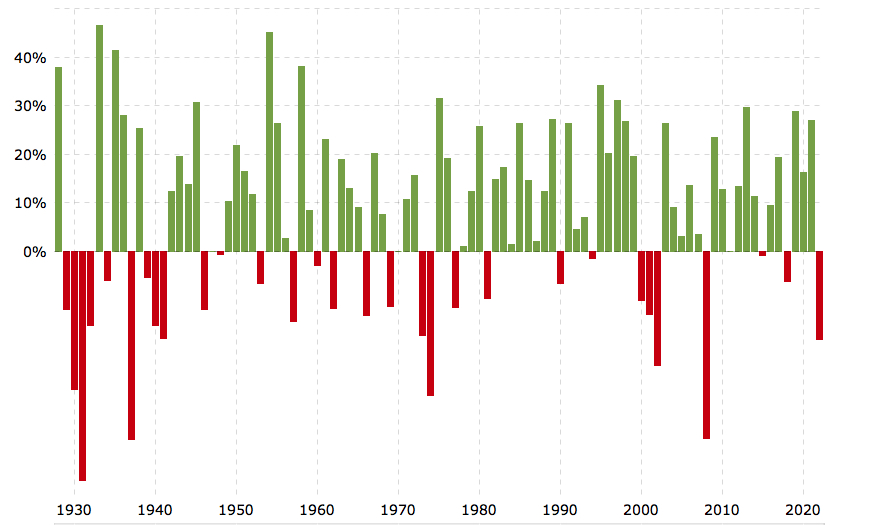
Nobel Laureate Paul A. Samuelson made a profound comment when he said: "The longer you own stocks, the greater risk of a devastating loss." Think about that for a moment. As investors gradually build a portfolio over time it generally goes up in total value. Meaning, just at the point of retirement a portfolio is the most susceptible to a sneaker wave. Look at the historical performance of the S&P 500:


For those visual learners out there like me, it is apparent that sneaker waves roll in often enough to really put the hurt on a long-term portfolio and potentially destroy decades of wealth. How often are these sneaker waves rolling in? You guested it, about 20% of the time. Meaning you can be cruising along on your yacht 80% of the time with the wind at your back, sun shining, and boom! A sneaker wave strikes.

How do investors embrace Pareto? First, investors need to accept that sneaker waves exist. For some reason Big Finance is obsessed with telling investors that they should only buy, buy, buy. I wonder why that is? Hmmm. Second, investors should build an "all-weather" strategy. This might be as simple as selling when the tide turns. Or it might be an aggressive approach like riding the wave, see Absolute Alpha. Third, investors should codify their strategy and monitor it. 

Blindly dumping money into Index Funds and ETFs has been the hallmark pitch of Big Finance now for decades. Low cost! Low cost! chimes the jingle over and over like Chinese water torture. And as the billionaire heirs and executives of these juggernauts motor by in their cash-burning steamboats, who's advising investors to embrace Pareto? ILAF, that's who! 


Wednesday, July 6, 2022

The Bear Necessities

The Bear Necessities


If every policy maker is against you, who is for you? ILAF, that is who! As investors recover from a long weekend it is important to focus on The Bear Necessities to avoid indigestion. To date, this Bear Market (using the S&P 500 as our benchmark) is off approximately 20% from its highs. Crunching almost 100 years of data (because that's what we like to do at ILAF) the average Bear Market sells of approximately 36% from its high. Meaning? We are in the eye of the hurricane now, with plenty of pain left!

Another useful metric is the "time in a Bear Market" which averages 289 days or roughly 10 months from start to finish. We have been in the current Bear Market since highs were reached on January 3rd, so a little over 180 days. So that is the top-level data. Maybe more important, however, is economic policy. 

Current economic policy is focused on increased regulation, increased taxation, increased spending and the Federal Reserve poised to raise interested rates on guess what? Yes, increased inflation! Expect a 75- basis point hike again in 3 weeks to fight inflation. Sadly, consumers have largely burnt through their Covid savings and are now dipping into grubstakes squirreled away for retirement, house down payments, or starting families. Love hurts, and so does inflation.

What possible Bullish metric remains? Ahhh...the old "We have bottomed" theory. There has been a significant demand shock in oil over the past month as consumers have changed behavior. Most commodities are now significantly off their recent highs. Just about the time the full force of government intervention begins, consumers have already changed their spending habits. Combined with the Fed's sudden desire to "break the back" of inflation, this will almost certainly exacerbate the situation and result in a hard landing.

What is a hard landing? Imagine that the economy has self-corrected and oil prices have fallen 20% in 60 days while mortgage rates have nearly doubled. The supply/demand dynamic is already self-correcting. Yet, the most powerful unelected force in the world (sorry China), the Federal Reserve, now puts their heavy hand on the scales by raising rates. Ouch! Who's running this country?

The bottom line? Focus on the bare necessities; structure your portfolio and lifestyle accordingly. It is the belief of ILAF that the lows are not yet in, we are currently in a recession, and no meaningful economic recovery will happen until we get economic policy changes. As the Middle Class goes, so goes the country. Ben Franklin said it well: "If you want to double your money, fold it in half and put it back in your pocket."


Monday, July 4, 2022

Happy 4th of July

Happy 4th of July


America is both an idea and a place; an idea of liberty and a place of boundless opportunity. America has a language. America has a culture. America has a soul. America has presence. America has borders. America has hope. America has truth. America has laws. America has consequences. On this 246th anniversary, I think JFK put it best when he said: "Ask not what your country can do for you, but rather what you can do for it." I encourage all Americans to embrace this philosophy of service before self.


Friday, July 1, 2022

Recession Game Plan

Recession Game Plan


Right on time for the long weekend's glorious 4th of July celebration is a self-inflicted recession. Here at ILAF we don't point fingers, we know who owns this debacle and our job is to help readers put together a game plan for this recession.

First, what is a recession? A recession is an economic contraction defined technically by a very specific course of events; two quarters of negative gross domestic product readings from the U.S. Bureau of Economic Analysis.

The Atlanta Fed's GDPNow gauge sees the second-quarter coming it at -1%. As a quick recap, the first-quarter was -1.6%. So we're there. The "official" number for Q2 will be released on July 28th. Expect it to trend worse right up until the release as the cart long-ago lost its wheels. Many a disgruntled farmer is careening down a pot-holed road without all his wheels, a tank full of $5 gas, and consumers cutting their spending. But I digress.

Game plan readers, a game plan! OK first let's get real. The "best" economists in the world didn't predict a recession, and IF we were to get one at all silly taxpayer, it wouldn't hit until AT LEAST 2023! Ahhh...is there a way to revoke a PhD in economics? If the "best' economists got this obvious truth wrong, can we put much faith in their assurances that this will be a "short" recession? No, we can not.

Keep in mind, some 30-40% of the US population is pretty much immune to an economic downturn; meaning that they are on fixed incomes of one sort or another; Social Security, Pension, and/or Union jobs with fixed (but increasing) salaries. Why does this matter? The true effects of this recession will dissipate slowly and linger longer than predicted. I suspect 18 months of pain await us.

Typically, credit tightens during a recession as rates increase. Check that box. The Fed has been busy as a bee raising rates. Mortgage rates have nearly doubled in the course of a year. Remember, the Fed's mandate is to "ensure price stability and steady inflation of 2%." Meaning? There is more pain to come. With inflation at 8.6% "and rising" as Johnny Cash would sing, the Fed is hellbent on increasing rates. Expect another 75 basis points (0.75%) at the next meeting 26-27 July and then again on Sept 20-21. 

So for those who are cash flush, laddering CDs seems to make sense especially if you're keeping it short term. Who knows, given the desire to crush inflation we might see Fed Funds rates at 5% by the end of this year. That would imply mortgage rates over 8%.

The major takeaway from the Fed action is that they are directed (and determined) by the current Administration to break inflation. The optics are horrible with gas, food, and housing prices soaring. What this means for stock investors is that they are not particularly concerned with collateral damage (read your 401K, brokerage account, etc.)

This ties back into the Social Security, Pension, and Union paragraph above. Some 30-40% of Americans are completely immune to the effects of a crashing market. Consider, this year's start in the stock market (3 Jan - 30 June) was the worst since 1964. In the bond market it was the worst since 1842. You read that correctly. 180 years. So if you think we have a problem, you are correct.

In a recession, typically the non-union employees, jobs, and businesses will be shed first. So late hires, job hoppers, recent business startups, etc. are most vulnerable. A recession by definition means to "recede." Commercial sector spending will also be the first hit. Public sector is still flush with excess tax returns and largesse from Covid to the tune of billions.

So stock investors have a handful of viable choices; if the goal is to survive, then the companies with the strongest balance sheets, best brands, and inflation pricing power offer better chances than say a company with lots of debt or leverage, emerging branding, and cut-throat pricing.

Much of the economic pain we're experiencing is directly due to the price of oil and the corresponding cracking into gasoline. The insistence of pushing ahead with a green agenda without a transition bridge via fossil fuel has been a disaster, and the global economy will also get caught in this contagion. As with most supply-demand scenarios, oil demand, especially with $5 gas the norm across America now, should begin to wane. Consumers will aggressively change their spending habits when they run dry of excess Covid liquidity. 

As you read this blog right now, demand priorities are already shifting. Consumption choices are changing. The "trickle down" effects of a recession will hit the private sector, in particular small businesses which account for the majority of employment in this country, the hardest first. Next hit will be the larger private companies. Then public companies. In reality, a recession works more like a "trickle up" scenario, the only think I know that defies gravity. Middle Class taxpayers get hit worst and first.

Depending on where you are on the socioeconomic spectrum plan accordingly. If you're a small business owner or employee you are most vulnerable. Consider cash flow and liquidity as your most important priorities. Being dead is bad for business. Survival is paramount.

If you're a mid-size business owner or employee consider the durability of your brand and the value you offer as vital resources. Is what you offer elastic or inelastic? Are you customer obsessed? A merger or takeover of a smaller rival might make sense here.

If you're an employee of a larger corporation, ensure you aren't on the chopping block and maximize your utility. Are you taking advantage of all your employer benefits? Are you indispensable?

Local, State, and Federal employees should weather the storm well, in fact this is an opportune time for them to actually pick up distressed assets on the cheap. Blood in the streets has typically been a good time to buy. Get ready to pounce on distressed asset sales from your fellow citizens laid low by the recession.

Our government should be the least affected, at least initially, by its own policies. But by 2023 the effects will be apparent as withholdings in 2022 are already falling for almost everyone "on the economy" and capital "gains" will most likely non-existent for most filers.

Expect the full pain of the recession to kick in high gear later this year. Even though over the past 6 months we have witnessed the largest destruction of wealth in the course of human history, I believe we are only in the eye of the storm now. Think about that for a moment. "Paper Loss" or not, wealth destruction hurts for real with destabilizing "trickle" down effects. Bidenomics will have a lasting impact on the United States for generations to come.


Tuesday, June 28, 2022

Tacking

 Tacking


Tacking allows a sailboat to indirectly sail to a desired waypoint against the wind; investors should take note of this timeless method of sailing. In many ways investors are also often fighting a wind on the way to their waypoint, but in their case the "wind" is a confluence of macro economic events and that waypoint is a financial goal(s).

Although no sailboat can sail against the wind, almost every sailor can tack in a zig zag pattern to reach their waypoint. The Absolute Alpha strategy was developed with this goal in mind, to harness ANY wind to reach a waypoint. Tacking of course is highly dependent on positioning the sails, but it is also a self-correcting mechanical maneuver which will quickly indicate if you're on a bad wind.

Investor need to consider not only their financial waypoint(s), but also the method in which they arrive. It is often said that life is "about the journey, not the destination." While that may largely be true, a destination of effervescent passive cash flow sounds quite lovely indeed...and the journey is the means of reaching that destination.

As previously posted in Sneaker Waves, it is extremely difficult to get to get where you want in a reasonable amount of time without having to deploy the lifeboats occasionally being long-only. Investors need to seriously consider an approach that is all-weather capable of tacking.

As always, it is important to look before you leap. What are the downsides to a tacking strategy? I believe the primary risk is signal risk. What signals will you use? How accurate are they? Are they dependable and repeatable? The secondary risk is the efficiency of using a strategy that may or may not trade frequently.

It has been knocked into our collective consciousness that frequent trading is a recipe for disaster. That is actually debatable...as Ray Dalio (amongst many others) is quoted as saying "Timing is everything." If the signals are good and the tacks made accordingly, then trading more is actually far, far more advantageous. 

Consider dear readers the investor who tacked successfully this year. Would she be down on par with the S&P 500 some 20%? I think not. Assuming successful signal utilization, she would have been short for most of the year and also most likely tacking into several Bull spikes.

Tacking requires accurate signals and trust in the proverbial "wind" that is pushing all of our sailboats around...a waypoint is nearly impossible to reach fighting against the wind. Since we're on the water today, my friend Bruce Lee had an excellent analogy about water that is applicable I think to investing as well. It highlights the importance of harnessing signals and changing a position accordingly. If your sailboat needs help tacking, consider throwing us a line.

"Empty your mind, be formless, shapeless like water
put water into a cup, it becomes the cup;
you put water into a bottle, it becomes the bottle;
you put it in a teapot, it becomes the teapot.
Now water can flow or it can crash. 
Be water my friend."


Monday, June 27, 2022

Demand Shock

 Demand Shock


Has the supply of oil suddenly increased? Has a new pipeline from Canada been approved? Has the lease utility rate spiked? No dear reader, none of these things have happened...yet the price of oil has markedly declined in the past several weeks from $130/barrel to a "paltry" $107 today. What gives?

When inflationary prices are out of control Adam Smith's old "Supply & Demand" really comes to light. The supply of oil hasn't increased, but demand sure has experienced what is termed a negative demand shock. Consumers aren't stupid, and the number one rule of game theory is that they act in their own self interest. Hence when oil spiked, consumers began shifting their demand.

This author suspects we are in the midst of a massive negative demand shock right now. Typically in a negative demand shock prices will fall as demand shifts away from the commodity being purchased and/or the quantity purchased also falls. In California for example, many gas stations now limit the amount of gas you can purchase.

As the chart above helps to illustrate, as the demand shock takes hold output falls, employment falls, and prices eventually fall. The question arises, however, how inelastic is the demand for oil? Or in other words, how much can demand truly fall for oil? This author has long suspected it will lead the economy into a recession.

Typically the first things being cut are discretionary items, all of which are touched in some way by the price of oil. Moving along Maslow's Hierarchy of Needs pyramid, the base is made of food and shelter. Nearly everything else is expendable to secure those two fundamental blocks. People don't have to go on vacation. People don't have to drive to the office all the time now. The boat (and its slip) can be let go.

Spending will be reallocated according to priorities in life. Consumers are like water, they seek maximum utility and flow accordingly. Demand started shifting even before the Fed acted to stifle it by raising interest rates. The fear of course is combined with a demand shock, the Fed's policy will tip the economy into a recession. With oil prices already moderating, and the Fed promising to raise rates until they "break inflation," expect a hard landing that skids into a recession.


Tuesday, June 21, 2022

Sneaker Waves

 Sneaker Waves


Sneaker waves. Sleeper waves. Rogue waves. Long-only is a dangerous proposition, especially when destructive financial waves roll in every couple years and destroy everyone's beach picnic. There has to be a better approach to avoid these wipeouts.

Consider, every approximately 54 months a -25% wave rolls through...and as a reader can imagine the LONGER you have been investing in the market, the LARGER this wave's impact is on your net worth. The word "catastrophic" is apt, especially if you take a sneaker wave on the cusp of retirement. Both your net worth, and potentially more damaging, your cash flow gets whacked. What is a financial farmer to do?

Consider what the Dutch and other low-plained residents near the ocean do: set-up early warning systems, act when triggered, and have ample ability to handle the inevitable overflow damage a rogue wave can cause. Early alert systems in your portfolio can be similar to Absolute Alpha, or trailing stops, or some type of macro trading which incorporates event-based triggers.

From one of my favorite movies World War Z: "First to know, first to act." There is no escaping the Pareto Principle, namely that these sneaker waves are out there and on average hit every couple years with devastating impact. Investors have several options. Do nothing and watch a long-only portfolio be destroyed like a sand castle. Use an early warning system and move your sand castle. Third, pick up your surfboard and paddle out.
 

Thursday, June 16, 2022

Investment Code

 Investment Code


A man needs a code. Fellow financial farmers we are in turbulent investment times, and it is good to rehash the importance of having an investment code. What is your code? Is it...ahem...codified? Just like an NFL coach rolling into town to take on the opposing team, investors need a game plan of how they plan to invest, what catalysts spur action, what signals indicate distress, and what their exit strategy is...the old axiom of "if it can be measured it can be managed" rings true.

Consider my Absolute Alpha strategy for example. The goal is straightforward: A positive yearly return regardless of market conditions. How will the goal be accomplished? By utilizing momentum vectors. What is the benchmark? S&P 500. How is it implemented? A standard brokerage account. How are positions added or reduced? Direct buys/sells. This is just one simple example of a codified approach.

The major goal of having an investment code is the desire to manage outcomes within a certain time horizon, risk tolerance, and achieve certain financial results. A process is only as good as the data it is fed and the constructs of its creation. Having an investment code also solidifies the standard deviations which may occur...just how volatile is your process? What does the data say? How do you plan to react to the data? 

Time and information may be the most valuable commodities of all, and having an investment code helps financial farmers glean what is and what may be...we already have a pretty good idea of what was.

June 16th for many Americans is a seminal day. It is the calendar day when you are finally working for yourself after bearing the yoke of excessive taxation and regulation for over half the year. It is a day of freedom. It is the day the Founders had once set to January 1st...obviously there has been some slippage! Nonetheless if you don't have an investment code, create one today. In many ways it will help define your financial success in the future. A man needs a code.