Showing posts with label Healthcare. Show all posts

Wednesday, October 23, 2024

Price Gouging

 Price Gouging


Healthcare insurance has become the perfect storm for price gouging. Like many gainfully employed hard-working Americans, I was shocked (but not surprised) to see my healthcare premiums spike up again, this time +15% year-over-year. Over the past 5 years this cost has doubled. How could this be? Isn't annual inflation 2.5%? Don't economies of scale typically LOWER prices? Hmmm.

Price gouging flourishes under unique economic circumstances, which typically right themselves in a free market; ie if one seller is gouging, then other sellers lower their prices to capture market share. Price gouging almost universally is short-lived. Unless it is engineered.

The danger arises when the market is manipulated by health insurance companies, healthcare providers, and politicians to engineer unfair economic incentives and laws. No one does this better than California, although Massachusetts is a close second. Not surprisingly, these are two of the five states still clinging to the individual mandate.

The individual mandate has been arguably the single most destructive pieces of legislation in history, mandating the purchase of services at a price set by health insurance monopolies in cahoots with government punishable by the IRS. Think about that one.

Access to healthcare is best provided by an open marketplace with multiple competitors vying for your business. By definition, the vast majority of medical services are commoditized services which have been established for decades; provider to patient, no middle man required should be the norm. Simple enough. The gouging begins when access itself is simultaneously squeezed from both ends (it sounds like an uncomfortable medical procedure, and it is.)

First, dollars flow from health insurance companies to politicians who restrict access to the market by defining which health insurance companies "own" certain counties or areas. ie They choose who can compete. Next, the politicians squeeze the constituents by mandating that they HAVE to use said insurance company in certain areas. Finally, the politicians appease the base by using taxpayer resources (read money) to subsidize as many people (not necessarily citizens) as possible.

"Free" is the most expensive word in the English language. When considered a "right" in the context of the healthcare system, high delivery costs are laundered through the hospital, clinic, physician, pharma, and admin systems to name a few. So a routine procedure at the ER which on its face value may cost $100, is ultimately billed out in the $10,000s+. That bill is then thrown into the "insurer pool" like a Baby Ruth on a hot summer day. Gouge the pool!

Monterey, CA is a great example of this price gouging gone amok, but there are hundreds of counties across the country in the same boat. A smaller and smaller pool of full-price payers gets gouged every year because they have no voice; the reality is our local Congressmen Jimmy Panetta happily helped engineer the current system. Residents of counties all across the country facing similar corruption have the same tough choices; vote with your feet out of your home towns or "grin and bear it" every year for the RICO shakedown. Most are just hoping to live long enough to age into Medicare. 

Meanwhile health insurance companies, the true constituents of Congress, continue to pay off the politicians, who are "outraged" by the high cost of healthcare insurance and simply expand the taxpayer umbrella to a larger and larger pool who pay close to nothing for top notch healthcare which encourages all sorts of gaming the system. It is an interesting racket; notch up the premiums every year, subsidize more of the population, gouge the middle class. 

Ending the price gouging corruption is simple; open every marketplace to real competition amongst insurers, publish costs for every service, and eliminate the individual mandate. The free market will solve this problem, and in fact INCREASE the quality of healthcare for everyone as completion drives out losers and promotes winners. This country needs to be in the business of the best outcomes, not beholden to engineered price gouging.

Monday, December 5, 2022

The War on Small Business

The War on Small Business


Kurt Vonnegut once quipped that: "The two real political parties in America are the Winners and the Losers." With the Small Business Index at 62.1, the lowest since the pandemic, which itself was the lowest in a generation, small business owners are the losers. Given that small businesses create two-thirds of new jobs and deliver 43.5% of the United States GDP this is a BIG problem. But your elected leaders don't care. Why? Because small businesses do not have the clout to influence political change.

Case in point, why would a Veteran-owned small business like mine have to pay 50X (you read that correctly, FIFTY times) the Blue Shield healthcare premium as an illegal resident in California for the SAME healthcare plan? Answer: Because somebody has to pay the bills, and the proverbial "last man standing" is the small business owner. Freedom is expensive.

How did we get here? The war on small business has been brewing for decades, but finally the straw that broke the small business owner's back was healthcare. With the passage of the ACA on April Fool's Day 2010, pieces on the chess board started moving around rapidly. Political parties immediately started jockeying for pole position.

Since the majority of politicians never owned a small business, they were easy to influence. The labor unions got to work. Big corporations saw what was happening and they got to work too. Given that small businesses are by nature fragmented without a unifying central leadership they waited to see what happened next. Plus they were busy working trying to make a living. Bad move.

Labor Unions and Big Business effectively gamed the healthcare system so that union members and employees got cut rates on healthcare plans, and to make the deal more palatable, they also negotiated for universal care pools. But of course somebody had to pay unsubsidized premiums, and that of course would be based on income. Who better to sock it to than the silent small business owner?

Reaching out to my elected representative, Jimmy Panetta resulted in the terse reply that "healthcare is complicated." After a decade in place, it is not that complicated; depending on your income you pay different rates. Imagine if McDonald's worked that way! Your "Happy Meal" price would be a direct result of whether you worked for a union, a large company, or your immigration status! Preposterous.

Across the spectrum of wealth distribution, healthcare is the most onerous. But that is just the most glaring example. Inflation is the next one. It hurts the small business owner most, because he has to absorb more of the pricing increases and if he is to survive, passes along less of those increases. The 16% pay increase for rail workers or 10% pay increase to pilots won't decrease rail traffic or flight volume. In fact, the COST to ship freight or park a butt in a seat will simply be adjusted up, up, and away!

For the small business owner it is a death by a thousand cuts, with some "cuts" akin to a sucking chest wound. Like him or despise him, Joe Biden has done one thing really, really well...he has acted as a fine bellhop for the labor unions. When you print the money and sign the contracts to print more, inflation doesn't hurt much. Indeed, most union workers have never had it so good. 

With Labor Unions the winners and small businesses the losers, what will the impact be on larger businesses? The cost of labor is typically the MOST expensive part of creating and delivering a product or service. As we can imagine then, large business are increasing prices and laying off employees (non-union of course, and many expendable H-1B visa holders at that) to cover the cost of inflation.

Net net when the wokescreen clears, this equation balances by the destruction of small businesses, many of which will cease to exist, go heavily into the black market, and/or rapidly innovate by embracing new technology and doing business differently (low odds on the latter.) At the end of Joe Biden's reign, fewer small businesses will remain, more unions will exist, and big business will be thriving (with far fewer employees.) Invest accordingly.


Sunday, November 27, 2022

Layoff Guru

Layoff Guru


As the Holiday Season fast approaches, the number of tech layoffs in Silicon Valley has spiked, disproportionately affecting smaller startups without monopolistic business silos to shelter all of their employees. To be fair, though, there have been large cuts at the likes of Amazon, Twitter, Facebook, and (loomingly) Google too. Many employees with H-1B visas have both employment and continued residency concerns. This situation looks dire. Now what?

Tech has followed a classic boom/bust cycle for multiple generations now, ever since the introduction of the seminal Silicon Valley invention; the microprocessor. If one thing has been constant, it is that during every boom there is hedonistic excess, and after every bust (like wildfire) new startups (sprouts) emerge from the charred landscape.

Being let go from a job is one of life's most stressful experiences and something you should not have to deal with alone. Below are the "Big 3" questions I typically get asked by clients recently laid off:

California Severance Pay

There is no legal requirement under California Law that employers provide severance pay to an employee upon termination of employment. Employees should refer to their employer's policy with respect to severance pay. As such, most employees DO NOT have a legal right to receive severance pay. Many companies, however, DO offer severance pay to help reduce the their legal lability. Make sure you have a copy of your employee policy and consider requesting time to review any severance agreement prior to signing it.

Healthcare

If you have been laid off you have a lot on your mind right now, and health care is surely near the top of the list. You have options for continuing health coverage. You may have heard about the Consolidated Omnibus Budget Reconciliation Act (COBRA), it is intended to give families an insurance safety net after a job loss. It is available if you have already enrolled in an employer-sponsored medical, dental, or vision plan, and your company has 20 or more employees. You can learn more about COBRA here.

Legacy Benefits

Many of your legacy employment benefits can continue or be rolled over or kept in place. Make sure you have received a copy of your employee policy and benefits package. It will detail what your options are for life insurance, 401K, and restricted stock or options vesting.

For many employees in Silicon Valley, the proverbial "elephant in the room" is their H-1B status after a layoff. Typically there is a 60-day grace period, meaning you will have a maximum of 60 days to arrange for another employer to submit an H-1B petition for you, change to another status, or depart the United States. A more detailed explanation can be found here

For a complimentary consultation and review of your specific situation please fill in the appointment form linked and I can contact you within one business day. I have been working with laid off employees for decades now, through multiple boom/bust cycles, and understand the stress it brings, but having a game plan in place can make the transition to a new, better path forward a a lot easier.


Friday, July 22, 2022

Reverse Engineering

Reverse Engineering


Generally speaking, stock prices increase with increased earnings. When a company makes more money, in general, their shares are worth more because investors put value in growth and reward it by bidding up the share prices of companies that increase their earnings. Naturally, the opposite is also true. Granted, there are always exceptions to the rule, but for the most part earnings drive the market higher.

Along those lines, investors should be able to reverse engineer a portfolio based on their spend habits, or even consider the spend habits of a typical cohort. So for example, if you have a breakdown of your monthly expenses you can also typically trace that spending to broad sectors, and specially individual brands. This provided a good backdrop to the Chinatown adage of "follow the money."

A classic Maslow's hierarchy of needs also works well in this example. For the "average" American, the top three expenses on a recurring monthly basis are housing, medical, and food. Now for people who are NOT self-employed, that medical cost might not be too high because your employer is picking up the tab. Consider their cost in our example as yours.

So right from the start we can see from a percentage basis how much of our monthly income feeds the banks for mortgages or the landlord, the medical plan operator, and the food prodders. Depending on your situation, there most likely will be energy costs (fuel and/electric), clothing, entertainment, and many others. List them out and I suspect you'll start to see the brands behind the sectors popping up. Take note of the specific brands you utilize both as a function of your purchase, but also your time. You might only buy a smartphone once a every couple years, but you most likely are using it frequently. Same for a computer. TV. Internet.

All of these purchases and time uses trickle down to brand utilization. The brands with the most utilization should be ones you pay attention to from a portfolio perspective. You are probably not alone in your brand utility. And generally speaking, yet again, the fewer brands choices you have for a good or service or time usage the more of the total market that brand is capturing.

This reverse engineering exercise should reveal some very powerful, some would say monopolistic, brands in your life. Maybe you should consider owning them?


Thursday, January 13, 2022

The Great Resignation

 The Great Resignation


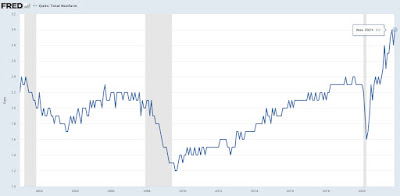
A by-product of the pandemic has been a spike in the "quits rate," the rate at which people quit their jobs, to an all-time high of 3%+. Now a measly 3% doesn't sound like much from a percentage standpoint, but when you factor in natural retirement, loss of workers, and a huge number of job openings we have a problem Washington.

Keep in mind 3% is the AVERAGE, meaning even with the explosive growth in certain sectors, quitting has become the norm in many fields, like tech and healthcare, which had rates significantly higher than the average. One of the best, if not THE best, piece I've seen studying this phenomenon was published recently in the Harvard Business Review. Yes Harvard is smart. Yes the article was superb, but it never really delved into WHY people are quitting. Worry not fellow financial farmer, ILAF is here with our "curriculum vitae" to help you decipher this trend.

Why does someone work? Generally the answer to that question is "to make money." If we strip out the other common reason "for the benefits," ie healthcare, then almost exclusively people work for money, especially if the state provides either free or significantly subsidized healthcare. I would say the REASON people work for money is to support themselves, their family, AND they REALLY have to work if there are debts like education, housing, and living expenses to pay. To totally generalize from the top two categories of those fueling the Great Resignation, tech and healthcare, I believe that there is a HUGE dichotomy in terms of WHY.

The curve to enter healthcare is relatively steep; there are years of education, training, and commitment to become a nurse, doctor, EMT, provider, etc., etc. Their quits rate would almost certainly have to come from burnout and exhaustion rather than choice, especially if there was significant debt overhang. This quits rate is more aptly termed a capitulation rate. This "cap rate" is a function of Maslow's Hierarchy of Needs, where literally survival trumps employment. Sadly, these professionals are also "being quitted" by mandates. It is a double-edged sword. The flip side of this quits rate in tech, however, is very different.

The tech industry has a much different dynamic occurring. Although the barriers to entry are arguably on par with the medical world in terms of education and skill, the REGULATORY environment is quite different. Generally speaking, in the tech world you are judged, hired, fired, retained, promoted, etc. on your ability to code, create, market, etc. There is an entire regulatory ecosystem MISSING from the tech industry that has allowed it to flourish. Which brings me to the quits rate for tech.

The tech quits rate is on par with the healthcare industry, but for vasty different reasons. The WHY, especially for the core quitters in the 30-45 age band is pretty simple. They don't necessarily HAVE to work. Through a confluence of events many of the tech quitters do not have high debts, nor onerous regulatory requirements to keep current to keep employed. Most own or owned some portion of a company that has gone UP in value. So debt free or low debt with a stash of cash and manageable healthcare costs make leaving work out of CHOICE for tech easy.

What does this quits rate dichotomy mean? I don't see healthcare DEMAND easing, so either more less qualified employees will be hired or pay will have to be raised for existing providers to remain or both. I bet on BOTH. The demand is simply too great to shoulder on the existing model, especially with various mandates being imposed on healthcare in general. So as a cost of our GDP healthcare will take an increasingly high bite, regulations will increase, and the misery index of working in healthcare will also increase. When the ratio of administrators to doctors begins to fall we will be on the right track.

On the tech front, billions of dollars are flowing into PE Funds (private equity) and the majority of that is flowing into tech companies. The great winnowing is always happening, where the best and most successful companies gain the lion's share of a disruptive market, whether it be food delivery, social networking, or EV engineering. Many will fail. Billions will be spent and lost. But from that wreckage a handful of truly exception winners will emerge....and in tech, quitting while you're ahead isn't the same as quitting.