Showing posts with label Failure. Show all posts

Saturday, September 3, 2022

Stagflation

Stagflation


Ever feel like you're going nowhere fast? That's stagflation in a nutshell; working harder for less while getting squeezed by paying more. A hallmark of the Biden Administration has been the failure of the economy. The jobs number gets a lot of ink, but the "new" jobs are typically service-orientated, lower wage, and not full-time. And that's the bright spot in the economy!

A combination of raging inflation and economic stagnation has resulted in morass of stagflation. Recent market trends indicate that rather than achieving escape velocity from the Bear Market begun in November 2021, we may have several months (years?) to go, especially if the S&P 500 tests the June '22 lows again. Couple that with a housing recession (mortgage rates have doubled since January, with mortgage demand lowest in 28 years), persistently high oil prices, and large companies FIRING as fast as they can email, and we are in dire straits.

One of the only options for Americans is that most favored by Third World residents; buy hard assets as soon and quickly as possible because fiat money (think paper money NOT backed by gold) is worth less and less every day. Hence we have seen massive, incoherent, gains in machinery, durable goods, and of course real estate. But even the latter might be in for trouble now as the Federal Reserve is on a mission to break the back of inflation.

The noted investor Warren Buffett once said: "5% Interest Rates Will Attract Money from the Moon." Expect the Fed Funds rate to exceed that by the end of the year. There is no stopping a motivated Fed on a mission with the implicit backing of the Biden Administration.

With equities range-bound and drifting lower, investors are in a pernicious position of having their dividends taxed at a higher rate, underlying corporate growth slowing, and innovative small companies being snuffed out of existence.

Stagflation ends when inflation is tamed and economic policies enable the free market to function. Two years into this Administration offers little hope that anything will change. The question that needs to be answered by investors is this: "What is the impetus to buy?"


Friday, July 29, 2022

Tax & Spend

Tax & Spend


If you really want to destroy a society, debase its money. With the M2 money supply currently at some $21T (that's correct, trillion) from a previous level of $14T, the country is flush with cash. This is causing lots of problems and weird things to happen. 

In terms of problems, too many people have too much money chasing too few goods. Hence, inflation is rampant. Of the two ways to combat this, either increasing supply of goods or killing demand, the Fed has chosen the latter. But even that action will be of little consequence if spending increases at a similar clip to the supply of money.

Money needs to come from somewhere, and the Treasury has been happy to keep the printing presses going night and day. This has led to an environment of stagflation and the government choosing winners and losers; the winners are the pork barrel recipients such as healthcare, (the) climate Solyndras, and "infrastructure." You can count on your taxes going on up, way up, especially if you're a small business owner. The pitch is always "pay your fair share" or "just a nibble" and when you take a look in the kitchen are your cookies are gone.

What is an investor to do? You need some good strategery. Assuming the omnipartisan "Inflation Reduction Act" agreed upon by Democrat members of the Senate gets approval in the House we can expect the "Tax & Spend" moniker to ring truer than ever. Investors need to adjust their portfolios accordingly.

Consider where and how the wealth redistribution is occurring, determine who the net losers and winners are, and allocate accordingly. Fighting the Fed is hard enough, fighting both the Fed and Congress is nearly impossible, especially when the IRS is being weaponized. Like the Indians of old, look for the gravy train and attack. Mark Twain put it best when he said "No man's liberty or property is safe while Congress is in session."
 

Saturday, May 28, 2022

Non-Linear

 Non-Linear


A 40-year chart of the DJIA obscures an almost infinite number of non-linear events. Judged over time by the eye, stock market volatility looks benign and performance linear. It looks resoundingly positive, and it is, but zooming in on almost any short period reveals intense periods of volatility. How can this be?

Statistically speaking, the long-term stock market performance may be the finest example of linear regression next to species genetics. In many ways there are similar. Multiple non-linear events occurring simultaneously over longer periods of time result in many economic failures, and also several sustaining successes. Consider the private equity world.

In the private equity world (PE for the pros) for every Apple, Facebook, Google, Uber, Amazon, success story there are probably 1,000,000X or perhaps even 1,000,000,000X failures to reach fruition. Put another way, investing works best when you own the survivors. A great example is the S&P 500 Index. 

The companies in an S&P 500 Index are not static; ie losers drop out and off the face of the Earth, while winners survive and populate the index. By default, investors are buying a basket of winners. To be a member of the S&P 500 Index, at this very snapshot moment, you must be a non-linear survivor. The failures by default are members of the S&P 1T failure index...that has a value of zero.

The Navy Seals have many excellent quips, one of my favorites is "It pays to be a winner." You got that right! The all-weather mentality of being in the stock market through thick and thin is a tough one to adhere to when volatility spikes and misery ensues. But being a winner means surviving and thriving, just like a member of the S&P 500.  

By default the longer an investor is in the stock market the greater her fortune should be (as evidenced by the 40-year chart above.)  The danger then becomes one of timing...more to come on that next post. 


Saturday, March 12, 2022

#Bidenflation

 #Bidenflation


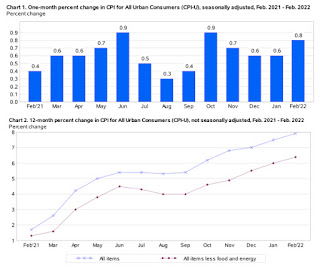
Mr. President, please stop lying. On Thursday the U.S. Bureau of Labor Statistics released the Consumer Price Index. "Over the last 12 months, the all items index increased 7.9 percent...the 12-month increase has been steadily rising and is now the largest since the period ending January 1982." That's 40 years fellow farmers, 40 years! Is a recession next?

In the face of rampant inflation, demand priorities shift to essential items a la a "Maslow's Hierarchy of Needs." So although unemployment is at historically low levels, the jobs aren't necessarily higher-paying. So once the purchasing barrier develops it will be hard to prevent negative GDP growth; ie consumers will focus on staples like food and housing, cut travel consumption to the bare minimum, and look for alternative means of entertainment. Pot and streaming services come to mind as the ultimate crutch for a large swath of the population; remember, politicians have a vested interest in keeping the "Bread & Circuses" running.

There is a great line in Seinfeld where Jerry asks George to teach him to lie like him. George shrugs and tells Jerry "That's like saying to Pavarotti, 'Teach me to sing like you.'" But he continues with this sound piece of advice Joe Biden has internalized: "Jerry, just remember. It's not a lie, if YOU believe it." That's where we are right now...data doesn't matter, truth is subjective, and the future is rosy. Just not for the middle class.


Thursday, March 10, 2022

Bear Market Playbook

 Bear Market Playbook


Surviving a Bear Market ain't easy. Obviously the first thing you lose is proper grammar, mainly do to shock of the financial mauling you're getting in the market. First, keep calm. It is highly unlikely you can outrun a bear. The goal here is survival. We're where we're at for a conflux of reasons, none of them good. Now the question is, "How do I position my portfolio to survive, no THRIVE in a Bear Market?"

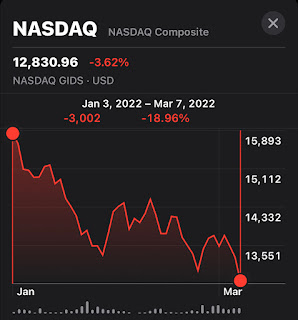
The first step is to understand what a Bear Market is. It is a historical "rule of thumb" for the past several hundred years which denotes the fall in valuation of roughly 20% off the highs of an index. I'm using the NASDAQ index as my benchmark. The high was 16,212 in Nov 21 and the low (so far) was 12,588 which we plumbed last week. This indicates we are some 22% off the record high and in a Bear Market.

More than just a percentage, a Bear Market also has some very, very "special" traits; ie it feels like you are getting mauled because, well you're getting mauled. Massive volatility spikes cause precipitous price declines (below what we think is even possible), which are often followed by sharp spikes the following day. Only to be succeeded by plunges the following day. And around and around the wheel turns until there is a day or period of capitulation in which the bear has taken everything he wants from you and departs for his cave.

The journey to the cave typically takes about 289 days on average. That's a long time. In that journey back to the cave there are multiple head-fakes, sniffing, foraging trips, digging, biting, and other general uncivilized acts of behavior. Timing the bottom is almost impossible. What is possible is security selection, discretion, and allocation. Investors need to decide if they plan on staying in the game or not, and if so what is a tolerable near-term loss. Booking a loss is painful, but not booking a loss is often worse.

So to playbook this out, figure out what type of loss is tolerable in the near-term. They say your first loss is your best loss, so with that in mind sketch out several "pain bands" and stick to them. After the bear rolls through, along with tons of carnage, there also remain good companies which have been beaten up. You have even previously owned them! Take a look around and start rebuilding slowly, and for God's sake please, please avoid the wash sale rule; don't sell a security and then buy it back within a 30-day window. As an American still kinda free, you have a right to minimize your taxes....part of this means don't get whacked for wash sales.

One of my previous posts dealt with the value of education. Reread that. A solid education often results in a solid job with a corresponding good income. A good income allows you to buy stocks, real estate, companies, etc. etc. during bad times. And a LOT of money can be made in the bad times. Indeed, it is often said "the profit is made in the purchase." That is the true value to an investor that a Bear Market provides; the ability to pick up good brands, companies, and cash flow on the cheap. In fact, a strategy of ONLY buying in Bear Markets is commonly used by investors I term "Mountain Men."

Mountain Men are like the sasquatch, they are only rumored to exist. Typically you don't hear from them for long periods of time until there is a crisis of some sort. Then they spring into action. The Mountain Men come down from the mountain, or in from the jungle or away from the beach with bags of money. These bags of money are then used to purchase quality stocks on the absurdly cheap prices of a fraction of their true book value or growth prospects or leadership value.

The point here is that you need a list, a bag full of money, and the structure in place to buy. We can all have a list. If we have a decent job and live (somewhat) frugally then we can use excess cash to purchase more assets. The structure of course is your brokerage account or retirement account or 401K or personal balance sheet.

Eventually a Bear Market turns into a Bull Market. And those Bear prices rise to Bull levels. And investors who had excess liquid capital available stand to make a killing if their list was good and there cash was deployed correctly. 

Monday, March 7, 2022

Bear Market Hell

 Bear Market Hell


Today marks the beginning of the Bear Market Hell. Although this country has endured much over the past 2 years, today we are embarking on something totally new...and painful. What was once the land of milk and honey has become one of soaring inflation, government disfunction, and most sadly the killing of thousands of innocent Ukrainian lives as we are on the cusp of WWIII. In the shadows lurks the bear.

A bear market is historically defined as a 20% or more fall from the market's highs, and in this instance we are refereeing the all-important NASDAQ market which has become the barometer for world innovation and advancement. It has badly stubbled, and we are now in a full-on Bear Market.

Bear Markets are brutal for investors who own long position in stocks because the equity in many ways becomes a value trap, ie the asset withers away on a daily basis, even though it might be supported by reasonable price-to-earnings ratios, a solid dividend, and a leading market position none of that really matters in a Bear Market. The only thing that matters in a Bear Market is survival. Fear is everywhere.

Assume we'll be in the bear's dark cave for some time, as there is no end in sight for the current fiscal policy, energy regulations, or leadership failures. We're stuck. Investors with long-term views, think decades, can find increasingly good deals out there. In fact, those old curmudgeons Warren Buffett and Charlie Munger LOVE the opportunities a Bear Market presents; much suffering, plenty of misery, and a huge serving of stocks-on-the-cheap. They feast fear.

What to do, what to do? With little hope on the economic policy front, little chance of domestic energy being reignited, and a war looking more like a siege, investors need to be wary of committing assets. Cash has become king again, and investors can survey the field of battle for carrion like vultures for purchases.

It is hard to believe we're not headed for a recession now. The benchmarks have spoken their truth, and investors are finally listening. "Nature, time, and patience are the great healers," but hopefully voters are the fourth great healer this November.

Financial farmers need to be patient here. Long-term capital can be deployed with care on great brands broken low. Stagflation has also risen its ugly head, so beware of companies that can't (or won't) pass along price increases. We may have 8 months of pain ahead with markets whipsawing back-and-forth until new leadership takes power. Until then, a siege mentality is appropriate (and warranted.) 


Friday, February 18, 2022

Grinding Halt

 Grinding Halt


The economy is grinding to a halt and on the cusp of a recession. As inflation ravages the economy, the Fed is well behind the interest rate curve now. Consumers are already pulling back demand via price-conscious shopping. Smaller cap stocks without tangible profits are being vaporized. Oh yeah, oil is taking a breather at around $100 on its way to $150 (or higher!) Can anyone say "Recession?"

Financial farmers need to be aware of what is happening in the global economy because macro events have salient and pertinent effects on their local sustainability. A confluence of events has put a once booming economy in the toilet. And if oil spikes further, the Fed raises aggressively, and/or consumer sentiment falls more, the economic gains of a decade will be flushed.

Considerable thought should be given in the coming days and weeks to the upcoming Fed meeting in mid-March where the Federal Reserve is now thinking of raising rates by 0.50%. Another eye should be on oil. High oil prices are yet another stealth tax on productivity (it costs significant energy to fed cattle, ship cattle, etc.) Almost every facet of the economy is greased by oil. Finally consumer sentiment might just be paramount, and it is falling like a rock. What should investors do?

Well anyone who has been in small cap stocks for the past 90 days has felt considerable pain. Like losses of 60%, 70%, 80% or more. This ties well into my previous post using Cathie Wood's ARKK ETF as a litmus test for innovation and risk appetite in small cap stocks. Let's just say the market is nauseous in regards to its appetite for this sector right now. "Bulletproof" tech hasn't done much better. Mid and Large tech have both been bushwhacked. The "survivors" so far have been pure commodity plays, ie banks, gold, and oil. People sitting on a pile of cash have also looked really, really smart.

If there is a gameplan to combat inflation, increase oil supply, or improve consumer sentiment nobody has seen it yet. Result? The pain will continue, and most likely get worse. We are the on the cusp of a recession; the economic gears are grinding to a halt. It will be extremely difficult to change poor economic policy, disastrous regulations, and incompetent leadership quickly. Financial farmers need to preserve capital here.
 

Wednesday, November 18, 2020

Buy Then Build

 Buy Then Build


Occasionally a book is so profoundly simple in its premise a reader is taken aback as to why he hasn't thought of this idea before; such is the case with Walker Deibel's "Buy Then Build"

Many of my friends and clients are always on the prowl for a side hustle or a retirement job and usually the path has been the well-trodden and well-marketed push toward converting either a hobby into a business or...gulp...starting a business from scratch. Theoretically either of this two methods can and do work, but for every Uber, Airbnb, or Slack there are literally tens of thousands of expensive failures. Put another way, there is only one Ferrari in California with the license plate "EPICWIN" 

Not to beleaguer the point, but for those readers who haven't had the pleasure of a very public start-up failure, it is unpleasant from many aspects; typically you lose (lots of) money, (lots of) time, and even friends or colleagues. So with that in mind, Walker Deibel's approach makes perfect sense.

They say a picture is worth a thousand words, and the major takeaway is clear as day on page 32:


Feel free to zoom in on that image. Deibel illustrates the "Odds of Success" comparing a startup, VC-backed startup, and the acquisition of a going concern. This is the proverbial money shot of why those interested in either starting a new career or adding a business to their existing schedule should strongly consider buying an existing business and building on it from there. Your odds of success increase exponentially when you buy an existing business and build it out.

Using Buy Then Build as a roadmap and having a handle on your time commitments as well as a potential budget, two resources I have found to be extremely helpful include: BizBuySell and Flippa. Perusing all the listings on both sites is really intriguing as to what is out there and also the different methods and techniques business owners have built their companies over the years. 

Hopefully this post acts as an entrepreneurial lightning rod and helps those readers interested in running a business or side hustle or both the value of approaching the startup cycle from the position of an acquisition then building on the existing customer base, infrastructure, and cash flow.