Showing posts with label Spanish Flu. Show all posts

Tuesday, January 25, 2022

Killing Them Softly

 Killing Them Softly


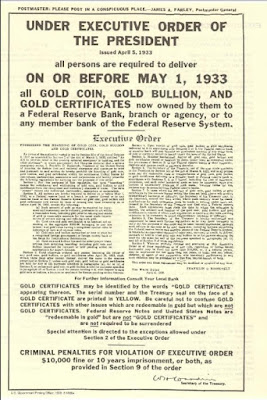
Executive Order 6102 signed by FDR made U.S. Citizen ownership of gold illegal in 1933. This act of tyranny went unchallenged for almost as long as his cousin Teddy Roosevelt's statue stood in front of the American Museum of Natural History. The two men could not have been more diametrically opposite in their policies, yet they were both men of their times. Sadly, it seems like we're reliving the early 20th Century all over again, both politically and socially with a pandemic which follows the Spanish Flu almost cough for cough,  an exit (entry?) into global conflict, and socialism rearing its Medusa head.

Change the dates and change the names and the resemblance is uncanny. Word War I raged in the midst of the Spanish Flu, and the "war to end all wars" finally ended on November 11th, 1918. The Spanish Flu swept around the world from February 1918 until April 1920 (give or take some months, of both sides of that figure.) The mortality rate of the two accounted for some 70 million deaths, of a population of 1.9 billion. Equivalent deaths today would be on the order of 300,000,000. That is a staggering figure. But what happened next in the early 1920s and what is happening today should scare the bejesus out of you.

When there is a vacuum in power, wealth, influence, leadership, ability, morality, etc., etc. it is usually quickly filled; indeed the adage "nature abhors a vacuum" is poignant and precise. Who or what fills that vacuum now is troubling for both financial farmers and more so to the citizens of this country. Just like Executive Order 6102, which made owning God's money, gold, illegal we are seeing a game plan right out of 1933.

If a government wants to fundamentally change the fabric of a society, it kills them softly. A two-pronged approach of utilizing acts of omission and commission works best. The players are on the field and the game has begun, with the first salvo being the most destructive, which of course is an act of omission. Getting something done in Washington is actually pretty hard, even if you are the ruling party. You often don't have the majority and then there is the pesky voting to worry about...but acts of omission? Oh boy, such opportunity!

National sovereignty is probably the most binary political issue there is...either a country has sovereignty or it doesn't, and all natural law flows from that fact. If a country does not have sovereignty, then it is not a nation by definition. It is a group of people who live in a certain geography. There is no border, there is no law inside that border, and there is no enforcement of said law(s). There is no shared value system, there is no language, there is no culture, there is simply of place residence. 

So if you want to dilute or negate the rights of citizens presumably in a nation, you simply ignore the presumption of a nation with borders. That's an easy act of omission that has a massive impact and can be accomplished by doing nothing, yet advances your political goals immensely. But that's just one variable to the final solution of a central government. 

The two other pieces to the "triumvirate" are Regulation and Taxation. Those two can pretty much steer a country to prosperity and freedom or doom and tyranny; although some voting might be involved by elected "representatives," a LOT of damage can be done with a regime fixated on changing the fabric of society via executive order.

Consider, FDR essentially made illegal a basic human right of the pursuit of happiness by outlawing gold as a store of value. This ring especially true today, where the first item on the IRS Form 1040 is a question about "crypto." Another way to regulate freedom is to require disclosure of something, and naturally then to tax it. And was we well know, the more you tax something the less of it you get. Let me say that again; the more you tax something, the less you get.

So less energy production, fewer side hustles, less crypto, less innovation, etc. etc. Ad nauseam. The end result of these polices inevitably less freedom for citizens and more control by the central government. Side effects naturally are the breakdown of society; more crime, more corruption, less enforcement, less good medical care, less good education, less good services in general.

When everything is free, nothing has value. Socialism's grip is tight. It provides government with tremendous control over its population. Just take a look at Australia and New Zealand, which have become de facto police states controlled by bureaucrats who have thoroughly embraced the strategy of "Killing Them Softly."


Thursday, January 20, 2022

Crimea 2.0

 Crimea 2.0


Eight short years ago we were just wrapping up the Winter Olympics when Russia invaded Ukraine and seized the Crimea. President Obama did nothing. The milquetoast response of "sanctions" were roundly brushed off by the Russians. The situation in the Ukraine today feels like Crimea 2.0. Does the European Union, NATO, or the United States have the backbone to prevent war? Probably not.

Investors ignore situations like this at their own peril; students of history are well aware of how the Balkans helped launch World War I with the assassination of Archduke Ferdinand. This catalyst caused a domino effect nearly 100 years ago. It isn't a far conjecture to see the chess board set-up quickly in 2022 as an early decisive move seems eminent. Frankly, it baffles the mind of this Western pro-democracy supporter of how the entirety of Western Europe and the United States is yet caught on their heels yet again as a Russian Military force effectively dictates the battlespace.

The most likely result will be further solidification of Ukrainian sovereign land into the Russian Federation. If recent history is any indicator, neither the rhetoric or economic sanctions proposed by Western Europe or the United States will have any stopping power. The Ukraine may in its entirety fall under Russian control. There is a strong possibility given the spineless response from the West that Ukraine could even be taken without a shot. Why? Simply put, Western Europe needs Russia more than Russia needs Western Europe; Russia supplies over a third of all power to Western Europe in the form of its natural gas and oil pipelines. This does not bode well for Ukraine.

Obviously this possible invasion is a serious problem for democracy in Ukraine, but it also further establishes a terrible precedent of a U.S. and Western Europe malaise and unpreparedness. Neither are good traits agains a Russia that is clearly capable of immediate action. Investors take note; the Russian Federation is proudly wearing their laurels as we sit on ours. Besides the clear violation of Ukrainian sovereignty, the very real possibility of further unimpeded annexation exists, all the while the West conducts meetings on what to do that should have occurred years ago.

Raising some cash here probably isn't a bad idea, and it is hard to believe that both the energy and gold markets won't express their concerns. Natural gas in particular looks like it is held in the crosshairs.  Watch this situation closely, obscure maneuvers in far-off lands often ultimately have dire global results. Putin knows he's playing chess with a pigeon, and Xi will feel emboldened to take Taiwan after the Olympics this year as his "Gold Medal" on the world stage if the West does nothing (again) in Ukraine.


Friday, March 27, 2020

Climbing a Wall of Worry

Climbing a Wall of Worry


It has often been said that stocks climb a wall of worry. Coronavirus is going to put this maxim to the ultimate test in the weeks, months, and years ahead as investors digest news cycles that seem to circulate in discrete 15-minute increments of despair, hope, jubilation, and despair again.

Coronavirus appears to be the most challenging wall of worry for bullish investors to climb in at least a generation. What to do? Like any good coach will tell you, having a playbook is essential. In terms of relevant coronavirus playbooks, I am a big fan of Laura Spinney's "Pale Rider" which describes the course of the Spanish Flu.

As previously mentioned on this very blog several weeks ago, COVID-19 closely resembles the spread of Spanish Flu from 100 years ago. Although not identical, both diseases share eerily similar traits. More importantly, in my humble opinion, is what we can glean from a societal impact and recovery timeline as useful takeaways.

Given the exponential growth rate of infections throughout the globe, and the denial still present in many countries (Mexico/Sweden) that the "Pale Rider" is coming, I think there is the distinct possibility it could be much worse. Ignorance may be bliss, but denial is not a good strategy. I also believe there are vast societal changes coming our way along the scale of 9/11. You know a crisis is real if it affects behavior. This one will.

Prior to 9/11 airport security was present, but for all intents it was simply a quick screening...i.e. gun/no gun. After the Twin Towers fell, the world as we knew it fundamentally changed in terms of security protocols. I suspect something similar will happen in regards to coronavirus. This brings us to the proverbial "wall of worry" that stocks need to climb in order to regain their highs. What will lead to an economic recovery?

I think a two-pronged solution is in order to beat the coronavirus. First, we need to flatten the curve nationwide immediately. Although roundly criticized, Bill Ackman's interview on CNBC last week (18 March 20) was spot on; much of what he said came to fruition rapidly, several of his ideas still need to be implemented. His thesis: The coronavirus cannot live (long) without a host. If you want to flatten the curve, shut down the USA for a month.

The second prong, which needs to be worked concurrently, is to laser-focus on restoring positive cash flow on a national level; from large companies to small business, cash flow is essential to survival. There are undoubtedly certain industries which are going to take longer than others to recover, especially customer-facing ones which have significant exposure to geographic movement and human sanitation. Via paradigm shifts in behavior and societal norms, however,  many industries can be up and running within weeks. Success in flattening the curve and an economic "jumpstart," however, both rely on a key factor: Trust.

One of the first questions many portfolio managers are asking is: "What will survive?" From there a lot of speculation ensues as to: "Who has the best balance sheet" or "Who stands to gain market share?" But ultimately all that matters is: "What brands do I trust?" That's the lynchpin to the entire economy. Trust. Trust is going to result in sales which will result in cash flow which underpins survival. Trust is essential.

The founder of Salesforce, Marc Benioff famously remarked last year that "trust" has become the coin of the realm, commenting that "Trust has to be the highest value in your company." I echo this philosophy, and also believe that is exactly what will help investors climb the wall of worry ahead. Logistics, supply chains, manufacturing, safety, sanitation, all of them and more, are completely dependent upon trust.

Saturday, March 14, 2020

Demand Shock

Demand Shock


The United States of America has entered a period of severe negative demand shock. Negative demand shock occurs when demand collapses across multiple economic sectors simultaneously. As the Wuhan coronavirus has spread in this country it has triggered a panic not seen in the stock market since 1987...and it presumably will last significantly longer. Much longer. Think 1929ish.

Entire industries have been laid low, namely: airlines, cruise lines, hotels, casinos, restaurants, sporting events, and education to name a few. There undoubtedly will be secondary and tertiary impacts such as the hundreds of thousands of small business that cater to these industries as well as the millions of employees whose livelihoods are intricately woven into supply/demand chain of our economy.

From an economic standpoint, Wuhan coronavirus has most likely triggered a recession. It is hard to conceive of our economy, which is 70% consumer-dependent, bouncing back from the Wuhan coronavirus quickly, especially since there will be many lingering concerns in regards to travel, safety, and trust.

The path forward is an arduous one. First, large segments of the American population will be exposed to the Wuhan coronavirus. Second, many Americans will undoubtedly be infected with this disease, with victims typically being the elderly and/or those with underlying medical conditions. Our most vulnerable. Third, it's not going away quickly.

Self-quarantine time alone is running at a minimum of 2 weeks, but there are staggered results popping up all over the country. What I mean by this is that another cluster might easily pop up in a month, or 2 months, or even next year. Wuhan coronavirus is the proverbial "whack-a-mole" scenario.

What does this all mean? Based on the existing infection rate it is probable that many millions of Americans will be infected with the Wuhan coronavirus and thousands will die. As America is a country that values life highly, this will have severe economic and social ripple effects; demand shock is the most obvious initial wave. Another rational wave is going to be societal push-back against viral originators responsible for deaths and economic destruction. Human nature is what it is. As previously stated, it is highly likely we entered a recession last week. We definitely entered a bear market. 

What's an investor to do? Price discovery has significantly altered the trading prices of many stocks, especially in the most affected sectors such as airlines, cruise lines, oil, etc. to name a few. Given that nobody really knows when the Wuhan coronavirus will be contained, it is important to focus on sustainability and that usually translates to quality of balance sheet and earnings.

There are many industries that do not seem sustainable if all of their demand collapses. I would avoid them. Survivors? There will be many survivors, namely in the food and beverage industries, many of which are actually experiencing tremendous demand. I like those sectors. Finally, there are some sectors (like tech) that have extremely large installed userbases which don't disappear overnight and given quarantine conditions might add to their installed userbases. I like those as well.

In times of uncertainty, having cash is a good thing; you might miss out on a quick turn of events and maybe not capture all of the upside, but when survival is on the line it is better to survive. Ultimately the Wuhan coronavirus will be contained at some level. The jury is still out on what level. Until that time it makes a lot of sense to focus on quality cash flow and survivability.

Tuesday, February 25, 2020

Coronavirus

Coronavirus


Global pandemics, real or perceived, have a nasty habit of rattling investors out of solid, long-term investment strategies; historically, however, within a six-month period, the stock market usually recovers ALL of its initial losses PLUS tacks on additional GAINS.

The trillion-dollar question though, is whether "this time" things will be different. Do we have the global health infrastructure and political will as well as decisiveness of fiscal leaders (I'm talking to you Federal Reserve) to mitigate the Coronavirus? I believe we do.

Although China has been criticized for acting too slowly, when they finally did act to contain the coronavirus, the Chinese didn't fool around; they went into full lockdown with a population zone size in the hundreds of millions. Of course several thousand or perhaps even hundreds of thousands of infected individuals had already left the country, which leads us to the current situation of initially small pockets of infection popping up all over the world. As we have become an increasingly interconnected world, literally within weeks travelers from almost anywhere in the world can go anywhere in the world. What used to take years now happens in weeks.

Now we're playing a global game of "whack-a-mole" while simultaneously trying to develop a vaccine. There are several advantages we currently enjoy over the virus, mainly due to panic and luck; reporting of new cases is broadcast over social media almost instantaneously, we "kinda" have a plan in place in nearly every pocket of the world to isolate and contain, and thankfully the fatality rate seems lower than comparable respiratory infections. That's the good news.

The bad news? The three weeks of lag time in shutting down the Chinese flight from Wuhan probably increased by one or perhaps even two orders of magnitude the GLOBAL impact of the spread. Also, keep in mind, China itself has largely slowed economically...many, many manufacturing operations have ceased. Consumption inside China, save for food, beverages, and the internet have largely collapsed. In terms of a baseball analogy, China is probably in the 5th or 6th inning in terms of containment/eradication while the rest of the world might be in the 3rd inning. A lot is going to depend on how many other clusters of coronavirus pop up, how those are contained, and also whether a vaccine can be developed in a safe and timely manner. A big wild card is whether the virus mutates.

For an interesting, and quite scary, historical perspective the Spanish Flu ranks probably second only to the Plague in terms of total human deaths. It ravished almost all of the known world over a period of several years (1918-1920). It literally went to almost every single patch of Earth where humans lived, particularly devastating remote island communities once it arrived there. It changed the fabric of human civilization in the 20th Century. Yet there were a handful of places it never arrived simply from the absolute remoteness of the places. Check out the hyperlink above to learn more...it is a fascinating story of viral infection, spread, and ultimate containment.

What's the average investor to do? Don't get rattled out of your long-term plan. If history is any indicator, there might even be some excellent buying opportunities in the weeks ahead!