Showing posts with label tech. Show all posts

Thursday, January 13, 2022

The Great Resignation
 The Great Resignation


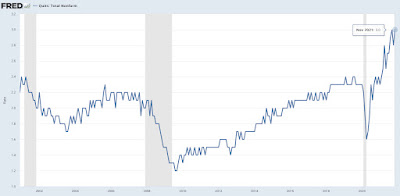
A by-product of the pandemic has been a spike in the "quits rate," the rate at which people quit their jobs, to an all-time high of 3%+. Now a measly 3% doesn't sound like much from a percentage standpoint, but when you factor in natural retirement, loss of workers, and a huge number of job openings we have a problem Washington.

Keep in mind 3% is the AVERAGE, meaning even with the explosive growth in certain sectors, quitting has become the norm in many fields, like tech and healthcare, which had rates significantly higher than the average. One of the best, if not THE best, piece I've seen studying this phenomenon was published recently in the Harvard Business Review. Yes Harvard is smart. Yes the article was superb, but it never really delved into WHY people are quitting. Worry not fellow financial farmer, ILAF is here with our "curriculum vitae" to help you decipher this trend.

Why does someone work? Generally the answer to that question is "to make money." If we strip out the other common reason "for the benefits," ie healthcare, then almost exclusively people work for money, especially if the state provides either free or significantly subsidized healthcare. I would say the REASON people work for money is to support themselves, their family, AND they REALLY have to work if there are debts like education, housing, and living expenses to pay. To totally generalize from the top two categories of those fueling the Great Resignation, tech and healthcare, I believe that there is a HUGE dichotomy in terms of WHY.

The curve to enter healthcare is relatively steep; there are years of education, training, and commitment to become a nurse, doctor, EMT, provider, etc., etc. Their quits rate would almost certainly have to come from burnout and exhaustion rather than choice, especially if there was significant debt overhang. This quits rate is more aptly termed a capitulation rate. This "cap rate" is a function of Maslow's Hierarchy of Needs, where literally survival trumps employment. Sadly, these professionals are also "being quitted" by mandates. It is a double-edged sword. The flip side of this quits rate in tech, however, is very different.

The tech industry has a much different dynamic occurring. Although the barriers to entry are arguably on par with the medical world in terms of education and skill, the REGULATORY environment is quite different. Generally speaking, in the tech world you are judged, hired, fired, retained, promoted, etc. on your ability to code, create, market, etc. There is an entire regulatory ecosystem MISSING from the tech industry that has allowed it to flourish. Which brings me to the quits rate for tech.

The tech quits rate is on par with the healthcare industry, but for vasty different reasons. The WHY, especially for the core quitters in the 30-45 age band is pretty simple. They don't necessarily HAVE to work. Through a confluence of events many of the tech quitters do not have high debts, nor onerous regulatory requirements to keep current to keep employed. Most own or owned some portion of a company that has gone UP in value. So debt free or low debt with a stash of cash and manageable healthcare costs make leaving work out of CHOICE for tech easy.

What does this quits rate dichotomy mean? I don't see healthcare DEMAND easing, so either more less qualified employees will be hired or pay will have to be raised for existing providers to remain or both. I bet on BOTH. The demand is simply too great to shoulder on the existing model, especially with various mandates being imposed on healthcare in general. So as a cost of our GDP healthcare will take an increasingly high bite, regulations will increase, and the misery index of working in healthcare will also increase. When the ratio of administrators to doctors begins to fall we will be on the right track.

On the tech front, billions of dollars are flowing into PE Funds (private equity) and the majority of that is flowing into tech companies. The great winnowing is always happening, where the best and most successful companies gain the lion's share of a disruptive market, whether it be food delivery, social networking, or EV engineering. Many will fail. Billions will be spent and lost. But from that wreckage a handful of truly exception winners will emerge....and in tech, quitting while you're ahead isn't the same as quitting.
 

Saturday, March 14, 2020

Demand Shock

Demand Shock


The United States of America has entered a period of severe negative demand shock. Negative demand shock occurs when demand collapses across multiple economic sectors simultaneously. As the Wuhan coronavirus has spread in this country it has triggered a panic not seen in the stock market since 1987...and it presumably will last significantly longer. Much longer. Think 1929ish.

Entire industries have been laid low, namely: airlines, cruise lines, hotels, casinos, restaurants, sporting events, and education to name a few. There undoubtedly will be secondary and tertiary impacts such as the hundreds of thousands of small business that cater to these industries as well as the millions of employees whose livelihoods are intricately woven into supply/demand chain of our economy.

From an economic standpoint, Wuhan coronavirus has most likely triggered a recession. It is hard to conceive of our economy, which is 70% consumer-dependent, bouncing back from the Wuhan coronavirus quickly, especially since there will be many lingering concerns in regards to travel, safety, and trust.

The path forward is an arduous one. First, large segments of the American population will be exposed to the Wuhan coronavirus. Second, many Americans will undoubtedly be infected with this disease, with victims typically being the elderly and/or those with underlying medical conditions. Our most vulnerable. Third, it's not going away quickly.

Self-quarantine time alone is running at a minimum of 2 weeks, but there are staggered results popping up all over the country. What I mean by this is that another cluster might easily pop up in a month, or 2 months, or even next year. Wuhan coronavirus is the proverbial "whack-a-mole" scenario.

What does this all mean? Based on the existing infection rate it is probable that many millions of Americans will be infected with the Wuhan coronavirus and thousands will die. As America is a country that values life highly, this will have severe economic and social ripple effects; demand shock is the most obvious initial wave. Another rational wave is going to be societal push-back against viral originators responsible for deaths and economic destruction. Human nature is what it is. As previously stated, it is highly likely we entered a recession last week. We definitely entered a bear market. 

What's an investor to do? Price discovery has significantly altered the trading prices of many stocks, especially in the most affected sectors such as airlines, cruise lines, oil, etc. to name a few. Given that nobody really knows when the Wuhan coronavirus will be contained, it is important to focus on sustainability and that usually translates to quality of balance sheet and earnings.

There are many industries that do not seem sustainable if all of their demand collapses. I would avoid them. Survivors? There will be many survivors, namely in the food and beverage industries, many of which are actually experiencing tremendous demand. I like those sectors. Finally, there are some sectors (like tech) that have extremely large installed userbases which don't disappear overnight and given quarantine conditions might add to their installed userbases. I like those as well.

In times of uncertainty, having cash is a good thing; you might miss out on a quick turn of events and maybe not capture all of the upside, but when survival is on the line it is better to survive. Ultimately the Wuhan coronavirus will be contained at some level. The jury is still out on what level. Until that time it makes a lot of sense to focus on quality cash flow and survivability.

Wednesday, November 23, 2016

BurgaBox


     Occasionally you run into an idea, a concept, an ethos that is so fundamentally right you just can't look away...I bring you fellow investors BurgaBox! BurgaBox is a Woburn, MA tech startup that delivers amazing cheeseburgers of varying size and construction to your front door. Many in this great country of ours have hoped for such an amazing development for years, because as the world well knows, America excels in convenience food sales. The real question is why it took so long after our second favorite food, pizza, could be had in virtually any zip code within 30 minutes?

Thursday, October 13, 2016

Jobs Purge


The Wall Street Journal published one of the most meaningful and visually interpretive surveys of the employment picture in the United States today. Coinciding roughly with the passage of NAFTA and the widespread adoption of the Internet in the early 1990s, it portrays the massive disruption of technology, management, and political policy in shifting this country from a manufacturing base to a software-centric service hub.

As anyone who has worked in Silicon Valley for the past several decades will tell you, the Valley has shifted from hardware to software. This megatrend has resulted in massive job losses to cheap overseas manufacturing; spun with rose-hued glasses one could say the United States has spurred global growth and prosperity on an unequaled basis for the past 20 years.

For those wishing to Invest Like A Farmer, the trend of service-based employment and out-sourced manufacturing may have reached its pinnacle, especially as 3D printing and the very machinery has negated the cheap labor rates which caused massive job flows to countries like China, India, Vietnam, and other Southeast Asian labor markets.

With lean-inventory and production-on-demand now commonplace, I predict former manufacturing hubs like Detroit, St. Louis, Cleveland, and other "left-for-dead" traditional manufacturing cities making a strong comeback on the heels of (literally) dirt-cheap land prices, a workforce educated on demand, and the massive shipping moat known as the Pacific Ocean.

As Amazon.com has successfully proven, consumers embrace the concept of sacrificing a little time to get a great product cheaper. An educated, mobile, fluid USA workforce with 3D printing, manufacturing-on-demand, and a diverse skill-set can successfully leverage the Pacific Ocean, dirt-cheap land, and hopefully a political climate that supports them via an "America-first" mentality.