Showing posts with label Crypto. Show all posts

Tuesday, January 25, 2022

Killing Them Softly

 Killing Them Softly


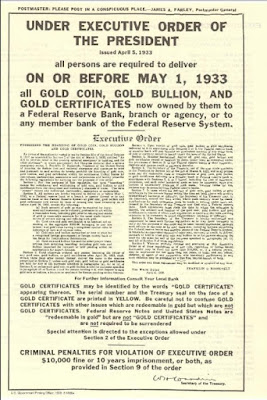
Executive Order 6102 signed by FDR made U.S. Citizen ownership of gold illegal in 1933. This act of tyranny went unchallenged for almost as long as his cousin Teddy Roosevelt's statue stood in front of the American Museum of Natural History. The two men could not have been more diametrically opposite in their policies, yet they were both men of their times. Sadly, it seems like we're reliving the early 20th Century all over again, both politically and socially with a pandemic which follows the Spanish Flu almost cough for cough,  an exit (entry?) into global conflict, and socialism rearing its Medusa head.

Change the dates and change the names and the resemblance is uncanny. Word War I raged in the midst of the Spanish Flu, and the "war to end all wars" finally ended on November 11th, 1918. The Spanish Flu swept around the world from February 1918 until April 1920 (give or take some months, of both sides of that figure.) The mortality rate of the two accounted for some 70 million deaths, of a population of 1.9 billion. Equivalent deaths today would be on the order of 300,000,000. That is a staggering figure. But what happened next in the early 1920s and what is happening today should scare the bejesus out of you.

When there is a vacuum in power, wealth, influence, leadership, ability, morality, etc., etc. it is usually quickly filled; indeed the adage "nature abhors a vacuum" is poignant and precise. Who or what fills that vacuum now is troubling for both financial farmers and more so to the citizens of this country. Just like Executive Order 6102, which made owning God's money, gold, illegal we are seeing a game plan right out of 1933.

If a government wants to fundamentally change the fabric of a society, it kills them softly. A two-pronged approach of utilizing acts of omission and commission works best. The players are on the field and the game has begun, with the first salvo being the most destructive, which of course is an act of omission. Getting something done in Washington is actually pretty hard, even if you are the ruling party. You often don't have the majority and then there is the pesky voting to worry about...but acts of omission? Oh boy, such opportunity!

National sovereignty is probably the most binary political issue there is...either a country has sovereignty or it doesn't, and all natural law flows from that fact. If a country does not have sovereignty, then it is not a nation by definition. It is a group of people who live in a certain geography. There is no border, there is no law inside that border, and there is no enforcement of said law(s). There is no shared value system, there is no language, there is no culture, there is simply of place residence. 

So if you want to dilute or negate the rights of citizens presumably in a nation, you simply ignore the presumption of a nation with borders. That's an easy act of omission that has a massive impact and can be accomplished by doing nothing, yet advances your political goals immensely. But that's just one variable to the final solution of a central government. 

The two other pieces to the "triumvirate" are Regulation and Taxation. Those two can pretty much steer a country to prosperity and freedom or doom and tyranny; although some voting might be involved by elected "representatives," a LOT of damage can be done with a regime fixated on changing the fabric of society via executive order.

Consider, FDR essentially made illegal a basic human right of the pursuit of happiness by outlawing gold as a store of value. This ring especially true today, where the first item on the IRS Form 1040 is a question about "crypto." Another way to regulate freedom is to require disclosure of something, and naturally then to tax it. And was we well know, the more you tax something the less of it you get. Let me say that again; the more you tax something, the less you get.

So less energy production, fewer side hustles, less crypto, less innovation, etc. etc. Ad nauseam. The end result of these polices inevitably less freedom for citizens and more control by the central government. Side effects naturally are the breakdown of society; more crime, more corruption, less enforcement, less good medical care, less good education, less good services in general.

When everything is free, nothing has value. Socialism's grip is tight. It provides government with tremendous control over its population. Just take a look at Australia and New Zealand, which have become de facto police states controlled by bureaucrats who have thoroughly embraced the strategy of "Killing Them Softly."


Wednesday, May 19, 2021

Crypto Meltdown

 Crypto Meltdown


Feels like 1636 all over again today with crypto crashing anywhere from 25-40%+ depending on the "currency" and, as expected by yours truly but apparently not by Coinbase, surging volumes at a key inflection point has taken down the major trading platform. All is definitely not well in cryptoland...at least with the Tulip Bubble you got some nice flowers for the cost of a home.

The problems with crypto are legion. First, it is not cryptocurrency in any traditional sense of the word cryptology...the entirety of the "currency" is easily tracked and this author believes it also can be seized or frozen very, very easily by the state. If the NSA is capable of tracking every conversation and data transmission in and out of the United States, then monitoring cryptocurrency is a piece of cake. But that's not necessarily the biggest problem with this "currency."

Crypto isn't backed by anything, except slave labor in China and fossil fuels (read coal) to mine it and put it into circulation. Once in circulation, crypto is subject to all sorts of tracking and seizure risks. With no physical representation, it lacks true portability. You own crypto at the pleasure of the state.

The best thing that could happen to crypto is happening. It is deflating. Confidence is eroding and its viability is being questioned. Readers of seminal classic "Extraordinary Popular Delusions and the Madness of Crowds" by Charles Mackay will recognize all the symptoms of a bubble in crypto. Shouting from the rooftops "the emperor has no clothes," however, often gets the cryer hung. Mackay said it best when he remarked "Men think in herds; it will be seen that they go mad in herds, while they only recover their senses slowly, one by one."

For thousands of years gold has been used by man as money. It requires toil to acquire from nature. It is rare. It cannot be created by man. It is malleable. It is portable. It feels nice. When it is in your hand you have little doubt what it is. "God's money" has been the basis of civilization almost since creation. True "crypto" is buried in the Earth. I would encourage financial farmers to consider its value to your portfolio.


Monday, March 22, 2021

Tokenization

Tokenization


Tokenization of assets is the springboard of capitalism. Ever since the establishment of the Amsterdam Stock Exchange in the early 1600s, the world's first official stock exchange, capitalism has taken flight and created a system of joint ownership of various assets. This allowed for virtually anyone to own a piece of a company without being personally responsible for its fate, yet this owner could share in any potential upside via an increase in the share price or as the early mining stocks in America proved, dividends from said share(s).

Here at ILAF we are always at the forefront of financial technology and innovation. Well kinda. But as financial farmers with a deep respect for ownership of assets that grow large over time, we would be remiss if we didn't talk about the advent of a *new* kind of financial development: tokenization.

Tokenization is the process of splitting either a real physical asset (such as a car, real estate, or even comic book) or increasingly non-fungible digital assets into identical pieces or shares or tokens of ownership. For all intents, what is occurring is a ledger system which is extremely NON-crypto in the sense that there is no ambiguity as to an asset's provenance. Crypto is probably one of the biggest fallacies of all time; it is eminently clear who owns what, what they paid, and when the item was purchased. Fungible assets, however, have anonymity by definition; think gold, physical paper cash, and oil for example.

One massive market that has been overlooked for decades, save perhaps for the avant-garde, haute couture world that Sotheby's and Christie's have built their empires on...paintings and sculptures. People of a certain generation, for generations, have stored their wealth in art. Primarily paintings. But for the past several decades as the older generations pass on and their collections are broken up and reconstituted by others as the wheel of time turns, a new store of wealth has emerged. Composed primarily of what loves were enjoyed in the past, or what loves where unobtainable in the past, a host of collectibles including classic cars, baseball cards, watches, and comic books have emerged.

Why would the comic book emerge as one of the hottest stores of value? Arguably in 1938 with the publication of Action Comics 1, a new generation of art, culture, and value was created with Superman's debut. Batman followed in Detective Comics 27. A host of other heroes soon joined the ranks. And in the early 1960s as culture itself changed dramatically, Marvel Comics launched the Fantastic Four. In quick succession The Hulk, The Amazing Spider-Man, The Avengers, etc. followed. So began the continuity of a medium that has influenced, often defined, culture for nearly a century. Those early pieces of paper are now worth millions. Perhaps billions. What does this have to do with tokenization? Read on fellow financial farmers.

I was recently introduced to a platform called Rally which has successfully tokenized collectibles into distinct pieces of collectible ownership. The implications of this should be vast, as there are a finite number of old goods...ie there are only so many X-Men 1 graded CGC 9.4 (13 to be exact) available in the world. Granted "new" old collections are sometimes found, but they are increasingly rare. Limited supply of high end goods, regardless of the category, usually prove good for their underlying owners over time, especially if there is consistent demand by a growing population. The item becomes a store of value.

Bitcoin is all the rage in terms of tokenization; but the true unleashing of value, in my opinion, will be in the vast untapped value trapped in collectibles...at least as long as the living generation valuing the assets lives; will a Monet always be a Monet? Only if each succeeding generation values the artwork as much, or more, as the previous generation. Unlike bitcoin though, tokenization of collectibles offers the owners a piece of tangible asset; the value, of course, is always in the wallet of the beholder.