Showing posts with label Taxation. Show all posts

Wednesday, September 9, 2026

Long-Short

Long-Short


The hottest hedge fund strategy in the world right now is a Long-Short equity approach popularized by AQR Capital Management (AQR) which has managed to vacuum up some $100B+ in assets under management.

The Long-Short strategy is seductively simple, and when executed correctly, can validate the fees being charged. Simply put, a Long-Short strategy seeks overall total portfolio growth. How it accomplishes this though is very interesting.

Investors, predominantly higher-net-worth and/or those with concentrated stock positions, either deploy capital in the form of new cash or inject existing equity positions into the strategy. To fully benefit from a Long-Short equity strategy assets are typically non-qualified (read as non-IRA, 401k, Roth, etc.) Typically these assets are subject to the standard tax code.

Using a Long-Short strategy a Portfolio Manager is simultaneously LONG (ie owning the position outright) and SHORT (selling a position he does NOT own.) This can be confusing. Most people understand the LONG leg of the strategy. It means you are betting on the future appreciation of a stock for example. A SHORT position is just the opposite; you are betting on the future DEPRECIATION of a stock.

For better or worse, modern finance has "evolved" via the use of derivatives to allow for short selling and also purchasing of options contracts like CALLS and PUTS which give the buyer the OPTION (but not the requirement) to either BUY or SELL a stock. Additionally, this strategy also uses one of the three "Ls" railed against by Charlie Munger: Leverage.

By combining several traditional investing methods with several modern financial tools, portfolio managers can successfully produce BOTH absolute alpha (growth) in a portfolio AND throw off LOSSES which can be harvested to off-set gains elsewhere. Tax rates can effectively be reduced to zero.

We can thank "an erudite dandy" who drank scotch with Hemingway in his youth while overlooking the Spanish Civil War for the origin of this strategy.

What a man named Alfred Winslow Jones theorized, then put into practice, in 1949 was essentially the first hedge fund. Pooling together $100,000 (a princely sum at the time, $40,000 of which was his) Jones created the first known example of a "hedged fund," ie he was simultaneously LONG some equites and SHORT others.

Jones published a finding of his research in the March 1949 issue of Fortune magazine titled "Fashions in Forecasting." While not a Harvard MBA, this magazine can be purchased on eBay for $20. Like most "fringe ideas" it was only initially noticed by the very observant looking for an edge wanting to break into the financial world.

Warren Buffett took notice. In 1956 Buffett started Buffett Associates with $105,000 and a 50% (you read that correctly) management fee on any return GREATER than 4%. A classic Balzacian outcome ensued, ie: "The secret of a great fortune for which you can find no cause is a clean crime, because it was cleanly done."

Carol Loomis reported on Jones's results on April 1st, 1966, some 17 years after Jones had launched A. W. Jones & Company, in her seminal article in Fortune magazine titled: "The Jones Nobody Keeps up With" 

This article sparked further imitation by nascent wealth managers including George Soros and his Quantum Fund as well as Michael Steinhardt's Steinhardt Partners. Soon hedge funds became the preferred investment vehicle of limited partnerships.

The Limited Partners (LP) strategy to investing got so hot in fact, Buffett closed down Buffett Partnership Ltd. at the end of 1969. He told his partners something to the effect that there was little future opportunity in a company he had just purchased called Berkshire Hathaway. Why deal with pesky limited partners? 

Fast forward some 50 years and AQR founder Cliff Asness, along with a host of other firms, are raking in serious assets by offering a classic Long-Short hedge fund strategy...with a twist: A big selling point is that the 2.0 version STRATEGICALLY THROWS OFF LOSSES. 

Why in the world would savvy investors want LOSSES? ILAF readers know we are all about growth. Why would sophisticated, wealthy, and smart investors want to LOSE money? Ahhh...read on dear farmers...as they say "timing is everything."

To a rich man losses are as valuable, if not more, than taxable gains. Indeed, the best time to take a gain may be never. The reason for this is the way the tax code is structured. Although a Long-Short strategy's OVERALL goal may be to pursue growth, it has a very, very interesting feature of throwing off significant losses.

These losses can be harvested just like ripe fruit my dear fellow farmers. Succulent, aromatic, peach juice dripping down your elbow oh delicious losses! And like any good harvest, you can can those peaches baby! Losses can be carried over from year-to-year-to-year.

Think of it like this: You have a farm with dozens of crops. Every year many of those crops grow and do extremely well. Some, however, fail. The current tax code allows you to harvest that loss, and keep it on your books INDEFINITELY. 

Sooner or later you *might* need to take a gain, for whatever reason; ie you are in need of a 2nd, 3rd, 4th home or your G550 needs engine work. Fear not. That carried loss can now be applied to your large gain.

As Apple, Facebook, Google, OpenAI, Anthropic, Microsoft, Amazon, SpaceX, etc. engineers occasionally leave their offices Wealth Managers are waiting for them in the parking lots ready to offer them this fantastic opportunity. Investors? Could be you!

This Long-Short 2.0 strategy has been increasingly proactive in the crystallization of the "K-shaped" economy where the (financial) winners are predominantly young(er) engineers or employees with significant equity stakes AND Baby Boomers at the highest echelons with considerable net worth.

Consider, there are almost a MILLION Americans with OVER $10M. Over 100,000 have $50M+. And some 10,000 have over $100M. A lot, probably 80-95%, of that wealth is in UNREALIZED gains that will not be taxed until it is realized. Even in death there is a significant tax break in terms of the cost basis being RESET to fair market value.

So if you are a financial farmer plowing the fields, earning a good living, and saving for the future it behooves you to consider allocating a good portion of your liquid net worth to a Long-Short equity approach. Just make sure it is tailored to your specific needs, risk tolerance, and time horizon.

Monday, April 20, 2026

QSBS & Chill

QSBS & Chill


Stop getting raked over the taxation coals every year. On the heels of Tax Day many of us are feeling like we paid far more than "our fair share." The types and forms of taxation in America are now legion, often leaving smart, hard-working business owners in the lurch as Tax Day approaches to round up taxes due, taxes to withhold, and taxes to anticipate. Fear not faithful readers of ILAF, we have a solution for you: Set your family up for generational wealth by harnessing QSBS!

Colloquially known as Qualified Small Business Stock (abbreviated QSBS) is rocket fuel for creating dynastic family wealth. QSBS allows founders and investors to exclude up to 100% of federal capital gains tax up to $15M or 10X basis, whatever is larger, of said stock held for over five years.

Ever wonder why the PayPal Mafia, and their descendants like Sam Altman and Dario & Daniela Amodei plus a host of others live so well with seemingly endless buckets of cash, the best real estate, the best medical care, the finest luxuries, and fly private wherever the go? Life is very sweet indeed when you do not pay taxes on massive capital gains.

Now QSBS is different than the Peter Thiel strategy of putting founders shares in a Roth IRA at $0.0001 each, ie putting 20,000,000 shares of Facebook (now Meta) in an account for $2000. That also works, obviously, but requires some specialized access along with lack of control of said company.

Qualifying for QSBS riches is relatively easy, and probably the greatest way to create dynastic family wealth that ever existed. As of July 4th, 2025 to qualify for QSBS the issuer (ie the company you invest in or start)  must be a domestic C-Corp with less than $75M in gross assets and the shares must be acquired at original issuance (ie not on a secondary market.)

Now there are some key requirements to keep in mind, and it would behoove you to meet with a tax professional to line up your ducks.  A couple initial considerations include the holding period, which is 5 years for the full 100% federal tax exemption, although there is a sliding scale for less than 5 years. 

As discussed above, the shares need to be obtained directly from the company and not via a secondary market. Also, the "asset test" as of July 4th, 2025 under the "Big Beautiful Bill" was upped from $50M to $75M, which should be plenty large for almost any "small" business.

One of the most tricky parts of the QSBS is the actual "Q"...what qualifies as a "Qualified Business?" As you can imagine this section of the tax code (Section 12002) was written for and by the previously mentioned PayPay Mafia types for themselves. Why does that matter? Well there are some very, very valuable businesses that are explicitly excluded. Business and professions that are extremely useful to humanity including health, law, and financial SERVICES. Banking, Farming, Mining and Hospitality are also specifically EXCLUDED.

This kind of leads us to ask the question, "What businesses then actually ARE included in the QSBS carve-out?" Answer: "Those businesses that create value through products or inventory rather than primarily providing services based on employee expertise."

A little foggy? You betcha! Think along the lines of manufacturing, but both physical AND software goods (yes of course AI Agents are included...who do you think wrote this tax language? Hahaha)

Specific examples of QBs include: Technology & SaaS, Manufacturing, Manufacturing & Consumer Goods, Technology-Enabled Services, Retail/Wholesale, Research & Development.

Some complexity aside, creating the right structure and business model can potentially result in massive tax savings as many business owners with QSBS "stack" this stock amongst family members, trusts, and friends as the $15M capital gains exclusion is PER PERSON. So just when you think things can't get any better under an ideal QSBS scenario, the founder(s) stack company stock with their spouse, children, and trust(s) and things do indeed get better!

If you are tired of being jerked around by a fickle tax code and seeing your tax dollars squandered away by government agencies left and right while you are grinding out hour after hour of work, consider taking advantage of Section 1202 and set your family up for generational wealth via massive tax savings.


Wednesday, April 15, 2026

Tax Day

Tax Day


"Tax Day," typically the 15th of April every year since 1955, is the day where that most odorous of civic duties compels citizens, residents, and even those Americans living far abroad to offer "their fair share" of taxation to the municipal, state, and federal governments.

For those who pay, I salute you. The annual redistribution of income, wealth, and labor should be recognized as the blight it has become on the growth of this nation; economically, socially and morally by the establishment of a National Holiday.

The flag should be flown at half staff on Tax Day to recognize the continuing sacrifice millions of taxpayers make to their government(s) annually. Sadly, this sacrifice is largely wasted by that very government. Fraud, waste, and abuse have been well-documented at every level of government and continue largely unabated daily. By some estimates, nearly 80 cents of every dollar is wasted.

The Founding Fathers were geniuses...they knew government would ultimately grow to become both uncontrollable...and unaccountable. The U.S. Constitution was specially written NOT to have income taxes. Indeed, an argument can be made America was born of resistance to taxation. Yet there is no creature more oft-maligned than your everyday taxpayer.

The everyday taxpayer goes to the back of the line, every time. Some 250 years ago this country began with NO income taxes at any level and seemed to do just fine, but government itself was hungry for the wealth and power the people had accumulated and so the cycle began again...this time cloaked under "fairness."

In 1913 everything started unraveling with the passage of the 16th Amendment which was an answer to the lowering of tariffs. Prior to this legislation, America ran on tariffs. Goods were taxed and consumers ultimately paid these taxes based on their consumption of said goods. Nobody was forced to buy certain goods or services, like say healthcare.

The 16th Amendment, however, changed everything; now a person would be taxed on BOTH their consumption of goods (tariffs did not go away completely) AND how much INCOME they derived on an annual basis.

"Progressive" Democrats at the time sold this to their constituents as perhaps the first instance of "tax the rich." It would not be the last, and it ultimately failed as every other attempt has, but not before the 16th Amendment shackled millions of Americans to a new form of economic slavery.

Initially pitched as "only 1% of people will be affected," the new income tax spread like wildfire from the Federal level, to the State level, ultimately to the municipal level. This obscene cash gusher was the beginning of the end for low-friction growth. Insidious like a cancer, and just as malignant, the income tax spread both horizontally and vertically across every part of the body of society.

In 1913 the original plan was to apply a 1% federal tax on all incomes over $3K (or $4K married.) A graduated scale rose to a maximum marginal tax of 7% on incomes overs $500K. There were no State taxes at this point. And taxes were paid annually. Consider what this has become over the next 100+ years.

First, vertical layers of taxation were added: local/municipal taxes, State taxes, and Federal taxes. Next taxation expanded horizontally like a locust plague...licenses, sales tax, usage tax, gas tax, water tax, etc. ad infinitum. Of course the brackets themselves expanded to capture nearly everyone. Remember, $3,000 in income in 1913 is equivalent to $300,000 today. So imagine everyone today making $300,000 (or $400,000 married) having ZERO income tax at either the Federal or State level!

Finally, the SPEED of taxation increased to zero. Zero? Correct! What once was paid annually in arrears, is now paid instantly at the point of sale. Who says the government is not efficient? They have compressed time to zero! That is just how far we have "progressed."

And the rates themselves? 1% is long gone. The lowest rate is now 10%. That's right, 10X the original lowest RATE! The moment someone starts to make a little bit more money their silent partner is also making a LOT more. The Federal Tax rate now peaks at 37% for those making over $626,000 (married.) Then add in State taxes, with California topping out at 13%. Add in local/muni taxes, sales taxes, gas taxes, etc. and high earners can easily drop 60% of their income to taxation.

What does all of this taxation support? Sadly, larger and larger government that wastes more and more of your money. The problem is that the taxpayer does not have a champion. Congress is tasked with SPENDING our money so it is pointless to approach them. The Executive Branch is the beneficiary of the spending and the Judicial Branch enforces the spending via "interpretation" (read Obamacare.) 

What can the average taxpayer do? Nothing. What can the savvy taxpayer do? Become an expert on the tax code to maximize your situation. There is a reason why the rich hire teams of CPAs. You may not need a team, but becoming knowledgeable on the tax code, geography, and strategy can help immensely.

For most, the "shakedown" will continue for a lifetime, and beyond if you do really well. Careful planning and execution can help sharpen the blade so the various immortal government entities cut off only what they are legally entitled to and not an ounce more. Sadly, after 250 years we have become a nation of taxation without representation. Happy Tax Day.


Monday, February 5, 2024

Dow 50,000

 Dow 50,000

 
Forty years of Dow Jones Industrial Average performance begs the question "When?" not "If?" the DJIA will reach the 50,000 milestone.
 
As often discussed on this blog, the greatest dangers to the financial farmer are taxation and inflation. In regards to the DJIA, we can clearly see the effects of inflation; the average has a relatively stable linear trajectory from 1984 to 2024. Albeit, there are some SERIOUS instances of volatility cause tremendous slides and spikes. 

With that said, we are about 32% away from Dow 50,000 or just about a third. Over the past forty years the Dow has risen some 37,000 points or 3200%. Is America 32X BETTER than it was in 1984? Doubtful.

As best I can tell, the major "advances" over the past 40 years have largely been in the PRICES. Real wages have fallen after having peaked sometime in the early 1970s. What has increased? The price of nearly everything save perhaps for COMPUTING power. And that is what I argue has been the REAL growth over the past 40 years, indeed perhaps even dating back to the invention of the microprocessor itself.

Nearly every component of the Dow, the the members have changed significantly over the past 40 years, have by definition been industrial companies. Over time though those components have weighted more and more towards technology. The same can be said of the broader S&P 500 Index, whose 505 members are a cross section of the largest companies in the United States.

Today fewer companies make more of the profits, and naturally those companies have higher market capitalizations. It has gotten so extreme that less than a dozen technology companies account for the majority of the capitalization. 

There have been several seminal events over the past 40 years of Dow performance which has driven the market significantly higher. In the early 1980s the taxation structure was significantly changed in the United States under President Reagan. This led to an unprecedented boom.

After the crash in 1987 and recession in the early 1990s I argue the next seminal event was in December 1994 when the Netscape Navigator browser was released. That opened the world to the internet. And even during multiple upheavals during the next 30 years the internet gradually came to dominate global commerce.

I believe we are at a similar inflection point to December 16th, 1994 the day after Netscape Navigator was released with AI today. Via ChatGPT and distribution via the largest company in the world, Microsoft, I believe the world again is going to pivot higher in terms of real growth.

What does this mean for the Dow Jones Industrial Average? Assuming more of its components harness AI, or are even replaced in the Index BY AI-dominate companies, the Dow itself should see meaningful increases in the year(s) ahead and not just due to inflation, but rather TRUE growth in terms of productivity. If the Netscape theory holds, then we should see Dow 50,000 sooner rather than later.


Sunday, January 28, 2024

How to Buy (& Sell) Gold

 How to Buy (& Sell) Gold

 
Buying gold as a store of value and protection against inflation seems like an easy thing to do, if you know how to do it correctly. Buying gold is only one side of the proverbial coin though, with selling proving to be the challenge many holders face. Thus, it is important to "begin with the end in mind," because it is far easier to buy gold close to spot price than it is to sell it near spot price.

First, it is important to understand some terms in the gold market. Chief amongst them is spot price. Spot price is the price paid for a certain weight of gold on the global exchanges with New York and London being the primary pricing markets. Gold is almost universally quoted in dollars.

Gold generally trades 24 hours a day, 7 days a week. The vast majority of this trading is via contracts for future delivery of gold. Spot pricing is for a certain moment in time. The spot price also refers to a certain fineness of gold, typically 24K. 

24K implies 99%+ pure gold. Other common measures of fineness include 22K, 18K, 14K, and 10K. An easy rule of thumb to mentally figure out what those different fineness benchmarks mean is to divide by 24K. So for example, 10K gold would be 10/24 or 41.67% gold.

There are many schemes to swindle the uneducated gold buyer out of their hard-earned cash involving spot price, weight, and purity. That is usually done on the selling side, but buyers need to be aware of what they are really buying.

Generally speaking, retail buyers should attempt to buy physical gold in liquid known instruments. That is a fancy way of saying gold coins and gold bars minted by either governments or the handful of private commercial mints.

To get the best pricing a buyer should shop around on several of the largest exchanges, eBay is a good starting point. There you can find hundreds of different sellers, many of whom have their own stores outside eBay. Companies with thousands of positive transactions with decades of experience are generally a safe bet.

Depending on what state you live in, there may or may not be sales tax on gold. In California for example, purchases UNDER $1500 are taxed, while those OVER are not. This is meaningful when you purchase say a 20 gram gold bar for $1450 and another $120 is tacked on for sales tax. Imagine if you were charged sales tax every time you bought a stock!

If you don't have $1500 or more to buy physical gold, or if you don't want to buy physical gold, there are other good options. Multiple companies have sponsored holdings called Exchange Traded Funds. These ETFs store gold in audited physical vaults with each share of this ETF representing a portion of that gold. 

The advantages of a gold ETF are significant. First they are very easy to buy and sell at close to spot prices. Second, you don't have to worry about storage or security for your gold. Third, the sales tax problem goes away. The downside is you don't physically have your gold in hand. There is an old saying in the gold buying world, "if you don't hold it, you don't own it."

Along with ETFs there are gold mining companies whose common stock can be readily bought and sold on most exchanges. This offers investors the upside of owning companies with gold mines. The downside is you have to be right twice; once on gold itself and second (perhaps more importantly) on management of these companies. In the Gold Rush era, it was extremely common for investors to own "feet," or literally the measured foot of a gold mine and be paid on that holding quantity every Sunday in dividend.

Buying coins, bars, and nuggets are all ways to physically buy gold. And generally the closer you get to the source, the closer you get to spot price. Dealers typically tack on a 2-5% premium ABOVE spot. If you contact a miner directly it is possible to get nuggets at up to 10% below spot. A lot depends on who you buy from and in what quantity.

One of the great conundrums of buying gold is that to get close to spot price on the buy you typically have to purchase larger quantities, unless you decide to go the ETF route. The real danger to an investor who has properly sourced a purchase of gold and perhaps needs to sell a portion down the road is SELLING it.

Of all the years I have been active in the gold market I have successfully only sold gold ONCE for above spot price, and that was for a gold bar still inside its protective plastic case. Barring that, you can expect to get a significant haircut SELLING gold; anything from 5-10% (or more!) depending on who you sell to. Seller beware!

Who you sell to is important. There are all types of schemes to lighten your load. They include trying to confuse you with different weights (pennyweights, grams, troy ounces, etc.) Then there is the old acid test where a piece of your gold is scraped against stone and different acids are applied to determine the fineness of the gold. Of course fineness is then called into question.

To help avoid these situations, physical gold like 1 Oz U.S. Gold Eagles, 100 Gram Gold Bars, and similar well-known instruments are best. For scrap gold or unknowns, it is almost always best to work with a smelter, but identify ahead of time what your estimated gold content is before a melt. Know the value before you sell!

This obviously is where ETFs have a significant advantage over physical gold. Liquidity is as easy as hitting "Sell" on the computer screen. The ETF shares are sold and funds deposited into your account immediately. Another advantage is that since ETFs trade as stocks rather than actual commodities any taxable implications are also treated favorably. 

As Johnny Cash said, "This world is rough, and if a man's gonna make it he's gotta be tough." The same can be said of the gold market. There still is tremendous friction in buying (and especially selling) gold. Scams and cheats abound, a little of the Wild West remains in every gold transaction. But if you know what you want to buy, can identify it precisely, and "buy smart" adding gold to your portfolio can be a smart move.


Saturday, January 27, 2024

Taxflation

Taxflation

 
It is hard to believe there was a time in the United States, nay the world, where there as NO income tax! Indeed, for the first glorious 137 years of our Republic there was no income tax. Save for a brief period of fundraising for the Civil War, 3% for incomes over $800 from 1861 to 1872, there was no Federal Income tax. 
 
In 1913, however, the Democrat Party along with Progressive Republicans helped usher in the age of taxation with passage of The 16th Amendment which provided that "The Congress shall have power to lay and collect taxes on incomes, from whatever source derived, without apportionment among the several States, and without regard to any census or enumeration."

The initial 1913 shakedown was minimal; less than 1% of the population paid income taxes at the then 1% rate. Oh how things have changed. The passage of the 16th Amendment quickly led to nearly every State then implementing an income tax. Not to be outdone, many local municipalities jumped on the bandwagon and passed legislation implementing THEIR own taxes.

Over time the RATE of income taxation has gone up in percentage terms considerably, where for many high earners the net take-home pay is less than half the amount earned. For some 110 years the trend has been for the Governments (yes plural; Federal, State, Local) to take MORE.

This is obviously a serious concern for an investor, and especially a financial farmer because we know how much effort and labor it takes to create capital, grow it, and even harvest it. That entire process is now steeped in taxation. But it gets worse.

America has long been involved in many conflicts, obviously the Civil War, World War I and World War II immediately come to mind. There have been numerous other large scale conflicts such the Korean War, Vietnam War, Cold War, Iraq Wars, Afghanistan, and also day-to-day funding of parawars in Central America, South America, Africa, Ukraine, and Israel to name but a few. Wars are expensive, very expensive.

In nearly every single one of the example illustrated above, this country needed to raise funds. This was accomplished by either increasing (starting) taxation or printing more money. Productivity gains, winning wars, and general population growth developing Western States generally took care of the Civil War, World War I, and World War II. We saw taxation rates stabilize and fall. Inflation spiked, but then cooled. The straw that broke the proverbial camel's back, however, was Vietnam.

To pay for Vietnam a combination of increased taxation and more spending wasn't enough. Ultimately Nixon needed to take the United States off of the Gold Standard in 1971. This allowed the government to print virtually unlimited money to pay for the war and inflate our way out of the financial situation. At least for a time, because we never went back on the gold standard. And the results have been disastrous.
 
So what is a financial farmer to do regarding taxflation? The most important thing to do first is realize the danger taxflation poses to your economic well-being. It is in your best interest to make the best tax-advantaged moves you can make. A lot of that has to do with WHERE physically you generate income. Another concern is HOW MUCH income your generate, and it there are ways to reduce that number. Finally, if we are all using the fiat dollar, the one must put serious thought in how to squeeze immediate value from the currency.
 
Not everyone can move to Florida or Texas, control their income generation, and buy gold, real estate or stocks with whatever dollars they do generate. But for many of us, there are other salient options available such as reducing "friction," ie triggering gains unnecessarily, frequent moves, consuming rather than saving more resources than needed, or wasteful behavior. Those all have meaningful long-term impacts.
 
Ultimately, growth in real terms springs from increase in productivity. Stores of value, like gold and real estate, help protect against inflation because gold talks toil to obtain while real estate is a need universal good. But growth in a function of productivity...doing something in a new way; faster, cheaper, smarter than we are currently doing it. And that is what we are looking for as financial farmers.


Friday, January 26, 2024

Escape Velocity

Escape Velocity

 
"Escape velocity is the speed that an object needs to be traveling to break free of a planet or moon's gravity well and leave it without further propulsion." - Northwestern University
 
As financial farmers striving to build, grow, and ultimately subsist off of our portfolio it behooves us to understand this aerodynamic concept.

As we have discussed many times, the greatest threats to the investor are taxation and inflation. Generally speaking, a financial metric like the S&P 500 will continue to increase in value over time because it is composed of survivors; ie only companies who remain prosperous remain in the index, while losers are dropped or go bankrupt. But even the S&P 500 fights a tough battle against inflation. 

The question investors need to ask themselves is whether real growth is occurring are we simply seeing an increase in prices? Inflation often disguises itself as growth. A superb example is M2, or money supply. Does increasing the supply of money increase its true value? Not if it isn't backed by productivity gains.

Knowing that every dollar is worth less tomorrow than today due to inflation, an investor should seek to capture the value of that dollar sooner rather than later. Over the past 5 years the 3 assets classes which have been able to do that are gold, real estate, and stocks (S&P 500 as the preferred benchmark.)

For the worker who has been saving cash the past 5 years it has been brutal. And for those who have been steadily socking it away for decades even worse. The traditional saver has been inflated out of a good portion of their buying power, some 50% in the past 3 years alone!

In the example above, a spaceship needs enough velocity to escape a planet's gravity well. Velocity in our situation are resources, whether gold, real estate, or stocks. Assets that not only hold their value, but perhaps offer growth potential as well. The "gravity well" can be considered that suffocating burden of taxation and inflation which erodes true value and stifles growth.

The reason we Invest Like A Farmer is to achieve sustained growth over time. That rarely happens by chance. An investor needs to understand the value of their paper money and how best to deploy it quickly as fiat currency apparently has a half life in the current environment of about 3 years.


Saturday, January 13, 2024

Corruptflation

 Corruptflation

 
"Where there is smoke, there is fire," the old adage goes. So too is the relationship between corruption and inflation; where one finds raging inflation, inevitably one will find corruption pushing those prices up via any number of nefarious schemes.
 
As per the Bureau of Labor Statistics, consider the following facts since January 2021: Overall Inflation UP 17.2%, with Food UP 33.7%, Housing UP 18.7%, and Energy UP 32.8%. If you are a small business owner or someone working in the private sector paying full boat for your mandated healthcare insurance, that number is approaching UP 50% depending in which state your reside. It is no wonder that inflation is often referred to as "the silent killer."

When too many dollars chase to few goods or services, inflation is the natural result. Too few goods or services are often a victim of government regulation which often seeks to control outcomes by restricting free market choice. Stifling private competition is a classic tactic of big government.

Joe Biden's "Inflation Reduction Act," culpably passed by Congress, is as laughable as a Netflix comedy special. It may have done more damage to America than anything since Obamacare was forced upon us. The destruction to the economy is in the trillions, as freedom of choice has been destroyed and replaced with mandatory purchases at government mandated prices.
 
Consider how crazy things have become: If you do not purchase healthcare insurance as a legal California resident, you can be thrown in jail. Yet, if you are an illegal resident in California, you are provided with free healthcare insurance. Think about that one.

How did we get here? Tremendous power begets tremendous lobbying. And the taxpayer citizen really has no representation at an individual level anymore. The best a taxpayer citizen can hope for is perhaps membership in a labor union to shake down other taxpayers or such wealth that they cannot be ignored by their "representatives."
 
Barring those two scenarios, a taxpayer citizen is left at the whim of chance. The net result of fiscal corruption results in inflation which reduces your purchasing power. Your "fair share" has silently become whether you can afford to buy a house, start a family, or even retire in dignity.


Monday, December 5, 2022

The War on Small Business

The War on Small Business


Kurt Vonnegut once quipped that: "The two real political parties in America are the Winners and the Losers." With the Small Business Index at 62.1, the lowest since the pandemic, which itself was the lowest in a generation, small business owners are the losers. Given that small businesses create two-thirds of new jobs and deliver 43.5% of the United States GDP this is a BIG problem. But your elected leaders don't care. Why? Because small businesses do not have the clout to influence political change.

Case in point, why would a Veteran-owned small business like mine have to pay 50X (you read that correctly, FIFTY times) the Blue Shield healthcare premium as an illegal resident in California for the SAME healthcare plan? Answer: Because somebody has to pay the bills, and the proverbial "last man standing" is the small business owner. Freedom is expensive.

How did we get here? The war on small business has been brewing for decades, but finally the straw that broke the small business owner's back was healthcare. With the passage of the ACA on April Fool's Day 2010, pieces on the chess board started moving around rapidly. Political parties immediately started jockeying for pole position.

Since the majority of politicians never owned a small business, they were easy to influence. The labor unions got to work. Big corporations saw what was happening and they got to work too. Given that small businesses are by nature fragmented without a unifying central leadership they waited to see what happened next. Plus they were busy working trying to make a living. Bad move.

Labor Unions and Big Business effectively gamed the healthcare system so that union members and employees got cut rates on healthcare plans, and to make the deal more palatable, they also negotiated for universal care pools. But of course somebody had to pay unsubsidized premiums, and that of course would be based on income. Who better to sock it to than the silent small business owner?

Reaching out to my elected representative, Jimmy Panetta resulted in the terse reply that "healthcare is complicated." After a decade in place, it is not that complicated; depending on your income you pay different rates. Imagine if McDonald's worked that way! Your "Happy Meal" price would be a direct result of whether you worked for a union, a large company, or your immigration status! Preposterous.

Across the spectrum of wealth distribution, healthcare is the most onerous. But that is just the most glaring example. Inflation is the next one. It hurts the small business owner most, because he has to absorb more of the pricing increases and if he is to survive, passes along less of those increases. The 16% pay increase for rail workers or 10% pay increase to pilots won't decrease rail traffic or flight volume. In fact, the COST to ship freight or park a butt in a seat will simply be adjusted up, up, and away!

For the small business owner it is a death by a thousand cuts, with some "cuts" akin to a sucking chest wound. Like him or despise him, Joe Biden has done one thing really, really well...he has acted as a fine bellhop for the labor unions. When you print the money and sign the contracts to print more, inflation doesn't hurt much. Indeed, most union workers have never had it so good. 

With Labor Unions the winners and small businesses the losers, what will the impact be on larger businesses? The cost of labor is typically the MOST expensive part of creating and delivering a product or service. As we can imagine then, large business are increasing prices and laying off employees (non-union of course, and many expendable H-1B visa holders at that) to cover the cost of inflation.

Net net when the wokescreen clears, this equation balances by the destruction of small businesses, many of which will cease to exist, go heavily into the black market, and/or rapidly innovate by embracing new technology and doing business differently (low odds on the latter.) At the end of Joe Biden's reign, fewer small businesses will remain, more unions will exist, and big business will be thriving (with far fewer employees.) Invest accordingly.


Friday, April 15, 2022

Half Pay All

 Half Pay All


To the half of all eligible taxpayers who pay for it all, I salute you! Sadly, not one of you will even get a cursory phone call from your elected "representative" on this hallowed day...regardless of how much of your income earned with blood, sweat, and tears is sent to the U.S. Treasury to be squandered by our politicians. And that fellow financial farmers is a true travesty...taxation without representation!

In a Republic everyone should have skin in the game, and today we have serious leakage at both the top and bottom...corporations are skirting income taxes by nefarious means protected by the politicians true constituents (corporations) and at the bottom it is is a free-for-all (literally and figuratively) as this country no longer has borders. The net result of both of these scenarios is the value of citizenship is diluted.

Diluted citizenship ultimately breaks the back of a Republic because it cannot function anymore without a rule of law. Oscar Wilde once quipped that taxation is the price of a civilized society. And he was right. But taxation cannot be increasingly borne by the middle class. The truly wealthy have achieved escape velocity. They have the ability to regulate income flow, or even employ the classic "Buy, Borrow, Die" strategy of owning assets, borrowing from them, and then when they die passing those assets to heirs who can then employ the same strategy. Effectively it is possible for multiple generations to not only to never pay income taxes, but to also pass those very assets to their heirs for generations to come.

For those wanting a better life and coming to America the pastures seem green indeed. Simply walk across the southern border into Texas and not only will you get a free iPhone and airfare to a destination of your choice, but more importantly, access to a myriad of services. But all is not what it seems. The America of today without laws, borders, or political leadership is simply replenishing the working class poor for the next generation of serfdom. Just like citizenship, "free" dilutes the value of goods and services to nothing. Free schools. Free housing. Free healthcare. Look at what "free" buys and it looks a lot like horse manure.

We know HOW this is happening. But WHY? Click the chart below and it should reveal some interesting statistics:


As of 2022, approximately 150,000,000 taxpayers filed returns. The United States has a population of about 330,000,000. So 45% of the total population filed a return. Of that 45%, only about 50% paid any taxes at all. So 50% of 45% comes to about 75M people. That essentially is the sum total of the remaining Middle Class. It effectively keeps the entire country running. Dear readers, let's call it what it is.  These 75M people pay "protection money" not to be ensnared in legal troubles, lose their passports, or go to jail. Who would actually pay taxes voluntarily without threats to their personal liberty? Civic duty my a$$.

Yet when we look for holes in the system, corporate taxation is oddly missing at levels commensurate with their respective profitability. And that's the rub. Big corporate earners now valued in the hundreds of billions of dollars and a handful in the trillions are largely avoiding taxation. 

Corporate scofflaws own the elected representatives in this country. How else could they pay only $360B in taxes (as estimated by the CBO in 2021), yet have a collective valuation of approximately $53T? A simple "back of the envelop" measurement indicates that some 99.4% of their valuation is retained on corporate balance sheets rather than in the US Treasury every year. Put another way, literally TRILLIONS are missing from the Republic's coffers. 

What's good for the goose should be good for the gander. The problem is the 16th Amendment permanently handicapped the human citizen, and empowered the corporation. Representatives listen and act for those who pay them. Today that is largely the corporation. Granted they get a "little" pocket cash in terms of salary and pension and healthcare from citizens, but the corporations keep them in power. The gravy train will continue until there is a significant legal schism that once again empowers people over corporations.
 

Thursday, February 17, 2022

Freedom Index©

 Freedom Index©


The Freedom Index© is the inverse ratio of the percentage of GDP spent on government annually. Currently the reading is somewhere between 45-70% of your God-given freedoms, depending on where you live in the United States. No wonder Elon Musk is fighting the SEC.

It is a sad state of affairs when the Thomas Edison of our generation has to SUE his own government for chilling his basic civil rights. Instead of unleashing innovation, the Biden Administration has made a point of trying to crush it. How did we get here?

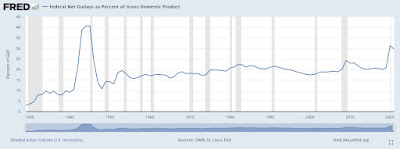
There has been a steady decline in basic civil rights for over a century, and it can be tied directly to the rise of the Income Tax and IRS. Once the government gained the power to tax it never stopped, because your tax dollars are its nutrients for growth. Hence we have witnessed a stunning growth in the size and scope of the government. Consider the historical chart below:


The Federal Government spend now is over 30% of our GDP. Combine that with State and Local spend and we're easily approaching 50%+. Why does that matter? Well as government grows, your freedoms erode. Sadly, the Founders knew this would happen. That is why they kept government small, knowing that it is inherently corrupt. Consider, since 1930 when Fed Spend was about 5%, you had essentially 95% of your freedom. Now it is less than half. And in many states like California it is worse. "The State" has become all.

Can this be fixed? That is a difficult question. President Reagan famously once said: "The closest thing to eternal life on earth is a Government Program." How true it is. Much of the problem lies with our elected representatives who do not represent us. They represent themselves and their lust for power. Change begins with voting them out, demanding term limits, and creating a task force to reduce regulations and simplify taxation. Yes, a task force to REDUCE government. We should not be the best country for political corruption and accountants, but rather for engineers, scientists, and poets.
 

Thursday, January 27, 2022

Getting Breyer'd

 Getting Breyer'd


The Biden Administration added another term to the popular lexicon yesterday when they leaked Justice Stephen Breyer's intention to retire to the media PRIOR to his actual announcement that he was indeed retiring, thus a Supreme Court Justice was effectively FIRED before he RETIRED. He was Breyer'd.

It is troubling in a Democracy that an elderly sitting Justice can be pushed aside with little recourse. Where was the President last night either apologizing or denying what happened? And to add further insult to the "retirement," Biden then vowed to break Federal Law by announcing both the RACE and GENDER of the new appointee...no need to discuss qualifications for sitting on the bench of the highest court fellow Americans, those are just needless distractions.

Politics determine policy and policy determine economic outcomes. Financial farmers should pay very close attention to the vetting "process" of highly appointed administration officials, bureaucrats, and judges as they will have significant impact on the future of this country's destiny. Gaffes add up, and lifetime appointments sometimes last a lifetime.


Tuesday, January 25, 2022

Killing Them Softly

 Killing Them Softly


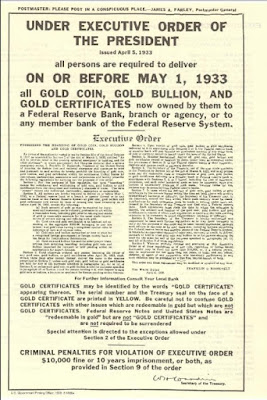
Executive Order 6102 signed by FDR made U.S. Citizen ownership of gold illegal in 1933. This act of tyranny went unchallenged for almost as long as his cousin Teddy Roosevelt's statue stood in front of the American Museum of Natural History. The two men could not have been more diametrically opposite in their policies, yet they were both men of their times. Sadly, it seems like we're reliving the early 20th Century all over again, both politically and socially with a pandemic which follows the Spanish Flu almost cough for cough,  an exit (entry?) into global conflict, and socialism rearing its Medusa head.

Change the dates and change the names and the resemblance is uncanny. Word War I raged in the midst of the Spanish Flu, and the "war to end all wars" finally ended on November 11th, 1918. The Spanish Flu swept around the world from February 1918 until April 1920 (give or take some months, of both sides of that figure.) The mortality rate of the two accounted for some 70 million deaths, of a population of 1.9 billion. Equivalent deaths today would be on the order of 300,000,000. That is a staggering figure. But what happened next in the early 1920s and what is happening today should scare the bejesus out of you.

When there is a vacuum in power, wealth, influence, leadership, ability, morality, etc., etc. it is usually quickly filled; indeed the adage "nature abhors a vacuum" is poignant and precise. Who or what fills that vacuum now is troubling for both financial farmers and more so to the citizens of this country. Just like Executive Order 6102, which made owning God's money, gold, illegal we are seeing a game plan right out of 1933.

If a government wants to fundamentally change the fabric of a society, it kills them softly. A two-pronged approach of utilizing acts of omission and commission works best. The players are on the field and the game has begun, with the first salvo being the most destructive, which of course is an act of omission. Getting something done in Washington is actually pretty hard, even if you are the ruling party. You often don't have the majority and then there is the pesky voting to worry about...but acts of omission? Oh boy, such opportunity!

National sovereignty is probably the most binary political issue there is...either a country has sovereignty or it doesn't, and all natural law flows from that fact. If a country does not have sovereignty, then it is not a nation by definition. It is a group of people who live in a certain geography. There is no border, there is no law inside that border, and there is no enforcement of said law(s). There is no shared value system, there is no language, there is no culture, there is simply of place residence. 

So if you want to dilute or negate the rights of citizens presumably in a nation, you simply ignore the presumption of a nation with borders. That's an easy act of omission that has a massive impact and can be accomplished by doing nothing, yet advances your political goals immensely. But that's just one variable to the final solution of a central government. 

The two other pieces to the "triumvirate" are Regulation and Taxation. Those two can pretty much steer a country to prosperity and freedom or doom and tyranny; although some voting might be involved by elected "representatives," a LOT of damage can be done with a regime fixated on changing the fabric of society via executive order.

Consider, FDR essentially made illegal a basic human right of the pursuit of happiness by outlawing gold as a store of value. This ring especially true today, where the first item on the IRS Form 1040 is a question about "crypto." Another way to regulate freedom is to require disclosure of something, and naturally then to tax it. And was we well know, the more you tax something the less of it you get. Let me say that again; the more you tax something, the less you get.

So less energy production, fewer side hustles, less crypto, less innovation, etc. etc. Ad nauseam. The end result of these polices inevitably less freedom for citizens and more control by the central government. Side effects naturally are the breakdown of society; more crime, more corruption, less enforcement, less good medical care, less good education, less good services in general.

When everything is free, nothing has value. Socialism's grip is tight. It provides government with tremendous control over its population. Just take a look at Australia and New Zealand, which have become de facto police states controlled by bureaucrats who have thoroughly embraced the strategy of "Killing Them Softly."


Monday, November 30, 2020

The Legend of Poopy Britches

The Legend of Poopy Britches


Occasionally a story is so bizarre, so outrageous, so unreal that it obviously MUST be true...hence is the case with Poopy Britches. Dubbed "the most significant fraud on taxpayer funds in California history," (which is actually really, really saying something), California has paid in excess of $1,000,000,000 in fraudulent unemployment claims to prison and jail inmates.

For some unknown reason, there doesn't exist a system to cross-check whether a citizen is in jail prior to paying out unemployment benefits. There are cameras at every street corner in LA to fine motorists. There are elaborate sting operations to catch people with more than 3 households for Thanksgiving. A surfer was arrested for...surfing. But things are so bad at the EDD (Employment Development Department) that not only are funds being dispersed to criminals currently in jail, but debit cards were issued to such outrageous names as Poopy Britches without any sanity checks.

Politicians are poor stewards of taxpayer funds because there is no incentive for them to be good stewards. Has there been any bigger victim to the largesse of government than the taxpayer? If ever there was a concrete reason to dismantle a complicated taxation system, this is it. Any time money is laundered through the government for benefit programs, inevitably there is "leakage." Why not change the policy to reward work? Eliminating the payroll tax benefits everyone, yet billions in PPP loans were issued with massive amounts of fraud, waste, and abuse.

Poppy Britches should teach us all that rather than launching payment programs funded by taxpayer funds, we should rather eliminate or reduce existing taxes and laws. Streamlining efficiency should be the goal, work should be rewarded, and ultimately bureaucracy that is not a good steward of taxpayer funds needs to be eliminated tout de suite.