Showing posts with label Cathie Wood. Show all posts

Friday, February 18, 2022

Grinding Halt

 Grinding Halt


The economy is grinding to a halt and on the cusp of a recession. As inflation ravages the economy, the Fed is well behind the interest rate curve now. Consumers are already pulling back demand via price-conscious shopping. Smaller cap stocks without tangible profits are being vaporized. Oh yeah, oil is taking a breather at around $100 on its way to $150 (or higher!) Can anyone say "Recession?"

Financial farmers need to be aware of what is happening in the global economy because macro events have salient and pertinent effects on their local sustainability. A confluence of events has put a once booming economy in the toilet. And if oil spikes further, the Fed raises aggressively, and/or consumer sentiment falls more, the economic gains of a decade will be flushed.

Considerable thought should be given in the coming days and weeks to the upcoming Fed meeting in mid-March where the Federal Reserve is now thinking of raising rates by 0.50%. Another eye should be on oil. High oil prices are yet another stealth tax on productivity (it costs significant energy to fed cattle, ship cattle, etc.) Almost every facet of the economy is greased by oil. Finally consumer sentiment might just be paramount, and it is falling like a rock. What should investors do?

Well anyone who has been in small cap stocks for the past 90 days has felt considerable pain. Like losses of 60%, 70%, 80% or more. This ties well into my previous post using Cathie Wood's ARKK ETF as a litmus test for innovation and risk appetite in small cap stocks. Let's just say the market is nauseous in regards to its appetite for this sector right now. "Bulletproof" tech hasn't done much better. Mid and Large tech have both been bushwhacked. The "survivors" so far have been pure commodity plays, ie banks, gold, and oil. People sitting on a pile of cash have also looked really, really smart.

If there is a gameplan to combat inflation, increase oil supply, or improve consumer sentiment nobody has seen it yet. Result? The pain will continue, and most likely get worse. We are the on the cusp of a recession; the economic gears are grinding to a halt. It will be extremely difficult to change poor economic policy, disastrous regulations, and incompetent leadership quickly. Financial farmers need to preserve capital here.
 

Friday, January 21, 2022

Mean Reversion

 Mean Reversion

Jeremy Grantham believes we are in the fourth superbubble of the last hundred years. He has many valid points and raises the specter of an utterly dismal 2022. Already we are down the first 3 weeks of January, and history shows that with almost certainty a down January results in a down year (.732 batting average.) With a handful of exceptions, notably massive Federal Reserve bailouts, this has always been the case. Grantham, however, takes it one step further than rule-of-thumb Wall Street adages and formulates a thesis on the simple premise of mean reversion.

Mean reversion describes just what it implies; that there will be a return to the average growth rate over time. Yes the growth rate itself might change over time, but sustainment of extremely high deviations from this average are difficult, if not impossible, to maintain over longer and longer periods of time. Typically they come in "bursts" that spike up (or down) in sharp, unstained points. Consider one of the best baseball batters in history, Ted Williams.

With a lifetime batting average of .344, Williams is arguably the best batter of all-time. He finished his career as the last batter with OVER a .400 average...that was almost a 20% deviation from his mean. Over long-enough careers with enough data players can be predictable, hence the rise of the current "Moneyball" climate of assembling a team on pure statistics. The stock market has even more statistics and a greater database to glean from for investors than baseball.

Consider the chart below, which identified 3 of the last 4 superbubbles and makes a prediction for the current situation: 


According to Grantham we're overdue for the next "blow off" from the housing, commodity, bond, and equity volcanic peaks. He even has a nice quick-reference rule set to follow:


The only caveat keeping the markets going, according to Grantham, is the paradigm shift we've allowed ourselves to believe in regards to markets (all of them) never falling and always going up. No matter what. Now almost all reasonable financial farmers know that this cannot be; we look outside the window and see the weather change by the minute and so it is with the economy as well.

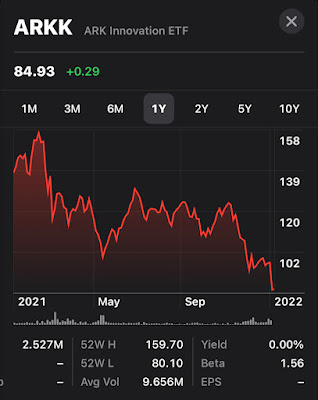
There is no doubt that Wall Street has been shedding risk like a snake molting skin. Case in point is the complete liquidation of stocks without an "E" in the P/E ratio...take a look at symbol ARKK for example, which is Cathie Wood's Ark Innovation ETF. That portfolio is composed almost exclusively of higher growth, lower (no) earnings companies. It has been dealt a severe blow in the past 6 months, and increasingly in the last month, as investors dump the speculative sector and plow right into the blue chips.

Grantham believe that this too will not matter when the reckoning comes because there will be an epic blow off taking down multiple markets simultaneously. It might be time for investors still riding high from recent valuations surges to round up some cash. Assets (things that pay YOU to own THEM) always seem to be in vogue, regardless of market conditions. But speculative "assets" without adequate reserves or more importantly paying customers might be in serious trouble. 

The big winners in history when bubbles pop are those with little to no debt, and an abundance of liquid cash. They have the ability to buy on the cheap when there is blood in the streets. Prices are high. Inflation is high. BUT high(er) paying jobs are still plentiful. If that final paradigm shifts, watch out below.


Tuesday, January 11, 2022

ARKK Barometer

 ARKK Barometer


Cathie Wood's ARK Innovation ETF (ARKK) acts as an excellent barometer for investor sentiment. Almost halved in a year, while the Dow spiked to over 35,000, ARKK visually displays the change in investor philosophy and risk appetite. 

A disciple of Arthur Laffer, Wood started her investment firm with the underlying thesis of disruptive innovation underpinning her investment goals, namely that disruptive companies create new markets and value networks. These companies hope to displace established market leaders aka entrenched monopolies.

In essence Wood is betting on a future of new technology that would improve humanity with better efficiency, because as a rule monopolies become less efficient and innovative as they mature into complete control of a market.

So why has Cathie's fund be cut in half? Rather than a collapse in the underlying technology, I believe there has been a 180 degree change in investor sentiment that believes reward (or gain) will come from "established" (read monopolies) that have existing market share, customers, and the big "E" in the P/E ratio...EARNINGS.

Mathematically, investors are betting on "business as usual" rather than innovation. Why? Because they are receiving signals that entrenchment wields the power and will be rewarded. Why? Because those are the signals being sent by Washington. How? Increased taxation. Increased regulation. Increased inflation. Increased enforcement. Decreased autonomy. Decreased workforce flexibility. Decreased worker qualifications. Those are a handful of the signals flashing. Investors have taken note.

Contrary to popular belief, Wall Street isn't dumb. Money flows where it is welcome and makes a return. Typically it chases winners. Just take a look at net new flows of money. It almost always flows into funds that have most recently performed well. And flees poorly performing funds. It seeks to survive and grow by chasing returns. The most successful funds of 2021 were the tech monopolies and natural resource monopolies. Small innovation got utterly crushed.

My final thought on this subject is that immutable laws are hard to break. They can be avoided. They can be postponed. But ultimately there is a reckoning. Although policy and regimes may put their weight behind the status quo, ie monopolies, the proverbial sidewalk flower will grow in a concrete jungle.