Showing posts with label Wealth. Show all posts

Friday, March 20, 2026

Catching Knives

Catching Knives


Catching falling knives (buying distressed assets) is tricky business, even the most seasoned investors get cut badly. The task seems relatively easy, yet perfect execution is a rarity. The challenge of buying on the low revolves around having almost perfect information. That is highly elusive, sometimes illegal, and in a multi-variable world with intense competition vying for any edge, almost impossible.

Investors hoping to scoop up additional alpha should leave the knife catching to the circus. Outfits like Ringling Bros perfected "the spinning wheel of death" so retail investors do not have to literally reinvent the wheel!

Rather, retail investors should consider playing to THEIR advantages over "professional money" like hedge funds, family offices, and AI-trading algo bots. Consider instead a boring, dollar-cost-averaging approach to building a portfolio over a LIFETIME with incremental purchases occurring multiple times a month.

By implementation of a dollar-cost-averaging approach, investors are constantly buying equites (and bonds) over a period of time that will have both highs and lows, and by default, greater position size will be purchased during selloffs and lower position sizes at the highs.

These DCA plans are relatively easy to set-up, and now virtually "free" with zero commissions. The rub of course, is always portfolio allocation...what exactly to buy? Portfolio allocation is critical to success.

Trepidation occurs when a portfolio has been built over some time and perhaps is no longer being built (ie inbound flows have stopped) and the portfolio is now in a "depletion phase," primarily used to pay for cost of living expenses.

The larger and older a portfolio gets, the more it is subject to short-term market forces, and also the temptation to make significant rash moves...this is exactly why this blog is a proponent of building a portfolio like a farm. 

Investors should have multiple "crops" ie baskets of equities whose cash flow can and should weather a financial storm(s). Ultimately most investing boils down to cash flow, so how are you building your cash flow? Do you have a repeatable process in place? Is your cash flow compounding? What companies are consistently raising their dividends? What are the best moats? What is the caliber of leadership in place? Can your portfolio take advantage of a higher Vix?

As previously mentioned, all these factors must be weighed because portfolio allocation is critical to success. This is why putting an emphasis on timing rather than process is dangerous; it skews the thought process from investing to gambling, and there is a significant difference between the two. Investors have odds in their favor, gamblers do not.

Catching knives is tricky business. For investors sitting on ready cash though it is deliciously tempting to go "all-in" after the market stumbles, and even more appealing after a tumble. Indeed, many great fortunes have been made in this manner (ie Rothschild family wealth was built off of perfect information.) If so compelled, have a playbook ready; know what assets you want to buy, at what price, and with what margin of safety this impacts your total portfolio.

Saturday, November 15, 2025

Barbell Society

Barbell Society


It is becoming increasingly obvious, just as AI imbedded in Google's Blogger helps predict my next words, that society has undergone some fundamental changes in just the past several years. Perhaps the biggest is the emergence of what I consider to be a "barbell society."

In the traditional sense, barbell economics means a concentration of wealth or economic activity at two ends of an economic spectrum; ie your working poor and your working rich. The Middle Class was the thick bar in the middle holding up both given its size, asset ownership, and political power. But with the rapid adoption of AI in the workforce, academia, logistics, fulfillment, food prep, etc., etc. combined with a monopolistic concentration of assets (read cash, gold, bitcoin, stocks, real estate, pensions, 401Ks, business ownership, IP assets, political power, etc.) in the hands of a single generation what has emerged is a barbell society.

This barbell society is new in the annuals of history; typically there was a pyramid type of structure where a few controlled or owned everything and the vast majority of people led lives of serfdom. This has drastically changed over the past two thousand years via successive revolutions. Up until recently in fact, almost every successive generation looked forward to a better standard of living than their parents. That is no longer the case, as "The American Dream" is poised to succumb to a barbell society.

The question that arises now with the arrival of AI in society is where on the barbell is AI? I propose that it is actually the left "BELL" increasingly responsible for more work utility (task importance times volume.) The left BELL is growing insanely fast, replacing mundane, dangerous, and increasingly knowledge-based tasks, jobs, and marketing/sales. The left BELL needs no sleep, no comp, no medical insurance, files no lawsuits, and works for the cost of its coding and electricity. The left Bell grows stronger by the second.

The BAR is what once was the working poor and middle class which have essentially are doing less task importance times volume work, but there are much more of them. Society today resembles more of hockey stick lying on the ice with five feet of it nearly flat and the last foot shooting up.

Mathematically the vast majority of Americans could not pay for health insurance without subsidies or employer contributions. Most Americans do not own their own homes. Most Americans could not round up $400 in an emergency. Simply put, most Americans are poor not middle class. 

In terms of asset concentration, the BAR represents the working poor and middle class with some tinge of upper middle class. Yes, all of these segments have varying degrees of ready cash, bitcoin, stocks, real estate, and perhaps political power but they are fragmented and hence the BAR appearance, flat and linear. The right BELL however is a completely different story.

The right BELL (and make no mistake, this does not imply a singular political party, both Democrats and Republicans transcend into the right Bell) not only controls vast swaths of assets, but also has managed to create wide moats to entry (think Prop 13 in California.) We are seeing the rise of socialism because of this very development. When the odds seemed stacked (and they are), younger generations embrace forceful redistribution of assets.

Consider: Baby Boomers own over 54% of stocks. Likewise with real estate. Small businesses. Obviously nearly 100% of Social Security cash flow. And political power? Well there has never been a Gen X or Millennial President. Average age of U.S. Senator? 65. That used to be the mandatory retirement age! As the poster child of his generation, Warren Buffett is finally retiring (sort of) at age 95 at the end of this year.

Modern medicine, healthy living habits, and unwillingness to "pass the torch" has led to some unusual societal developments...combine this with the rise of AI and what we see is a true barbell society. Think about this: Over 33% of someone's LIFETIME medical costs occur in the last 5 years of their lives. There are approximately 75 million Baby Boomers in the United States. The average Baby Boomer is 68 years old with a life expectancy increasing daily. With miracle drugs like GLPs many in this generation have a good chance of living into their 90s. "Centurion" is one of the fastest going demographics.

From a societal standpoint, it will become increasingly difficult to support the largest demographic. If both the left BELL does not significantly increase economic productivity and the BAR does see real wage growth healthcare costs will drive this country bankrupt. Let me say that again, AI (the left BELL) needs to drastically increase productivity while the working poor, middle class, and upper middle class (the BAR) needs to drastically increases their real wages

Tuesday, January 21, 2025

Longevity

 Longevity


There is an old saying that "youth is wasted on the young, and wealth on the old." That presents a true quandary, because for many of us wealth does not appear until there is gray in the hair and we are on the pickleball courts! So barring a tectonic shift in altruism, the only other option is for investors to internalize a truth: time is the most valuable commodity. It deserves to be considered its own asset class.

If time is truly the most valuable commodity, then investors need to embrace longevity as one of their key tenets in creating dynastic wealth. Along with creating value (the more the better) and buying assets (once again, the more the better), living long allows for many opportunities for both creating wealth and compounding it. The latter factor is vital. Compounding alters lives.

Even a grub stake over time can become princely wealth. A vital factor is correct asset selection which results in compounding. Much of the asset selection process can be learned, and it is often quipped "lessons are expensive and good ones dear." Continuous (yes "Dollar Cost Averaging") of proper asset selection (read that as "real growth," defined as growth in excessive of inflation) over time (and here we want AS MUCH TIME AS POSSIBLE) can result in magnificent wealth. 

Of the three components of #CVBALL (Create Value, Buy Assets, Live Long), Live Long is the most important. You can have many, many failures in life, but generally the older you become you learn from mistakes and try not to repeat them. You may have new mistakes and never exhaust the total "pool" of mistakes possible, but generally you get better at the game as you age.

New Year, same plan! #CVBALL! Concentrating on the "LL," there have been many studies done on longevity. Increasingly it has moved from the fringe to mainstream, especially with widespread adoption of "miracle drugs" like Ozempic. These semaglutides decrease the urge to eat and help jumpstart a virtuous cycle that combined with exercise and a modified diet often results in significant weight loss, improved cardiovascular fitness, and better cognitive functionality. Bottom line, semaglutides along with changing behaviors will result in collectively MILLIONS of years in longer lifespans.

Longevity, whether obtained from pickleball, Ozempic, and/or a reboot of the traditional food pyramid will have massive effects on wealth. Adding just one (1) more doubling cycle to your wealth can drastically improve your quality of life and potentially that of your heirs. Adding two (or more!) doubling cycles is almost hard to fathom...an estate saved over a lifetime for someone in their early 60s worth say $3M potentially becomes close to $25M if they can live into their 90s. And that is becoming increasingly possible. The centurion is one of the fastest going age demographics.

So ILAF (Invest Like A Farmer) offers a solution to those who may feel they are priced out of the real estate market, or don't earn enough to compete, or who have perhaps just suffered a big financial or life loss...hang in there. Longevity offers a myriad of outcomes and forgives many mistakes. Create Value. Buy Assets. Live Long. (#CVBALL).


Saturday, March 5, 2022

The Case for Gold

 The Case for Gold

Physical gold that can be carried with you or stashed has been the backbone of wealth for thousands of years; hordes of gold coins are still being found in England that date from Roman times! The recent invasion of Ukraine further illustrates the case for gold.

Gold is an ideal store of wealth because it is compact, rare, liquid, valuable, useful, portable, universal, elemental, incapable of being created by man, hard(er) to seize, doesn't rust, and you can stash it almost anywhere.

In contrast to "crypto," in which nearly everything is known about the buyer and seller, where it can be seized almost at any time by any government agency for any reason, and if there is a thunderstorm you potentially lose all access to your wealth, gold offer significant advantages.

There is no better example of the value of gold than the current situation in Ukraine. Millions are fleeing the Russian onslaught and have to leave behind their belongings, real estate, and bank accounts (save what they were able to withdraw at the last minute.) Refugees are literally leaving with the clothes on their backs and whatever they can put in their pockets.

When the grid is down and your crypto is frozen, your AMEX is worthless, and nobody is taking your cash, gold is the proverbial golden ticket out. Physical gold should be a component of every financial farmer's portfolio.
 

Monday, December 13, 2021

Inflation Nation

 Inflation Nation


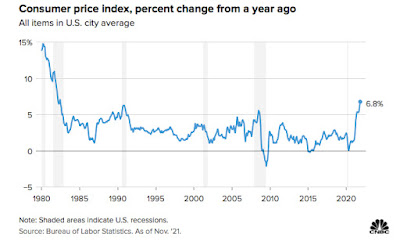
Nothing makes America poorer faster than inflation. Last Friday's annualized Consumer Price Index (CPI) number came it at a sizzling annualized 6.8%, the highest since Reagan had to go to work defeating the last remnants of the Carter's administration's handiwork. Reagan broke the back of inflation by jacking up interest rates to the point where inflation was tamed. The greatest Bull Market the world has ever witnessed soon followed. We might not have that luxury of both a prudent leader and the liquidity to tame inflation this time around.

Simply put, inflation is the by-product of a fiat fiscal and monetary policy run amok, too much paper money (fiat money) is created rather than actual value. Gold has well stood the test of time for literally thousands of years because it cannot be created by man. It must be acquired by toil. Not the case with Benjamins. The Treasury Department can keep on a-printing those bad boys all day long. In fact, with the modern marvels of blockchain and digitization 1s and 0s can now account for the actual "money." No need to even print it...just add a couple comas to the supply and viola, you have more money!

The Biden Administration is in a serious bind. There is tremendous demand for a limited set of real products; read housing, energy, food, education, healthcare, and hard goods. Consumers are not stupid. They are moving their digital paper money as quickly as possible into goods and services, hence simply via a classic supply & demand scenario prices go up with increased demand and diminishing supply.

Although the headline number of 6.8% annualized is bad, the reality is far, far worse dear farmers. The fact is the majority of Americans do NOT live in Megacities. As evidenced by the population density map of the USA below, the country is pretty well distributed with the East (loosely East of the Mississippi River) being at least 2X more dense than the West (up until you get to coastal California of course.) Why does this matter?


This matters financial farmers because both the CPI data set is a fallacy. The majority of Americans are seeing double digit inflation in everything that matters, and most importantly they're actually paying for it out of pocket. Let me explain. A significant portion of the residents of Megacities are subsidized in terms of housing, food, and healthcare. Meaning the government is picking up the tab. Whereas outside these areas, the median (not average) citizen is paying through the nose for higher gas prices, housing, food, healthcare, education, etc., etc.

The end result is a total theft of wealth from the very people who the Government SHOULD be focused on improving their opportunity in life with lower taxation, less regulation, and more opportunity for goods and services sold in the USA. The opposite is happening. The government is subsidizing cheap labor and goods overseas which then compete at a significant advantage against home-grown goods and services. The net result is the loss of market share, employment participation, and meaningful opportunity for the very citizens the government was elected to serve.

What is a hard-working financial farmer and patriot to do? First, keep calm and carry on. Second, look to circle the wagon(s) around physical goods and vital services. There is nothing "transitory" about the hordes of people competing for the same goods and services...lock up your share of real estate, blue chips (larger-cap monopolies paying a dividend, see "Rapko's Rules"), gold, education, and healthcare. Oddly enough having some cash might not be a bad idea, because even though its buying power decreases by the day (hour?) there is something to be said of "buying the dip" in terms of assets.

When will the ship turn around? It might not turn around. We have a timid Fed unwilling to buck the interests of the Biden Administration. An impartial Fed does not exist, if it ever did. So what this means is interest rate hikes will be milquetoast at best, especially if the "BBB Plan" is enacted by some unfortunate miracle. Part of the BBB Plan relies heavily on low rates, forever. As an investor this means 2022 doesn't look particularly bright in terms of upside as investors will be fighting for survival against the Fed.

2022 is all about finding assets which offer REAL growth in terms of capturing market share, increasing dividends, and raising their prices for goods and services. A great question to ask is "can this business pass along costs?" For companies without positive cash flow and living on the largess of zero interest rates it becomes a eloquent kabuki dance of finding investors willing to stomach volatility spikes. Only those that create and sell real value will survive.


Friday, January 3, 2020

Compressing Time

Compressing Time


One of the greatest challenges in creating wealth is sustaining it. A BIG part of that challenge is trying to compress time by leapfrogging traditional linear investing techniques. In reality wealth creation is AT LEAST a 3-dimensional solution.

The traditional compound interest model assumes that there are simply only 2 variables; time and the interest rate on a initial principal amount. Below is a typical example of a fixed initial savings amount of $5,000 compounded monthly at an 8% annual rate for 45 years.


Visually this looks nice, but virtually no one can succeed in a 45-year holding period. Life just throws too many variables, whether opportunities or disasters, to leave capital alone for such a long stretch of time. Not to mention the interest rate will vary. And the instrument itself (whether it is a CD, Bond, common stock, etc.) also has signifiant systemic risk over that period of time.

My argument is this: wealth creation is much more a function of at least a 3-dimensional solution. In addition to time and interest rate applied to capital we need to incorporate chance. Chance is the missing variable that helps explain the implementation of luck, knowledge, experience, struggle, and failure in the wealth equation.

So rather than a linear result, consider modeling your wealth creation as a 3-dimensional reservoir of time, interest, and chance. Life is far too complicated to rely on a linear approach to building a significant store of wealth. 

Adding this 3rd dimension of wealth creation allows R.I.S.E. Movement members to leapfrog many years, if not decades, of traditional simple or even low-rate compound interest and compress time. By that I mean by successfully implementing chance you have the ability to progress to the leading edge of the traditional compound interest chart rapidly.