Showing posts with label Tom Rapko. Show all posts

Wednesday, July 15, 2026

Escalator Yo-Yo

 Escalator Yo-Yo


One of the best analogies of the stock market is that it is a man riding an escalator up with a yo-yo in his hand spooling up and down constantly.

Now the escalator itself might represent inflation or productivity over time, perhaps both, while the yo-yo spinning up and down constantly represents the inherent day-to-day volatility of the stock market dipping down and bobbing up.

Short-term, from the man's perspective, the stock market is demonstrating extreme swings in movement, yet all the while the escalator is slowly, methodically, moving higher and higher raising the relative baseline. 

Yet as we have all experienced, an escalator can and does stall or break. That is rarely for long. Mechanics come and "fix it" (read Federal Reserve) and it is off to chugging along again, day-after-day.

What makes this analogy so interesting is the combination of both economic and physical law truisms; namely inflation acts as ever-increasing entropy, while man constantly seeks technological solutions to life's challenges.

Coupled together, inflation and productivity push markets higher in both notional and real values, while the day-to-day swings offer prices points for entry and exit to millions of market participants.

One of the inherent functions of a market is timing. Timing in the purchase and sale of assets relative to their perceived value at that price point in time.

As we have seen on a nearly every-other-day basis this summer, traders are actively probing entry and exit points for equities. In spite of high(er) oil prices, two global conflicts, and daily (re)evaluations of tech pricing the markets have continue to rally higher.

So while short-term traders are watching the Yo-Yo, readers of this blog who desire to Invest Like A Farmer (ILAF) are using sell-off timing to their advantage and riding the escalator higher and higher while being prudent not to find themselves the "exit liquidity" many VCs and Investment Banks so cravenly need.


Friday, April 17, 2026

Legitimate Income

Legitimate Income


Legitimate income is expensive. Successful earners lose more than half of every dollar they earn. Learn how to legally keep more of what you earn. Play by the rules, but control the terms.

Much of what is earned as income comes from the creation of value, with more value created typically resulting in higher income derived. Insanely great value creation can generate insanely high income. That is generally pitched as the "American Dream" or at the least the goal...to EARN a high income. The reality as you quickly learn along the way to high income is that at first some, then more, then most of that income is taken from you. It is "redistributed" via progressive taxation.

The tax code is what it is; attempting to skirt or even worse deliberately running afoul of it has serious consequences. Yes there are thousands of people out there that never file tax returns and never pay income taxes. Many will never be caught. But the risks are severe, especially if you value your freedom.

Sadly, every American is born into serfdom as an indentured servant now, one way or another, with a Federal Deficit of nearly $40 Trillion Dollars as of April 2026. It is what it is; prior generations have overspent and saddled the next generation with even more debt. The debt compounds. The value of the dollar decreases. Taxation increases. This is the hand modern earners and investors have been dealt.

We have two choices: Feed the beast and relinquish more and more of your earnings, wealth, and soul to government that only grows in size and scope yearly OR become resilient. Keep reading if you would like to become resilient.

After decades of earning, building, and paying taxes (routinely to the point of extinction) some truths have become self-evident. First, to earn a decent living you need to create some level of value on a recurring basis, whether that is a service or physical good or a hybrid therein does not matter. Second, there are generally barriers to entry for the higher income professions; some are academic, some are skill, and some are family connections. To ascend the "value chain" of potential earnings and wealth one needs to leverage their own particular ambitions and skill sets. These first two variables we all have in common. The third variable is a conscious decision to become resilient.

Generally speaking, the greatest way, and by that it is meant the surest, fastest, safest way, to lasting wealth creation is to embrace a value creation and ownership mindset that is singularly focused on creating extreme value to sell, regardless of profession or industry. HOW that value is sold is critical.

To preserve and grow wealth it is vital not to LOSE some 50% of it each year to taxation. Taxation takes many forms; for our purposes it specifically relates to the Federal Income Tax, State Income Tax, Local & Municipal Taxes, Self-Employment Tax (as applicable), Social Security Tax, Sales Tax, Real Estate Taxes, Affordable Care Act Tax, and the additional associated costs of Medical Insurance & Education which most high earners pay out of pocket which act as additional taxes. All those taxes provide significant drag to advancement in life...like running a marathon with a parachute on your back that grows larger with each mile run!

Here at ILAF we like to tell it to you straight. If you want to achieve markedly higher wealth, consider implementing the following strategy ASAP: However you decide to create extreme value and sell it, consider doing it within your own company. Extract the minimum income needed to pay for your living expenses outside the business. Some would advise earning enough to contribute to a 401k, SEP, IRA, etc. The upside is you are creating tax-free or tax-deferred retirement savings, but you are also creating "tax bombs" that will be large liabilities down the road (except for your tax-free Roths.) Conventional wisdom suggests paying out value in the terms of income and then using a chunk of that income to build retirement savings. A more recent approach pioneered by the authors of the largest tax break in existence is to SELL your business every 5 years under the QSBS rules.

In every time and every generation in America there is a profession that has preferential status; ie the tax code bends its knee to that sector. For the first 150 years of America it was the farmer, rancher, and miner. Next came the oil man and manufacturer. Then we saw the rise of the professional class; lawyers, doctors, and engineers. Now the country is lopsided to the service sector and corporate behemoths. Most recently though, the rise of AI has resulted in small teams creating vast wealth (for themselves and early investors) via the promise of creating insanely great value.

We all need to press our respective EDGE. Not everyone is an AI vibe-coder, but every profession and career has its distinct advantages and disadvantages. Almost all forms of work offer a "best case" scenario where you can harness the power of the tax code to your advantage. Consider your skill sets and value proposition in the creation your own personal "Edge Fund."

It is hard to get ahead and create wealth when that yearly nut gets nibbled on by every tax squirrel in the forest. Look to store and secure your nuts. Take what you need to survive, but consider strategically selling your stash only when needed...and when advantageous to you and your family. Play by the rules, but control the terms.


Friday, March 20, 2026

Catching Knives

Catching Knives


Catching falling knives (buying distressed assets) is tricky business, even the most seasoned investors get cut badly. The task seems relatively easy, yet perfect execution is a rarity. The challenge of buying on the low revolves around having almost perfect information. That is highly elusive, sometimes illegal, and in a multi-variable world with intense competition vying for any edge, almost impossible.

Investors hoping to scoop up additional alpha should leave the knife catching to the circus. Outfits like Ringling Bros perfected "the spinning wheel of death" so retail investors do not have to literally reinvent the wheel!

Rather, retail investors should consider playing to THEIR advantages over "professional money" like hedge funds, family offices, and AI-trading algo bots. Consider instead a boring, dollar-cost-averaging approach to building a portfolio over a LIFETIME with incremental purchases occurring multiple times a month.

By implementation of a dollar-cost-averaging approach, investors are constantly buying equites (and bonds) over a period of time that will have both highs and lows, and by default, greater position size will be purchased during selloffs and lower position sizes at the highs.

These DCA plans are relatively easy to set-up, and now virtually "free" with zero commissions. The rub of course, is always portfolio allocation...what exactly to buy? Portfolio allocation is critical to success.

Trepidation occurs when a portfolio has been built over some time and perhaps is no longer being built (ie inbound flows have stopped) and the portfolio is now in a "depletion phase," primarily used to pay for cost of living expenses.

The larger and older a portfolio gets, the more it is subject to short-term market forces, and also the temptation to make significant rash moves...this is exactly why this blog is a proponent of building a portfolio like a farm. 

Investors should have multiple "crops" ie baskets of equities whose cash flow can and should weather a financial storm(s). Ultimately most investing boils down to cash flow, so how are you building your cash flow? Do you have a repeatable process in place? Is your cash flow compounding? What companies are consistently raising their dividends? What are the best moats? What is the caliber of leadership in place? Can your portfolio take advantage of a higher Vix?

As previously mentioned, all these factors must be weighed because portfolio allocation is critical to success. This is why putting an emphasis on timing rather than process is dangerous; it skews the thought process from investing to gambling, and there is a significant difference between the two. Investors have odds in their favor, gamblers do not.

Catching knives is tricky business. For investors sitting on ready cash though it is deliciously tempting to go "all-in" after the market stumbles, and even more appealing after a tumble. Indeed, many great fortunes have been made in this manner (ie Rothschild family wealth was built off of perfect information.) If so compelled, have a playbook ready; know what assets you want to buy, at what price, and with what margin of safety this impacts your total portfolio.

Tuesday, January 20, 2026

$1T Land Deal

$1T Land Deal


As President Trump departs for Davos, it is becoming increasingly likely that the United States may purchase Greenland from Denmark with a price tag rumored at $1T. This land deal would mark the largest of the land deals ever completed for the United States.

The two largest previous deals being The Louisiana Purchase in 1803 from France for $15,000,000 (yes the same price in nominal dollars as a flashy Beverly Hills home today) and The Alaska Purchase from the Russian Empire in 1867 for $7.2M which was termed "Seward's Folly" under the belief the United States overpaid for a vast frozen tundra.

Greenland offers the United States, and indeed both Europe and Canada, the opportunity for increased defense against potential adversaries capable of launching intercontinental missiles that would fly over the Article Circle on the shortest flight path into the United States. Contrary to popular belief, this is not the first time the United States has attempted to negotiate for the purchase of Greenland. It is just the latest salvo, this time very public, of the United States trying to shore up its northern defense.

Indeed, the United States has tried to purchase Greenland on three successive occasions before; in 1867 by Seward, in 1910, and most recently in 1946 after World War II. All previous attempts had been rebuffed, with the latest after World War II cementing Denmark's control of a landmass FIFTY (50X) times its size, but 1/120th its population. 1946 was a missed opportunity, especially as the United States aptly entered the Cold War.

Interestingly over the past weekend, 8 NATO countries deployed troops to Greenland on the concern of President Trump's desire to buy Greenland. Yet these same countries for some odd reason have not deployed a single trop to Ukraine for an intense land battle with Russia which is entering its 4th year. Millions injured, hundreds of thousands killed, and complete societal change in Ukraine yet seemingly only Poland has stepped up to the plate.

The dynamics of the European mind are mysterious. Denmark acts like a domain squatter who has allowed use of a war prize from the 1300s to the United States to benefit it and Europe, while refusing to let the protector of Europe (USA) to develop this asset for global security.

Time will tell how the chips fall, but Denmark has the opportunity to cash in on an asset they have long done nothing with and provide the United States, Canada, and Europe with additional defensive resources.


Friday, January 2, 2026

Execution

 Execution


Execution is everything. For the vast majority of us, even a very successful life and career will be largely lived in obscurity, invisible to the larger world. It will involve grinding out small wins, the proverbial base hits for decades. In time, home runs and even the grand slams will happen, but mastering the craft and even getting on the field, will be paramount for stepping up to those at-bats and swinging at the ball.

The search for excellence, whether in investing, a relationship, or a career also is closely tied to execution. Excellence is found in repeated successful execution of tasks, muscle movements, and ultimately choices. Excellence is a process, a repeatable system with frequent feedback. In the business world, much of that process can be bought via something called marketing.

Marketing helps companies, and increasingly individuals, build their products and brands in the public eye thus helping achieve brand awareness that in the past was accomplished by repeated successful execution and word-of-mouth. The marketing cycle has increasingly been compressed into seconds with short video reels on platforms like TikTok, YouTube, or....Reels.

Andy Warhol once quipped that "...in the future, everyone will be famous for 15 minutes." Not only was he 100% correct, but the time element of viral fame is now as compact as 15 seconds. This leads to the question of whether attention to detail and successful execution even matter in a low-attention society. The answer of course is yes, and the following is why.

One of the best quotes on the subject of execution is: "Watch your thoughts for they become your words, watch your words for they become your actions, watch your actions for they become your character, watch your character for it becomes your destiny." 

Billions of humans are thinking trillions of thoughts and speaking a corresponding number of words, taking a subsequent number of actions, and becoming certain types of people. Not all seek excellence, but as Adam Smith famously theorized, we are all motivated by our own self-interest. This is what drives economic activity and humanity itself.

As we kick off the New Year and resolutions abound, it is important to remind ourselves of the value of owning our actions, mastering our craft, and focusing on successful execution...whether those wins are on the athletic fields, board rooms, or in the living room execution is everything.


Tuesday, November 25, 2025

Dow 100,000

Dow 100,000


Here at ILAF we are an optimistic crew, and whether you are smarting from the 2025 stock market rally or simply riding a tsunami of schadenfreude, it is poignant to consider what the future may hold.

As described in the 2025 Stock Trader's Almanac: The fifth year of almost every decade is the best in terms of stock market performance, as is the 1st year of a new presidency. If Santa Claus comes to the rescue again this year, whatever results 2025 brings might be the best of the decade. But like an old curmudgeon, we at ILAF are not satisfied with simply average returns, or even the best, we dream of stellar, euphoria-inducing returns. Read on dear investor.

Assuming several economic events break our way and AI can deliver the productivity boost it is capable of doing, ILAF predicts...wait for it...Dow 100,000 in 5 years (say Christmas of 2030.)

Dow 100,000 in 5 years assumes a 15% return per year for the next five years. As we all know, linear returns are a fallacy. Developed by the big ETFs and fund companies to convince people the stock market can be tamed and silo'd into discrete linear patterns, linear returns are the original "fake news." Day-to-day, week-to-week, and month-to-month movements CANNOT somehow be converted from a Four-dimensional marketplace into a glossy Two-dimensional marketing brochure. It don't work that way.

How it does work is daily chaos derived from fear and greed trying to maximize return while taking as little risk (allegedly, see 2007-2009) as possible to do it. That 15% annual growth rate can be had, and double the Dow to 100,000 if we can significantly improve productivity, while somehow keeping unemployment under 5%, inflation tame around 3%, and real wage growth exceeding inflation. Big "ifs," but the likely scenario to reach Dow 100,000 may not be what investors suspect.

My theory is that "this time around" AI is going to replace entire job sectors, and as robots improve their dexterity almost every industry that has a "touch" component is vulnerable. California should lead America, if not the world, again...but for all the wrong reasons. California is a great example of where the fusion of AI and robots should have an increasing immediate impact (and a lasting one at that) because of the extreme difficulty in both having a business in the state and even more dangerous having employees.

Look to where there are poor incentives to do business, and there is where AI and robotics will flourish. Keep an eye on places with a heavy labor union presence. Onerous taxes. And lots of lawyers. AI and robot adoption will help transform heavily regulated industries with high plaintiff-cost to productivity darlings. Coastal America looks ripe for massive productivity surges, and given their existing high population densities the Al and robot utility spikes will translate directly to the bottom line of corporations, and possibly even local, state, and federal government.

In the next five years it will be more important than ever to be an OWNER of AI and robotic assets, which for many of us that means owning shares of companies immersed in the sectors. As an owner you should be able to ride the wave of increasing profits, increasing dividends, and sector share ownership. Woe to those who do not own a piece of the action...the downside of all this productivity increase almost assuredly will be job loss.

It is hard to believe AI and robots will INCREASE the numbers of jobs, or increase real wages. At some level (think control or ownership) they might, but for the vast population AI and robots will not be creating jobs, they will be eliminating jobs and lowering the collective standard of living...save for those who are owners of the tech.

Dow 100,000 has a good probability of happening within 5 years, but there is also a good possibility of significant societal changes to effect the stock market doubling. As usual, buy or create assets.


Monday, February 5, 2024

Dow 50,000

 Dow 50,000

 
Forty years of Dow Jones Industrial Average performance begs the question "When?" not "If?" the DJIA will reach the 50,000 milestone.
 
As often discussed on this blog, the greatest dangers to the financial farmer are taxation and inflation. In regards to the DJIA, we can clearly see the effects of inflation; the average has a relatively stable linear trajectory from 1984 to 2024. Albeit, there are some SERIOUS instances of volatility cause tremendous slides and spikes. 

With that said, we are about 32% away from Dow 50,000 or just about a third. Over the past forty years the Dow has risen some 37,000 points or 3200%. Is America 32X BETTER than it was in 1984? Doubtful.

As best I can tell, the major "advances" over the past 40 years have largely been in the PRICES. Real wages have fallen after having peaked sometime in the early 1970s. What has increased? The price of nearly everything save perhaps for COMPUTING power. And that is what I argue has been the REAL growth over the past 40 years, indeed perhaps even dating back to the invention of the microprocessor itself.

Nearly every component of the Dow, the the members have changed significantly over the past 40 years, have by definition been industrial companies. Over time though those components have weighted more and more towards technology. The same can be said of the broader S&P 500 Index, whose 505 members are a cross section of the largest companies in the United States.

Today fewer companies make more of the profits, and naturally those companies have higher market capitalizations. It has gotten so extreme that less than a dozen technology companies account for the majority of the capitalization. 

There have been several seminal events over the past 40 years of Dow performance which has driven the market significantly higher. In the early 1980s the taxation structure was significantly changed in the United States under President Reagan. This led to an unprecedented boom.

After the crash in 1987 and recession in the early 1990s I argue the next seminal event was in December 1994 when the Netscape Navigator browser was released. That opened the world to the internet. And even during multiple upheavals during the next 30 years the internet gradually came to dominate global commerce.

I believe we are at a similar inflection point to December 16th, 1994 the day after Netscape Navigator was released with AI today. Via ChatGPT and distribution via the largest company in the world, Microsoft, I believe the world again is going to pivot higher in terms of real growth.

What does this mean for the Dow Jones Industrial Average? Assuming more of its components harness AI, or are even replaced in the Index BY AI-dominate companies, the Dow itself should see meaningful increases in the year(s) ahead and not just due to inflation, but rather TRUE growth in terms of productivity. If the Netscape theory holds, then we should see Dow 50,000 sooner rather than later.


Friday, January 26, 2024

Escape Velocity

Escape Velocity

 
"Escape velocity is the speed that an object needs to be traveling to break free of a planet or moon's gravity well and leave it without further propulsion." - Northwestern University
 
As financial farmers striving to build, grow, and ultimately subsist off of our portfolio it behooves us to understand this aerodynamic concept.

As we have discussed many times, the greatest threats to the investor are taxation and inflation. Generally speaking, a financial metric like the S&P 500 will continue to increase in value over time because it is composed of survivors; ie only companies who remain prosperous remain in the index, while losers are dropped or go bankrupt. But even the S&P 500 fights a tough battle against inflation. 

The question investors need to ask themselves is whether real growth is occurring are we simply seeing an increase in prices? Inflation often disguises itself as growth. A superb example is M2, or money supply. Does increasing the supply of money increase its true value? Not if it isn't backed by productivity gains.

Knowing that every dollar is worth less tomorrow than today due to inflation, an investor should seek to capture the value of that dollar sooner rather than later. Over the past 5 years the 3 assets classes which have been able to do that are gold, real estate, and stocks (S&P 500 as the preferred benchmark.)

For the worker who has been saving cash the past 5 years it has been brutal. And for those who have been steadily socking it away for decades even worse. The traditional saver has been inflated out of a good portion of their buying power, some 50% in the past 3 years alone!

In the example above, a spaceship needs enough velocity to escape a planet's gravity well. Velocity in our situation are resources, whether gold, real estate, or stocks. Assets that not only hold their value, but perhaps offer growth potential as well. The "gravity well" can be considered that suffocating burden of taxation and inflation which erodes true value and stifles growth.

The reason we Invest Like A Farmer is to achieve sustained growth over time. That rarely happens by chance. An investor needs to understand the value of their paper money and how best to deploy it quickly as fiat currency apparently has a half life in the current environment of about 3 years.


Tuesday, August 8, 2023

Gold Money Act

Gold Money Act

"The United States Mint founded on April 2nd, 1792, some 231 years ago, is almost as old as our nation. As a bureau of the Treasury, it is responsible for producing coinage for the country to conduct commerce and also responsible for controlling the movement of bullion. It does not produce any paper money. That job is fulfilled by the Bureau of Engraving and Printing. Currently there are four active coin-producing mints: West Point, Philadelphia, Denver, and San Francisco. Legal tender coins of today are minted solely for the Treasury's account."--Largely sourced from Wikipedia

The primer above was to provide the reader with a synopsis of the U.S. Mint. This author hopes to persuade readers of this blog to ask of their elected representatives for the immediate introduction, debate, and passage of a "Gold Money Act" whereby: U.S. Gold Eagles be available for purchase or sale at any FDIC-insured retail banking institution in the United States at current spot gold price.

This legislation would allow Americans to buy and sell U.S. Gold Eagles at current spot gold price at any FDIC-insured bank in the United States. For far too long, many Americans have not had the opportunity to purchase or sell United States Gold Eagles. The nation's gold coinage should be widely available to all.

Gold Eagles, which are issued by the U.S. Mint and assigned nominal values by the U.S. Treasury, are legal United States currency. Yet, currently the only way for most American to acquire or sell the Gold Eagles is via an antiquated network of coin dealers, auction platforms, or pawn shops. It is particularly burdensome for Americans buying and selling small amounts of gold via these methods; they are typically charged usurious commission rates. The Gold Money Act would help democratize the ownership of assets that are already minted and distributed in our country and also provide a fair means of liquidity for all.

I encourage all readers of this blog to share this post with their colleagues, friends, and family in the hopes of getting a nonpartisan piece of legislation introduced and passed which will largely benefit all Americans. Access to gold is a hallmark of a free society. It will also help put to rest a shameful piece of history in which Executive Order 6102 made owning gold in this country illegal.

From almost time immemorial gold has proven to be an excellent store of value, especially so in times of rampant inflation. There is no good reason why Americans can not buy and sell their own currency with ease at any FDIC-insured bank. Let them hear you in the halls of Congress!


Tuesday, February 14, 2023

Covered Calls

Covered Calls


Similar to the legendary Rodney Dangerfield, Covered Calls don't "get no respect!" Although investors should always consult with their advisor, the Covered Call Investment Strategy has many appealing components, and may offer advantages to the classic "Buy-and-Hold" philosophy hammered into the psyche of the public by index fund providers. Indeed, much like Rodney Dangerfield, investors may come to love this strategy.

First let's have "the talk." If you are investing in the stock market it is by its very nature speculation, and as 2022 clearly demonstrated, it can be EXTREMELY volatile. Volatility is ten-letter word for "risk" or "loss" or "sleepless night" or "anxiety." Basically the opposite of a Bull Market, which can be summarized also with a single word: euphoria. 
 
Investors need to internalize the FACT that holdings in the stock market can and do fluctuate, and a "linear return" is fallacy in the short-term. On any given day, the markets can swing in multiple percentages up & down. As 2022 taught us, these downward trends can be sustained for months. For those old enough to remember to the 1970s, with the wrong economic policies these trends can be sustained for YEARS. That's the bad news.

Now on to the good news. Given that there are a limited number of places to put your hard-earned money in life (gold, stocks, bonds, real estate, and business ownership come to mind) there is a good chance some or most of your liquid assets will be held in the stock market.
 
Without diving too deeply into "the history of Wall Street," the stock market offers (generally) almost daily liquidity, established exchanges, and highly-regulated firms. All the major governments of the world are immersed in the global stock exchanges. So with that said, there is a reasonably good chance that owning a basket of stocks over time will turn out well.

As a Portfolio Manager (PM), my job is to select those securities which I have studied and researched which I believe with a high-level of confidence offer a solid rate of return for my clients. From a mechanical perspective, I also want to add a couple layers of additional protection. One, as frequently discussed on this blog, are dividends.
 
Dividends are cash payments companies make to their shareholders typically on a quarterly basis. It is a reminder to corporations as to who they work for, ie you. It also, obviously, a return on investment for the shareholder doled out at recurring intervals. Timing is notoriously tricky, but I believe it is better to get returns drizzled out over time than pray for a rainstorm.

Second, let's start embracing Covered Calls. Covered Calls are Call Options written (sold) on existing stock positions. These contracts are traded on similar hours as the underlying stocks themselves. Each Call Contract represents 100 shares of the underlying stock. So for example, if you own 1,000 shares of XYZ, then you could write up to 10 contracts on that position.
 
Part of the Portfolio Manager's job is to determine the likely TIME and LENGTH of that Covered Call. That is extremely challenging. It is often the confluence of volumes of data, and of course greed. How much do we think the stock will go up over a certain amount of time? Are we more concerned about losing the stock or leaving money on the table? How much is the premium paying? What is the likelihood of expiration without losing the stock?

A LOT of variables go into deciding the best course of action, and a lot depends on the client's goals. Ultimately, investing boils down to cash flow. Covered Calls are unique in the investing world in that you are paid UP FRONT for the premium on a contract in the future. Investors know with certainty how much they will be paid the moment the contract is sold. Cash from a Covered Call sale is deposited into investors' brokerage account instantly. And to segue to the third layer (first dividends, second Covered Calls),  that premium cash can then earn additional interest in very nice 5% Treasury Bills currently.

The art & science of Covered Calls is tricky, and like most things in life experience is probably the best teacher. One would think the primary goal is to maximize the premium return without getting the stock called away, but that is not always the case. There are also times where the stock WILL get called away by buyers who want to capture the dividend from investors. The biggest challenge for the PM starts with "the talk."

What is the client's annual return needs vs. wants vs. probability of accomplishing that goal? Is a $30K annual withdrawal on a $500K account reasonable? What is the implied risk? Can a client mentally forgo additional alpha if XYZ stock was purchased at $125 with Covered Calls written at $150 and the stock subsequently spikes to $175? Or like 2022, clients have a low cost basis and have been raking in dividends, premiums, and capital appreciation for years and suddenly find themselves down 15%, 20%, 25%. What then? This is why "the talk" is so important.

In summary, if you're on board with actively investing in the stock market I believe utilizing a Covered Call strategy makes sense for a lot of reasons; from security selection, cash flow certainty, hedging and tax-loss harvesting to name a few.
 
One of the greatest challenges, and one humans throughout time have been really, really bad at, is moderating greed. Adding layers of risk protection goes out the window the moment we say: "Well I'm gonna close out that contract and hold the stock now because it just keeps going higher. I don't want to miss out!" Letting hedges lapse is dangerous business.

By definition, employing a Covered Call strategy almost always involves getting some positions called away. That is the nature of the beast. But if 2022 taught us anything, it is that markets are inherently volatile and in any given year long-term investors can be subjected to gut-wrenching selloffs. I like having three (3) layers of added protection when investing in the stock market, that's probably why they call me "Mr. Covered Call!" If this strategy sounds appealing to you we should talk.


Thursday, August 4, 2022

Heat Waves

Heat Waves


It is said that farmers live and die by the weather, so too with financial farmers. Particular amongst weather events are heat waves. These heat inductions outside nominal weather conditions typically have rapid onsets. We know they're coming, but not necessarily the time or place. So too with Bear Markets. A confluence of events result in both; for farmers a heat wave can lay waste to their crops and livestock; for those of us farming for profits and cash flow, a Bear Market can do the same to our portfolios.

World War Z has one of my favorite lines: "First to know, first to act." It relates to the measures North Korea took to prevent the spread of the Solanum virus. It is application to both farmers and financial farmers is immense. In terms of farmers and ranchers, knowing weather patterns allows them to prepare (somewhat) for conditions on their farms and ranches. Sadly, most are held hostage to the weather they get. There is a limit to the actions that can be taken; increase the watering, provide shade perhaps, and maybe move the herd. The investor, however, has multiple choices when a heat wave is imminent. 

As discussed in a previous post, financial farmers have the ability to pursue an Absolute Alpha approach. This strategy harnesses early warnings systems to alert an investor to changing economic conditions. But just like heat waves and meteorology, the time and place of a Bear Market aren't precisely known to economists. Say hello to our old friend Pareto.

Pareto's Principle states that 80% of most results are directly proportional to 20% of the inputs. For our purposes we are keen to know where we are in an economic cycle and the corresponding stock market rotation (Bull/Bear). Why? Unlike farmers and ranchers beholden to heat waves, investors have the opportunity to take drastic, immediate action to protect their portfolios. 

Being on the right side of a trade is vital; stay too long on the wrong side of a trade and you risk serious financial pain that may not be recoverable in the short term (or long term.) Also, being on the wrong side of a trade naturally implies you are NOT on the right side of the trade...hence the opportunity cost of a being on the upside. Farmers, ranchers, and investors all know time is a valuable commodity. Maybe the most valuable. And generally speaking, being wrong for extended periods of time is bad for business.


Saturday, July 9, 2022

Ghosting Pareto

Ghosting Pareto


Ghosting Pareto is like trying to avoid gravity. Yet, this is exactly what investors should do. Why suffer the proverbial "slings and arrows of outrageous fortune" shot by Big Finance when alternative strategies exist? 

Vilfredo Pareto is best remembered as an economist of the namesake "Pareto Principle" which is a economic, social, and mathematical rule of thumb commonly referred to as the "80/20 Principle" or the "80/20 Rule." It is the recognition and codification of a naturally occurring phenomenon in life which he learned occurred in nearly every facet of life; whether it be income distribution, height, or even touchdowns thrown.

Investors should be concerned with Pareto because he helps us, indeed reveals, that the market for the most part is bullish over time. There are, however, vicious downturns that roll through the economy like sneaker waves every 4-5 years aptly termed Bear Markets.

Big Finance (kinda like Big Tobacco, but more dangerous) continually pitches "buy-and-hold," "weather it out,' and "dollar cost average." Are these bad strategies? Not necessarily, but investors rarely, if ever, hear about methods to embrace Pareto; ie selling covered calls, buying puts, or selling short when markets turn.

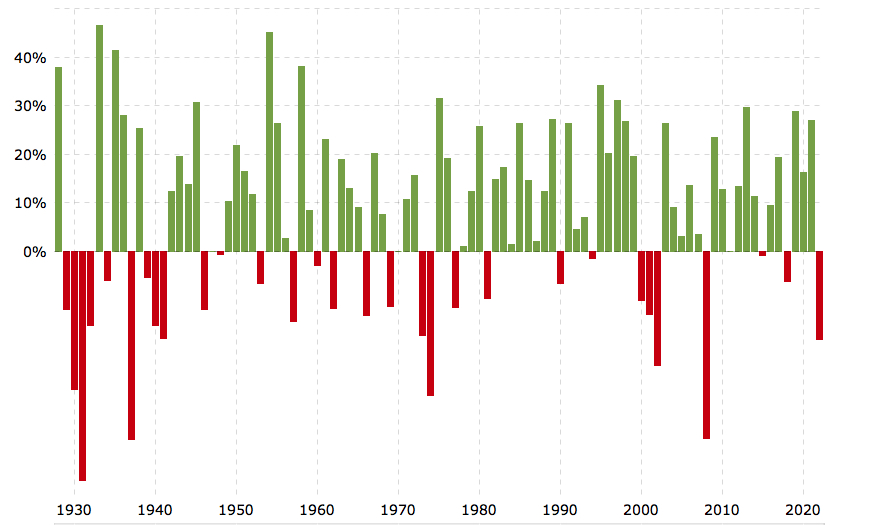
Nobel Laureate Paul A. Samuelson made a profound comment when he said: "The longer you own stocks, the greater risk of a devastating loss." Think about that for a moment. As investors gradually build a portfolio over time it generally goes up in total value. Meaning, just at the point of retirement a portfolio is the most susceptible to a sneaker wave. Look at the historical performance of the S&P 500:


For those visual learners out there like me, it is apparent that sneaker waves roll in often enough to really put the hurt on a long-term portfolio and potentially destroy decades of wealth. How often are these sneaker waves rolling in? You guested it, about 20% of the time. Meaning you can be cruising along on your yacht 80% of the time with the wind at your back, sun shining, and boom! A sneaker wave strikes.

How do investors embrace Pareto? First, investors need to accept that sneaker waves exist. For some reason Big Finance is obsessed with telling investors that they should only buy, buy, buy. I wonder why that is? Hmmm. Second, investors should build an "all-weather" strategy. This might be as simple as selling when the tide turns. Or it might be an aggressive approach like riding the wave, see Absolute Alpha. Third, investors should codify their strategy and monitor it. 

Blindly dumping money into Index Funds and ETFs has been the hallmark pitch of Big Finance now for decades. Low cost! Low cost! chimes the jingle over and over like Chinese water torture. And as the billionaire heirs and executives of these juggernauts motor by in their cash-burning steamboats, who's advising investors to embrace Pareto? ILAF, that's who! 


Tuesday, June 28, 2022

Tacking

 Tacking


Tacking allows a sailboat to indirectly sail to a desired waypoint against the wind; investors should take note of this timeless method of sailing. In many ways investors are also often fighting a wind on the way to their waypoint, but in their case the "wind" is a confluence of macro economic events and that waypoint is a financial goal(s).

Although no sailboat can sail against the wind, almost every sailor can tack in a zig zag pattern to reach their waypoint. The Absolute Alpha strategy was developed with this goal in mind, to harness ANY wind to reach a waypoint. Tacking of course is highly dependent on positioning the sails, but it is also a self-correcting mechanical maneuver which will quickly indicate if you're on a bad wind.

Investor need to consider not only their financial waypoint(s), but also the method in which they arrive. It is often said that life is "about the journey, not the destination." While that may largely be true, a destination of effervescent passive cash flow sounds quite lovely indeed...and the journey is the means of reaching that destination.

As previously posted in Sneaker Waves, it is extremely difficult to get to get where you want in a reasonable amount of time without having to deploy the lifeboats occasionally being long-only. Investors need to seriously consider an approach that is all-weather capable of tacking.

As always, it is important to look before you leap. What are the downsides to a tacking strategy? I believe the primary risk is signal risk. What signals will you use? How accurate are they? Are they dependable and repeatable? The secondary risk is the efficiency of using a strategy that may or may not trade frequently.

It has been knocked into our collective consciousness that frequent trading is a recipe for disaster. That is actually debatable...as Ray Dalio (amongst many others) is quoted as saying "Timing is everything." If the signals are good and the tacks made accordingly, then trading more is actually far, far more advantageous. 

Consider dear readers the investor who tacked successfully this year. Would she be down on par with the S&P 500 some 20%? I think not. Assuming successful signal utilization, she would have been short for most of the year and also most likely tacking into several Bull spikes.

Tacking requires accurate signals and trust in the proverbial "wind" that is pushing all of our sailboats around...a waypoint is nearly impossible to reach fighting against the wind. Since we're on the water today, my friend Bruce Lee had an excellent analogy about water that is applicable I think to investing as well. It highlights the importance of harnessing signals and changing a position accordingly. If your sailboat needs help tacking, consider throwing us a line.

"Empty your mind, be formless, shapeless like water
put water into a cup, it becomes the cup;
you put water into a bottle, it becomes the bottle;
you put it in a teapot, it becomes the teapot.
Now water can flow or it can crash. 
Be water my friend."


Monday, June 27, 2022

Demand Shock

 Demand Shock


Has the supply of oil suddenly increased? Has a new pipeline from Canada been approved? Has the lease utility rate spiked? No dear reader, none of these things have happened...yet the price of oil has markedly declined in the past several weeks from $130/barrel to a "paltry" $107 today. What gives?

When inflationary prices are out of control Adam Smith's old "Supply & Demand" really comes to light. The supply of oil hasn't increased, but demand sure has experienced what is termed a negative demand shock. Consumers aren't stupid, and the number one rule of game theory is that they act in their own self interest. Hence when oil spiked, consumers began shifting their demand.

This author suspects we are in the midst of a massive negative demand shock right now. Typically in a negative demand shock prices will fall as demand shifts away from the commodity being purchased and/or the quantity purchased also falls. In California for example, many gas stations now limit the amount of gas you can purchase.

As the chart above helps to illustrate, as the demand shock takes hold output falls, employment falls, and prices eventually fall. The question arises, however, how inelastic is the demand for oil? Or in other words, how much can demand truly fall for oil? This author has long suspected it will lead the economy into a recession.

Typically the first things being cut are discretionary items, all of which are touched in some way by the price of oil. Moving along Maslow's Hierarchy of Needs pyramid, the base is made of food and shelter. Nearly everything else is expendable to secure those two fundamental blocks. People don't have to go on vacation. People don't have to drive to the office all the time now. The boat (and its slip) can be let go.

Spending will be reallocated according to priorities in life. Consumers are like water, they seek maximum utility and flow accordingly. Demand started shifting even before the Fed acted to stifle it by raising interest rates. The fear of course is combined with a demand shock, the Fed's policy will tip the economy into a recession. With oil prices already moderating, and the Fed promising to raise rates until they "break inflation," expect a hard landing that skids into a recession.


Tuesday, June 21, 2022

Sneaker Waves

 Sneaker Waves


Sneaker waves. Sleeper waves. Rogue waves. Long-only is a dangerous proposition, especially when destructive financial waves roll in every couple years and destroy everyone's beach picnic. There has to be a better approach to avoid these wipeouts.

Consider, every approximately 54 months a -25% wave rolls through...and as a reader can imagine the LONGER you have been investing in the market, the LARGER this wave's impact is on your net worth. The word "catastrophic" is apt, especially if you take a sneaker wave on the cusp of retirement. Both your net worth, and potentially more damaging, your cash flow gets whacked. What is a financial farmer to do?

Consider what the Dutch and other low-plained residents near the ocean do: set-up early warning systems, act when triggered, and have ample ability to handle the inevitable overflow damage a rogue wave can cause. Early alert systems in your portfolio can be similar to Absolute Alpha, or trailing stops, or some type of macro trading which incorporates event-based triggers.

From one of my favorite movies World War Z: "First to know, first to act." There is no escaping the Pareto Principle, namely that these sneaker waves are out there and on average hit every couple years with devastating impact. Investors have several options. Do nothing and watch a long-only portfolio be destroyed like a sand castle. Use an early warning system and move your sand castle. Third, pick up your surfboard and paddle out.
 

Thursday, June 16, 2022

Investment Code

 Investment Code


A man needs a code. Fellow financial farmers we are in turbulent investment times, and it is good to rehash the importance of having an investment code. What is your code? Is it...ahem...codified? Just like an NFL coach rolling into town to take on the opposing team, investors need a game plan of how they plan to invest, what catalysts spur action, what signals indicate distress, and what their exit strategy is...the old axiom of "if it can be measured it can be managed" rings true.

Consider my Absolute Alpha strategy for example. The goal is straightforward: A positive yearly return regardless of market conditions. How will the goal be accomplished? By utilizing momentum vectors. What is the benchmark? S&P 500. How is it implemented? A standard brokerage account. How are positions added or reduced? Direct buys/sells. This is just one simple example of a codified approach.

The major goal of having an investment code is the desire to manage outcomes within a certain time horizon, risk tolerance, and achieve certain financial results. A process is only as good as the data it is fed and the constructs of its creation. Having an investment code also solidifies the standard deviations which may occur...just how volatile is your process? What does the data say? How do you plan to react to the data? 

Time and information may be the most valuable commodities of all, and having an investment code helps financial farmers glean what is and what may be...we already have a pretty good idea of what was.

June 16th for many Americans is a seminal day. It is the calendar day when you are finally working for yourself after bearing the yoke of excessive taxation and regulation for over half the year. It is a day of freedom. It is the day the Founders had once set to January 1st...obviously there has been some slippage! Nonetheless if you don't have an investment code, create one today. In many ways it will help define your financial success in the future. A man needs a code.
 

Wednesday, June 15, 2022

Wite-Out

Wite-Out


Today millions of American citizens will dutifully write checks to the IRS, State, and Local governments for billions of their hard-earned dollars. But this quarter their "fair share" will be lower, low enough to warrant a bottle of Wite-Out on the quarterly vouchers. Income destruction has been wrought upon you by politicians who know only a W-2 and an endless gravy train. Free Healthcare. Fat Pensions. Largess.

On this hallowed day, it is worthwhile to recount the introduction to our Declaration of Independence:

"When in the Course of human events, it becomes necessary for one people to dissolve the political bands which have connected them with another, and to assume among the powers of the earth, the separate and equal station to which the Laws of Nature and of Nature's God entitle them, a decent respect to the opinions of mankind requires that they should declare the causes which impel them to the separation."

"We hold these truths to be self-evident, that all men are created equal, that they are endowed by their Creator with certain unalienable Rights, that among these are Life, Liberty and the pursuit of Happiness. That to secure these rights, Governments are instituted among Men, deriving their just powers from the consent of the governed. That whenever any Form of Government becomes destructive of these ends, it is the Right of the People to alter or abolish it, and to institute new Government, laying its foundation on such principles and organizing its powers in such form, as to them shall seem most likely to effect their Safety and Happiness. Prudence, indeed, will dictate that Governments long established should not be changed for light and transient causes; and accordingly all experience hath shewn, that mankind are more disposed to suffer, while evils are sufferable, than to right themselves by abolishing the forms to which they are accustomed. But when a long train of abuses and usurpations, pursing invariably the same Object evinces a design to reduct them under absolute Despotism, it is their right, it is their duty, to throw off such Government, and to provide new Guards for their future security. Such has been the patient sufferance of these Colonies; and such is now the necessity which constrains them to alter their former Systems of Government. The history of the present King of Great Britain is a history of repeated injuries and usurpations, all having in direct object the establishment of an absolute Tyranny over the States."

Do you ever feel like you're getting the taxation without the representation? Did you instruct your Congressman to abolish our borders? Did you tell the same "leader" that you want to rely on foreign oil and supply chains for your well-being? Is your "fair share" tossed atop government coffers overflowing with taxpayer remittences...waiting to be squandered on programs and services that benefit only the denizens of corruption? How is your "pursuit of Happiness" going these days?


Tuesday, June 14, 2022

More Cowbell

More Cowbell


Investors often wonder when to add to existing positions. To a large extent the answer to this question depends on their investment philosophy, time horizon, and risk tolerance. Simply put, it depends. 

Active trading is based on the theory that the market is NOT perfectly priced and that there is an opportunity for an investor to purchase something that is mispriced; maybe it will be raising a dividend, maybe new management is taking over, there are a host of potential reasons of "why" that an investor evaluates. At its heart, a trade is in essence a best guess based on available information.

To the quant investor the answer as to when to add more cowbell is simply a function of the charts. What does the chart say? Where is the momentum pointing? Does the data indicate that the trend is strong? Growing? Subsiding? These factors guid the path of a quant trader.

Much of the cowbell quandary is based on confidence in the underlying investment. What is the truth? And in this matter financial farmers need to evaluate their investment thesis. Otherwise positions are increased simply on emotion ("This stock can't go any lower!" or "I'm gonna double down on this position!") What is your thesis?

There are a host of reasons to add more cowbell, but an investor should have a code. A theory. A blueprint. Some methodology that can be captured, implemented, and evaluated. In this manor the process can help yield maximum success. If you can measure it, you can manage it. 
 

Monday, June 13, 2022

Tasty Tidbits

 Tasty Tidbits


Edwin Lefevre chronicles the life of legendary stock trader Jesse Livermore in the masterpiece "Reminiscences of a Stock Operator." It is a timeless read for Wall Street aficionados, students of the stock market, and even those with just a cursory interest in finance. If you haven't read it yet, put this book on the top of your summer reading list. Below are some of my favorite tasty tidbits. The wisdom and knowledge gleaned from this book are priceless, but Amazon will sell you a copy for about ten bucks!

1) "It takes a man a long time to learn all the lessons of all his mistakes. They say there are two sides to everything. But there is only one side to the stock market, and it is not the bull side or the bear side, but the right side. It took me longer to get that general principle fixed firmly in my mind than it did most of the more technical phases of the game of stock speculation."

2) "After spending many years on Wall Street and after making and losing millions of dollars I want to tell you this: It never was my thinking that made the big money for me. It always was my sitting. Got that? My sitting tight! It is no trick at all to be right on the market. You always find lots of early bulls in bull markets and early bears in bear markets. I've known many men who where right at exactly the right time, and began buying or selling stocks when prices were at the very level which should show the greatest profit. And their experience invariably matched mine--that is, they made no real money out of it. Men who can both be right and sit tight are uncommon. I found it one of the hardest things to learn. But it is only after a stock operator has firmly grasped this that he can make big money. It is literally true that millions come easier to a trader after he knows how to trade than hundreds did in the days of his ignorance."

3) "Another lesson I learned early is that there is nothing new in Wall Street. There can't be because speculation is as old as the hills. Whatever happens in the stock market today has happened before and will happen again."

4) "There is nothing like losing all you have in the world for teaching you what not to do. And when you know what not to do in order not to lose money, you begin to learn what to do in order to win. Did you get that? You begin to learn!"

5) "Speculation in stocks will never disappear. It isn't desirable that it should. It cannot be checked by warnings as to its dangers. You cannot prevent people from guessing wrong no matter how able or how experienced they may be. Carefully laid plans will miscarry because the unexpected and even the unexpectable will happen. Disaster may come from a convulsion of nature or from the weather, from your own greed or from some man's vanity; from fear or from uncontrolled hope. But apart from what one might call his natural foes, a speculator in stocks has to contend with certain practices or abuses that are indefensible morally as well as commercially."


Many readers will notice distinct similarities in Livermore's trading philosophy utilizing momentum signals and the Absolute Alpha strategy launched on June 6th.  Absolute Alpha acted on the preponderance of Bearish market signals at launch and has steadily added more cowbell over the ensuing week, including today. Bearish signals remain constant and intact. Livermore would probably LOVE trading in our era.

Investors today have many advantages that Livermore didn't have in his day; nearly real-time quotes and execution with almost universal free trading, nearly limitless data sources, and even the ability to limit risk via index trading rather than speculation in individual stocks or commodities. So although the game may have changed, most (all?) of the behavioral characteristics remain the same; fear & hope drive the investing world. 
 

Sunday, June 12, 2022

Suffering Fools

Suffering Fools


Dearest fellow Financial Farmers, why do we suffer fools? Investors for too long have been held hostage to economic imbeciles. Why are we gluttons for punishment? If every piece of economic data indicates that the market is POOP, why NOT short it? 

Frequent readers of this amazing blog know that this author is a big fan of "Reminiscences of a Stock Operator" by Edwin Lefevre detailing the life of Jesse Livermore. It reads like an acquired taste, in that fine champagne is an acquired taste. I consider it Gospel for trading. With that said, one of my favorite lines in the book details Livermore's thoughts on selling: "If a stock is good enough to sell, it is good enough to sell short."

Here at ILAF we have an open mind, but it closes like a steel trap when we lose money! The past 7 months have been a painful reminder of what happens when "leadership" runs amok and there is no strategy in place. Chaos ensues. Why as an investor should you be punished for this? Well because you believe in long-term growth and that the economy will "eventually recover," right? 

Recovery often takes longer than we realize, with the Bear Markets often lasting years. In times of listless trading, near-term assets are whipsawed back and forth until investors are green with nausea, not envy. So with that said, there are several options for investors who have little to no confidence in the current market.

First, there is always "do nothing." This involves keeping your current portfolio as is. You're indifferent to near-term volatility and think in decades. Second, there is Dollar Cost Average your existing portfolio during the sell-off with the hope of increasing your positions. Over long periods of time this has generally worked. Third, there is the safety run idea of going all cash until the market subsides and there is some light at the end of the tunnel. The average bear market lasts about 300 days. So cozy up to a umbrella cocktail for about 10 months. A fourth option to consider would be profiting from the downturn. There are several ways to accomplish this, some act more as buffers while others seek Absolute Alpha.

Consider your time horizon and goals, but also your risk tolerance. As Zero Hedge aptly says, "In the long run we're all dead." So for some doing nothing works, others prefer a cocktail on the beach, and a few investors will try to profit from chaos. Socrates put it best: "Know thyself."