Showing posts with label Pareto. Show all posts

Thursday, August 4, 2022

Heat Waves

Heat Waves


It is said that farmers live and die by the weather, so too with financial farmers. Particular amongst weather events are heat waves. These heat inductions outside nominal weather conditions typically have rapid onsets. We know they're coming, but not necessarily the time or place. So too with Bear Markets. A confluence of events result in both; for farmers a heat wave can lay waste to their crops and livestock; for those of us farming for profits and cash flow, a Bear Market can do the same to our portfolios.

World War Z has one of my favorite lines: "First to know, first to act." It relates to the measures North Korea took to prevent the spread of the Solanum virus. It is application to both farmers and financial farmers is immense. In terms of farmers and ranchers, knowing weather patterns allows them to prepare (somewhat) for conditions on their farms and ranches. Sadly, most are held hostage to the weather they get. There is a limit to the actions that can be taken; increase the watering, provide shade perhaps, and maybe move the herd. The investor, however, has multiple choices when a heat wave is imminent. 

As discussed in a previous post, financial farmers have the ability to pursue an Absolute Alpha approach. This strategy harnesses early warnings systems to alert an investor to changing economic conditions. But just like heat waves and meteorology, the time and place of a Bear Market aren't precisely known to economists. Say hello to our old friend Pareto.

Pareto's Principle states that 80% of most results are directly proportional to 20% of the inputs. For our purposes we are keen to know where we are in an economic cycle and the corresponding stock market rotation (Bull/Bear). Why? Unlike farmers and ranchers beholden to heat waves, investors have the opportunity to take drastic, immediate action to protect their portfolios. 

Being on the right side of a trade is vital; stay too long on the wrong side of a trade and you risk serious financial pain that may not be recoverable in the short term (or long term.) Also, being on the wrong side of a trade naturally implies you are NOT on the right side of the trade...hence the opportunity cost of a being on the upside. Farmers, ranchers, and investors all know time is a valuable commodity. Maybe the most valuable. And generally speaking, being wrong for extended periods of time is bad for business.


Saturday, July 9, 2022

Ghosting Pareto

Ghosting Pareto


Ghosting Pareto is like trying to avoid gravity. Yet, this is exactly what investors should do. Why suffer the proverbial "slings and arrows of outrageous fortune" shot by Big Finance when alternative strategies exist? 

Vilfredo Pareto is best remembered as an economist of the namesake "Pareto Principle" which is a economic, social, and mathematical rule of thumb commonly referred to as the "80/20 Principle" or the "80/20 Rule." It is the recognition and codification of a naturally occurring phenomenon in life which he learned occurred in nearly every facet of life; whether it be income distribution, height, or even touchdowns thrown.

Investors should be concerned with Pareto because he helps us, indeed reveals, that the market for the most part is bullish over time. There are, however, vicious downturns that roll through the economy like sneaker waves every 4-5 years aptly termed Bear Markets.

Big Finance (kinda like Big Tobacco, but more dangerous) continually pitches "buy-and-hold," "weather it out,' and "dollar cost average." Are these bad strategies? Not necessarily, but investors rarely, if ever, hear about methods to embrace Pareto; ie selling covered calls, buying puts, or selling short when markets turn.

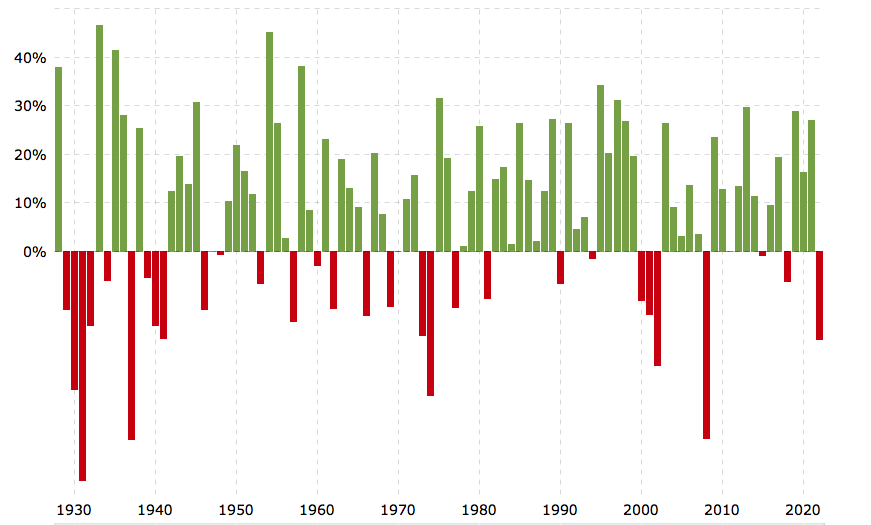
Nobel Laureate Paul A. Samuelson made a profound comment when he said: "The longer you own stocks, the greater risk of a devastating loss." Think about that for a moment. As investors gradually build a portfolio over time it generally goes up in total value. Meaning, just at the point of retirement a portfolio is the most susceptible to a sneaker wave. Look at the historical performance of the S&P 500:


For those visual learners out there like me, it is apparent that sneaker waves roll in often enough to really put the hurt on a long-term portfolio and potentially destroy decades of wealth. How often are these sneaker waves rolling in? You guested it, about 20% of the time. Meaning you can be cruising along on your yacht 80% of the time with the wind at your back, sun shining, and boom! A sneaker wave strikes.

How do investors embrace Pareto? First, investors need to accept that sneaker waves exist. For some reason Big Finance is obsessed with telling investors that they should only buy, buy, buy. I wonder why that is? Hmmm. Second, investors should build an "all-weather" strategy. This might be as simple as selling when the tide turns. Or it might be an aggressive approach like riding the wave, see Absolute Alpha. Third, investors should codify their strategy and monitor it. 

Blindly dumping money into Index Funds and ETFs has been the hallmark pitch of Big Finance now for decades. Low cost! Low cost! chimes the jingle over and over like Chinese water torture. And as the billionaire heirs and executives of these juggernauts motor by in their cash-burning steamboats, who's advising investors to embrace Pareto? ILAF, that's who!