Showing posts with label Bull Market. Show all posts

Saturday, July 9, 2022

Ghosting Pareto

Ghosting Pareto


Ghosting Pareto is like trying to avoid gravity. Yet, this is exactly what investors should do. Why suffer the proverbial "slings and arrows of outrageous fortune" shot by Big Finance when alternative strategies exist? 

Vilfredo Pareto is best remembered as an economist of the namesake "Pareto Principle" which is a economic, social, and mathematical rule of thumb commonly referred to as the "80/20 Principle" or the "80/20 Rule." It is the recognition and codification of a naturally occurring phenomenon in life which he learned occurred in nearly every facet of life; whether it be income distribution, height, or even touchdowns thrown.

Investors should be concerned with Pareto because he helps us, indeed reveals, that the market for the most part is bullish over time. There are, however, vicious downturns that roll through the economy like sneaker waves every 4-5 years aptly termed Bear Markets.

Big Finance (kinda like Big Tobacco, but more dangerous) continually pitches "buy-and-hold," "weather it out,' and "dollar cost average." Are these bad strategies? Not necessarily, but investors rarely, if ever, hear about methods to embrace Pareto; ie selling covered calls, buying puts, or selling short when markets turn.

Nobel Laureate Paul A. Samuelson made a profound comment when he said: "The longer you own stocks, the greater risk of a devastating loss." Think about that for a moment. As investors gradually build a portfolio over time it generally goes up in total value. Meaning, just at the point of retirement a portfolio is the most susceptible to a sneaker wave. Look at the historical performance of the S&P 500:
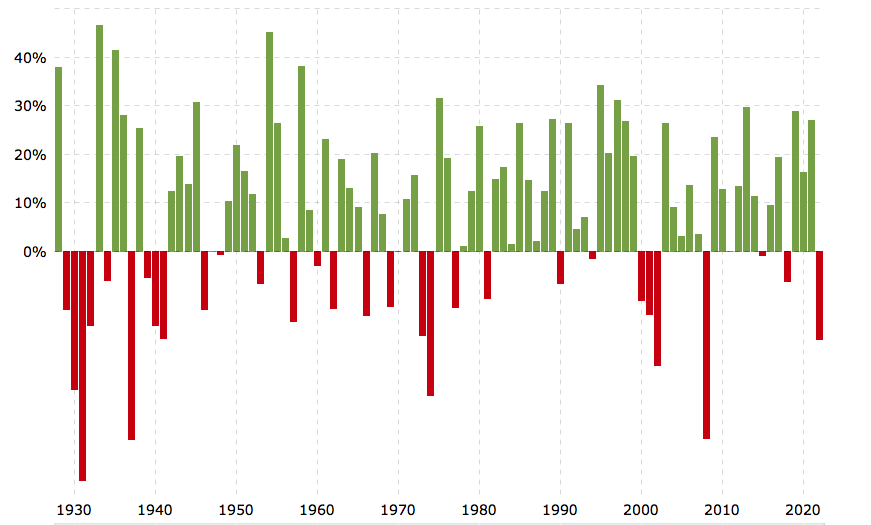

For those visual learners out there like me, it is apparent that sneaker waves roll in often enough to really put the hurt on a long-term portfolio and potentially destroy decades of wealth. How often are these sneaker waves rolling in? You guested it, about 20% of the time. Meaning you can be cruising along on your yacht 80% of the time with the wind at your back, sun shining, and boom! A sneaker wave strikes.

How do investors embrace Pareto? First, investors need to accept that sneaker waves exist. For some reason Big Finance is obsessed with telling investors that they should only buy, buy, buy. I wonder why that is? Hmmm. Second, investors should build an "all-weather" strategy. This might be as simple as selling when the tide turns. Or it might be an aggressive approach like riding the wave, see Absolute Alpha. Third, investors should codify their strategy and monitor it. 

Blindly dumping money into Index Funds and ETFs has been the hallmark pitch of Big Finance now for decades. Low cost! Low cost! chimes the jingle over and over like Chinese water torture. And as the billionaire heirs and executives of these juggernauts motor by in their cash-burning steamboats, who's advising investors to embrace Pareto? ILAF, that's who! 


Wednesday, March 7, 2018

A Tale of Two Markets

A Tale of Two Markets


It was the best of times, it was the worst of times...the NASDAQ's heavy tech components roared to new 52-week highs on almost a daily basis, while iconic global consumer brands struggled to keep their heads above water. What happened?

I have noticed a massive decoupling in the stock market over the past 5 years, and over the past year in particular. Typically defensive consumer staple stocks have gotten hammered...and we're talking Bear Market territory for many of the largest brands in the world (a Correction is a 10% selloff from a stock's high, while a Bear Market is defined as a 20% or more fall.)

How could this happen when rates are still at historic lows, unemployment is low, the global population continues to grow, and the economy is booming? Not so fast. The economy IS booming, BUT in CERTAIN sectors. Consumer staples (think toothpaste, diapers, soap, hot dogs, macaroni & cheese, bleach, tissues, paper towels, etc.) have for decades relied upon BRANDING to charge a massive premium over a similar generically produced product. Who ever orders just a "cola" from a restaurant? Or asks for carbonated water and sugar? No one. Consumers have been steered towards brands since birth. An interesting thing is happening though, and it seems to be accelerating.

The oft-cited force of "tech disruption" has uniquely impacted classic brands in a singular way; consumers can now price shop globally and have orders filled at signifiant discounts to traditional full retail prices. Rather than laser-focusing on innovation, distribution, and consumer satisfaction what I've seen are major brands saddling up with lean manufacturing to such an extent that employees have to justify ordering pens or toilet paper. This is a race to the bottom.

The flip side of the coin are the tech innovators who leverage their massive economies of scale and state-of-the-art logistics to provide an unrivaled consumer experience. Many of them are pure software companies, some are not, but the result seems to be the same: extremely satisfied customers who have developed TRUST in the brand. So much trust, that these tech innovators can repeatedly launch offshoots of their core brands into a captive consumer market that actually embraces the new product or service. And many of these products or services directly compete with established legacy brands.

The game plan needs to change for legacy brands to thrive; the old vertical mindset of acquiring lowest cost raw commodities, manufacturing with razor thin margins, spending billions on marketing, and capturing the global consumer from birth is giving way mightily to logistical systems offering consumers ease...and better prices.