Showing posts with label harvard. Show all posts

Thursday, January 13, 2022

The Great Resignation
 The Great Resignation


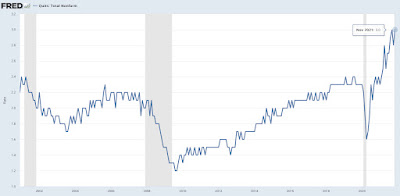
A by-product of the pandemic has been a spike in the "quits rate," the rate at which people quit their jobs, to an all-time high of 3%+. Now a measly 3% doesn't sound like much from a percentage standpoint, but when you factor in natural retirement, loss of workers, and a huge number of job openings we have a problem Washington.

Keep in mind 3% is the AVERAGE, meaning even with the explosive growth in certain sectors, quitting has become the norm in many fields, like tech and healthcare, which had rates significantly higher than the average. One of the best, if not THE best, piece I've seen studying this phenomenon was published recently in the Harvard Business Review. Yes Harvard is smart. Yes the article was superb, but it never really delved into WHY people are quitting. Worry not fellow financial farmer, ILAF is here with our "curriculum vitae" to help you decipher this trend.

Why does someone work? Generally the answer to that question is "to make money." If we strip out the other common reason "for the benefits," ie healthcare, then almost exclusively people work for money, especially if the state provides either free or significantly subsidized healthcare. I would say the REASON people work for money is to support themselves, their family, AND they REALLY have to work if there are debts like education, housing, and living expenses to pay. To totally generalize from the top two categories of those fueling the Great Resignation, tech and healthcare, I believe that there is a HUGE dichotomy in terms of WHY.

The curve to enter healthcare is relatively steep; there are years of education, training, and commitment to become a nurse, doctor, EMT, provider, etc., etc. Their quits rate would almost certainly have to come from burnout and exhaustion rather than choice, especially if there was significant debt overhang. This quits rate is more aptly termed a capitulation rate. This "cap rate" is a function of Maslow's Hierarchy of Needs, where literally survival trumps employment. Sadly, these professionals are also "being quitted" by mandates. It is a double-edged sword. The flip side of this quits rate in tech, however, is very different.

The tech industry has a much different dynamic occurring. Although the barriers to entry are arguably on par with the medical world in terms of education and skill, the REGULATORY environment is quite different. Generally speaking, in the tech world you are judged, hired, fired, retained, promoted, etc. on your ability to code, create, market, etc. There is an entire regulatory ecosystem MISSING from the tech industry that has allowed it to flourish. Which brings me to the quits rate for tech.

The tech quits rate is on par with the healthcare industry, but for vasty different reasons. The WHY, especially for the core quitters in the 30-45 age band is pretty simple. They don't necessarily HAVE to work. Through a confluence of events many of the tech quitters do not have high debts, nor onerous regulatory requirements to keep current to keep employed. Most own or owned some portion of a company that has gone UP in value. So debt free or low debt with a stash of cash and manageable healthcare costs make leaving work out of CHOICE for tech easy.

What does this quits rate dichotomy mean? I don't see healthcare DEMAND easing, so either more less qualified employees will be hired or pay will have to be raised for existing providers to remain or both. I bet on BOTH. The demand is simply too great to shoulder on the existing model, especially with various mandates being imposed on healthcare in general. So as a cost of our GDP healthcare will take an increasingly high bite, regulations will increase, and the misery index of working in healthcare will also increase. When the ratio of administrators to doctors begins to fall we will be on the right track.

On the tech front, billions of dollars are flowing into PE Funds (private equity) and the majority of that is flowing into tech companies. The great winnowing is always happening, where the best and most successful companies gain the lion's share of a disruptive market, whether it be food delivery, social networking, or EV engineering. Many will fail. Billions will be spent and lost. But from that wreckage a handful of truly exception winners will emerge....and in tech, quitting while you're ahead isn't the same as quitting.
 

Friday, December 4, 2020

Double Dip Anyone?

 Double Dip Anyone?


Double-dipping is a really bad idea in the time of Covid and equally painful in economic terms as well. In the culturally-definitive series Seinfeld, George is caught at a funeral double-dipping (dipping a chip that has already been dipped and eaten) in the sour cream. My elite friends at Harvard have taken the trouble of analyzing the danger of this possibility in detail. You can read their analysis here: "Double Dipping" Dangerous or just...icky?

Although a fervent Seinfeld fan, my interest is more along the economic terms. In particular, I'm wondering if we're setting up for a double-dip recession that will put a nail in the coffin of American small business owners (and the middle class.) Historically, a double-dipper has been defined as a recession that begins prior to the previous one ending. If we were to see a fall in GDP over two consecutive quarters that would qualify as the first (check that box), but it seems like GDP is recovering, right? Well...if you believe the "science" (and shut-up if you don't, a la Andrew Ross Sorken debating Rick Santelli) the 3Q GDP accelerated and we're out of the woods.


But look around the woods. Do you see a lot of small businesses open? Or people starting up new businesses? Any new coffee shops open up in your neighborhood? Or just the long, long lines at the Starbucks drive-thru? Is your local handyman killing it or is he hanging out at the full Home Depot parking lot? How about those local mom-and-pop retail stores? You remember them, right? If you can get past the traffic jam of UPS, FedEx, and Amazon delivery vehicles their shops are all boarded up on Main Street. 

We're in the midst of a Dickensian recovery; in particular a Tale of Two Economies...one economy is bust. They were previously small business owners who owned restaurants and hardware stores and retail shops in your town's shopping areas. They've either been Covid-slammed or looted or both. The other economy, however, is a booming. Large capitalization companies are killing it; their infrastructure, logistics, capital, and political contacts have not only allowed them to survive, it has almost single-handedly allowed them to thrive. 

So when we talk about a double-dip recession, it is important to realize that there are two distinct economies at work right now; the small-business, family-owned company that has suffered greatly during Covid and the recent political chaos, the other is the monopolistic business with strong balance sheets that has cannibalized the consumer's buying power.

So in answer to the original question of whether we will experience a double-dip recession, my answer is that it is almost impossible that we don't; the dry powder typically used to bail out the middle class has largely been spent, ie the Fed Funds rate is already at 0%. The only thing keeping the economy afloat right now are sky-high real estate prices and a stock market at all-time highs. But these factors bedevil the fact that the U.S. Dollar has pretty much collapsed in terms of buying power. Anything of value, whether it be education, health care, or housing are at highs. Money is flowing into physical goods.

I suspect the end-game will be further erosion of the middle class and more dependance on government programs. The billionaire class will be the net winners. Raising taxes, punishing work, and increasing bureaucracy is not going to be helpful, unless the goal in an anemic recovery similar to 2009-2016 numbers. But that's what I think will be served for dinner; cold burgers and flat soda with a paper straw. The appetizer bowl of salsa with a bunch of chips floating on the surface will be the least of our problems.


Sunday, October 27, 2013

Why Does Wealth Cluster?


A shared system of beliefs and values prompts, as the saying goes, birds of a feather to flock together, but there are also other significant considerations for the world's wealthy.

Why as a financial farmer should you care? Given that the goal of this blog is to Invest Like A Farmer, it is a very relevant goal to study, learn, and hopefully replicate success. A lot of successful learning can be gleaned by studying and implementing the habits of wealthy investors.  In an earlier post we discussed the blueprint of creating your very own Berkshire Hathaway, today we take a look at wealth clustering. 


The above image is of Washington, D.C. The red dots correspond to Apple iPhone owners and the green dots represent Android owners (image courtesy of MapBox.) The image below is an income view of the exact same area where blue represents higher income, and yellow lower income.


What does this prove? Not much, except that there is a clear overlap between income and general choice of smartphone device. This is one example, and there are many more that can be implied, but the general point being made is that wealth does indeed cluster in certain geographic areas.

Where does wealth cluster? Primary locations are major world metropolises and to a lesser extent remote, pristine sparsely inhabited areas. Why? Shared beliefs and values (ethnic heritage, religion, language, politics), geographic desirability (climate, safety, airports), and resources (education, health care, jobs) help provide the answer.

Is wealth the end result of luck, toil, education or some combination? If we assume it is of some combination, then naturally our initial question of what causes wealth clustering is really a question of why geographically wealth has (re)located itself in a particular area. Furthermore, is it "earned" wealth, inherited wealth, budding wealth, or some combination of that rule set? Oddly enough, they are all usually in proximity!

This proximity derives from the inherent advantages of being close to the prize; there is a reason that more promotions always come from the headquarters of an organization. HQ is a great place to be for an up and coming whippersnapper, these are areas of excellence often in more than one regard; from pure physical beauty to educational infrastructure to engineering know-how and even reputation plays a strong hand. (Consider the frequency Harvard is cited versus nearly any other university!)

Let's face it; everyone loves a winner, and by extension we like to be near winners; whether economically, socially, or politically. The reasons for wealth clustering are complex, but the proximity to excellence is nearly universal. How does this help us Invest Like A Farmer? Excellence is its own momentum, and something we as financial farmers want to replicate as our own personal brand. Sustained excellence becomes a self-fulfilling prophecy.