Showing posts with label wall street. Show all posts

Wednesday, July 15, 2026

Escalator Yo-Yo

 Escalator Yo-Yo


One of the best analogies of the stock market is that it is a man riding an escalator up with a yo-yo in his hand spooling up and down constantly.

Now the escalator itself might represent inflation or productivity over time, perhaps both, while the yo-yo spinning up and down constantly represents the inherent day-to-day volatility of the stock market dipping down and bobbing up.

Short-term, from the man's perspective, the stock market is demonstrating extreme swings in movement, yet all the while the escalator is slowly, methodically, moving higher and higher raising the relative baseline. 

Yet as we have all experienced, an escalator can and does stall or break. That is rarely for long. Mechanics come and "fix it" (read Federal Reserve) and it is off to chugging along again, day-after-day.

What makes this analogy so interesting is the combination of both economic and physical law truisms; namely inflation acts as ever-increasing entropy, while man constantly seeks technological solutions to life's challenges.

Coupled together, inflation and productivity push markets higher in both notional and real values, while the day-to-day swings offer prices points for entry and exit to millions of market participants.

One of the inherent functions of a market is timing. Timing in the purchase and sale of assets relative to their perceived value at that price point in time.

As we have seen on a nearly every-other-day basis this summer, traders are actively probing entry and exit points for equities. In spite of high(er) oil prices, two global conflicts, and daily (re)evaluations of tech pricing the markets have continue to rally higher.

So while short-term traders are watching the Yo-Yo, readers of this blog who desire to Invest Like A Farmer (ILAF) are using sell-off timing to their advantage and riding the escalator higher and higher while being prudent not to find themselves the "exit liquidity" many VCs and Investment Banks so cravenly need.


Friday, March 3, 2023

Bond Ladder

Bond Ladder

 
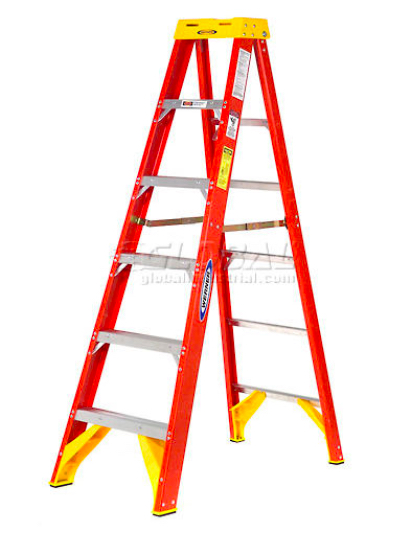
The Bond Ladder has recently emerged as the hottest trade on Wall Street. Laddering bonds is both elegant and efficient; investors parcel out their cash via "steps," or purchases, of certain denomination & maturity bonds which yield a certain annual rate. These "steps" form the proverbial rungs of the Bond Ladder. As rates steadily rise, the investor is locking in that higher rate with each new rung.

This strategy is particularly effective in a rising interest rate environment. With a Bond Ladder, the investor is frequently rolling cash into new bonds at higher rates. So for example, using a $120,000 cash position to build a bond ladder an investor could buy Treasury Bills now yielding over 5% at multiple maturities. In this instance, an investor could buy twelve (12) $10,000 Treasury Bill positions maturing each month for the next year. Every month that $10,000 would come due, and the investor could roll those funds into new, and possibly higher paying, Treasury Bills.
 
With the Federal Reserve hellbent on breaking the back of rampant inflation in the United States, it seems highly probable. In fact, Greenlight Capital's David Einhorn suggests investors should be "Bearish on stocks and Bullish on inflation." Meaning? He suspects that the Federal Reserve will raise rates higher than the existing consensus of 4.50-4.75%.


With Treasury Bills yielding over 5% now, this should be a concern for investors as selling rates are exceeding predicted rates, ie Einhorn is probably correct assuming the Fed raises again in March. There's an old axiom on Wall Street: "Don't fight the Fed." For those investors looking to preserve a portion of their capital, and earn a "riskfree" rate of return, a Bond Ladder here might make sense. 


Thursday, June 16, 2022

Investment Code

 Investment Code


A man needs a code. Fellow financial farmers we are in turbulent investment times, and it is good to rehash the importance of having an investment code. What is your code? Is it...ahem...codified? Just like an NFL coach rolling into town to take on the opposing team, investors need a game plan of how they plan to invest, what catalysts spur action, what signals indicate distress, and what their exit strategy is...the old axiom of "if it can be measured it can be managed" rings true.

Consider my Absolute Alpha strategy for example. The goal is straightforward: A positive yearly return regardless of market conditions. How will the goal be accomplished? By utilizing momentum vectors. What is the benchmark? S&P 500. How is it implemented? A standard brokerage account. How are positions added or reduced? Direct buys/sells. This is just one simple example of a codified approach.

The major goal of having an investment code is the desire to manage outcomes within a certain time horizon, risk tolerance, and achieve certain financial results. A process is only as good as the data it is fed and the constructs of its creation. Having an investment code also solidifies the standard deviations which may occur...just how volatile is your process? What does the data say? How do you plan to react to the data? 

Time and information may be the most valuable commodities of all, and having an investment code helps financial farmers glean what is and what may be...we already have a pretty good idea of what was.

June 16th for many Americans is a seminal day. It is the calendar day when you are finally working for yourself after bearing the yoke of excessive taxation and regulation for over half the year. It is a day of freedom. It is the day the Founders had once set to January 1st...obviously there has been some slippage! Nonetheless if you don't have an investment code, create one today. In many ways it will help define your financial success in the future. A man needs a code.
 

Monday, June 13, 2022

Tasty Tidbits

 Tasty Tidbits


Edwin Lefevre chronicles the life of legendary stock trader Jesse Livermore in the masterpiece "Reminiscences of a Stock Operator." It is a timeless read for Wall Street aficionados, students of the stock market, and even those with just a cursory interest in finance. If you haven't read it yet, put this book on the top of your summer reading list. Below are some of my favorite tasty tidbits. The wisdom and knowledge gleaned from this book are priceless, but Amazon will sell you a copy for about ten bucks!

1) "It takes a man a long time to learn all the lessons of all his mistakes. They say there are two sides to everything. But there is only one side to the stock market, and it is not the bull side or the bear side, but the right side. It took me longer to get that general principle fixed firmly in my mind than it did most of the more technical phases of the game of stock speculation."

2) "After spending many years on Wall Street and after making and losing millions of dollars I want to tell you this: It never was my thinking that made the big money for me. It always was my sitting. Got that? My sitting tight! It is no trick at all to be right on the market. You always find lots of early bulls in bull markets and early bears in bear markets. I've known many men who where right at exactly the right time, and began buying or selling stocks when prices were at the very level which should show the greatest profit. And their experience invariably matched mine--that is, they made no real money out of it. Men who can both be right and sit tight are uncommon. I found it one of the hardest things to learn. But it is only after a stock operator has firmly grasped this that he can make big money. It is literally true that millions come easier to a trader after he knows how to trade than hundreds did in the days of his ignorance."

3) "Another lesson I learned early is that there is nothing new in Wall Street. There can't be because speculation is as old as the hills. Whatever happens in the stock market today has happened before and will happen again."

4) "There is nothing like losing all you have in the world for teaching you what not to do. And when you know what not to do in order not to lose money, you begin to learn what to do in order to win. Did you get that? You begin to learn!"

5) "Speculation in stocks will never disappear. It isn't desirable that it should. It cannot be checked by warnings as to its dangers. You cannot prevent people from guessing wrong no matter how able or how experienced they may be. Carefully laid plans will miscarry because the unexpected and even the unexpectable will happen. Disaster may come from a convulsion of nature or from the weather, from your own greed or from some man's vanity; from fear or from uncontrolled hope. But apart from what one might call his natural foes, a speculator in stocks has to contend with certain practices or abuses that are indefensible morally as well as commercially."


Many readers will notice distinct similarities in Livermore's trading philosophy utilizing momentum signals and the Absolute Alpha strategy launched on June 6th.  Absolute Alpha acted on the preponderance of Bearish market signals at launch and has steadily added more cowbell over the ensuing week, including today. Bearish signals remain constant and intact. Livermore would probably LOVE trading in our era.

Investors today have many advantages that Livermore didn't have in his day; nearly real-time quotes and execution with almost universal free trading, nearly limitless data sources, and even the ability to limit risk via index trading rather than speculation in individual stocks or commodities. So although the game may have changed, most (all?) of the behavioral characteristics remain the same; fear & hope drive the investing world. 
 

Tuesday, May 10, 2022

Wall Street Perspective

Wall Street Perspective


As Financial Farmers we must be wary of svengalis constantly whispering doom and gloom, because it is vital to have a long-term Wall Street perspective and remember all finance is behavioral finance.

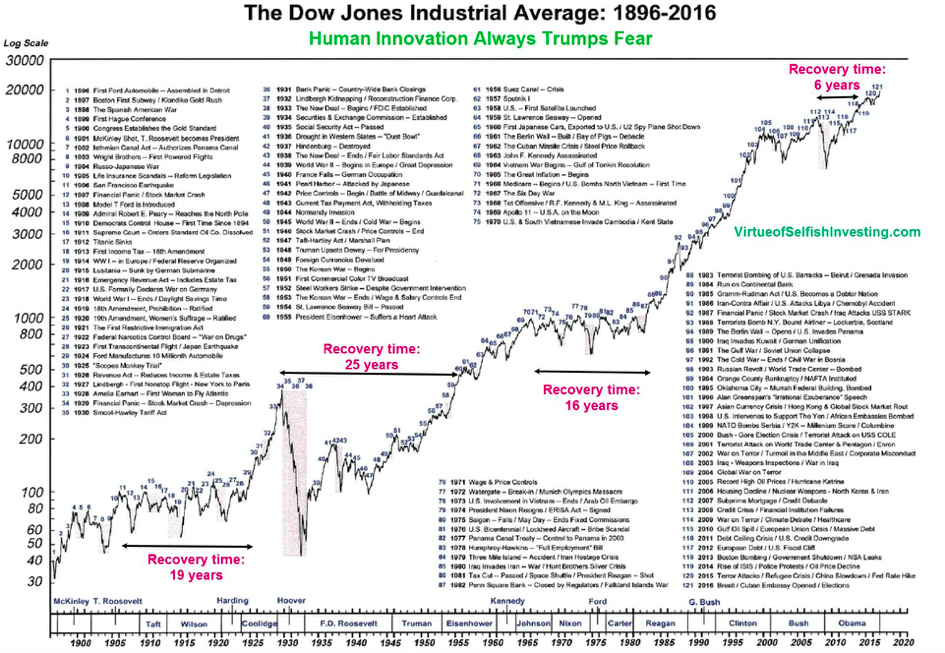
First, why is it vital to have a long-term Wall Street perspective? Over a long enough time period, as Zero Hedge has popularly quipped, we're all dead. BUT, a counterpoint to this morbid fact, is that innovation over time has propelled the economy and society to greater productivity. And the stock market has been along for the ride.

The second reason to question a svengali is that behavioral finance drives a LOT (most?) of the market's near-term volatility, trading, and returns. Sustained movements are the result of earnings, growth, innovation and major societal changes.

At this point in the economic cycle (most likely we're either in or on the cusp of a recession), the corporate picture isn't exactly bright. We've witnessed massive selloffs in tech companies and the only winners seem to be "boring" consumer staples anchored by a dividend. A lot of money has flowed out of the market into cash. Or real estate. So the bloom is off the rose for the time being.

For those entering the market, opportunity abounds. With multiple companies well off their highs and solidly into bear market territory. Many have been completely vaporized and sit some 60%, 70%, 80% or more off of their  highs from just a couple months ago. For those who have been long-term holders, the past six months has been horrific, watching gains for the past two years getting destroyed. Even "blue chip" companies haven't been spared. Carnage is everywhere.

What's an investor to do? Stay focused on what matters; earnings, branding, growth, innovation, integrity, and cash flow. Have emergency cash on the sidelines. Look for opportunities and be patient. The last bit is perhaps the hardest. Many older investors in the stock market don't think they'll live to see a Bull Market again. But it is hard to believe that this great country, which has weathered so much in the past, could be permanently hobbled by inept leadership today for very long. So we're in a waiting game now.

Similar to economic cycles, the political pendulum swings and very few Presidents or political parties survive recessions intact. New blood focused on innovation, growth, and stability rises to the moment. Remember dear readers, the business of America is business. In the meantime, a fallow field presents many, many opportunities for a farmer with a keen eye.


Sunday, April 24, 2022

DCA Primetime

 DCA Primetime


Imagine investing for a lifetime. Not for a moment, not just early in your career, but rather for a lifetime. Consistent, disciplined buys made over decades. Many long-term investors like the curmudgeon Warren Buffett swear by it. But why?

The stock market will generally go up over time. In fact, something like 53% time on a daily basis the Dow Jones Industrial Average ends the day in the green. Granted, that's only slightly better than a coin flip, but that small spread adds up significantly over time. Wall Street is pretty much the opposite of a casino actually; the longer, more regularly you invest in the stock market the higher percentage chance you have of winning. 

Dollar Cost Averaging (DCA) is an investment strategy wherein an investor buys stocks, or an index even, on a regular basis with the same dollar amount over an extended period of time, ideally forever.  This results in purchasing more shares of an index for example when the price is LOW and fewer shares when the price is HIGH.

In a listless Bear Market with violent swings in daily prices with no discernible end in sight, this strategy makes plenty of sense. When no man, or even computer, can call a bottom buying in fixed intervals offers an investor the ability to circle around a low with higher conviction rather than investing a massive lump sum at a singular point. Think of it this way: Would you rather have 50 small darts to hit the bullseye of a moving target or one big dart?

The greatest risk of the DCA strategy is when investors abandon it, either by cashing out or no longer making periodic investments. Once that occurs they are fully at the whim of the market's volatility, which as we have painfully learned again this year can whipsaw violently, leaving investors who were punch drunk only months ago on the euphoria of a winning cycle easily down double digits in a short, brutal period of time.
 

Friday, January 21, 2022

Mean Reversion

 Mean Reversion

Jeremy Grantham believes we are in the fourth superbubble of the last hundred years. He has many valid points and raises the specter of an utterly dismal 2022. Already we are down the first 3 weeks of January, and history shows that with almost certainty a down January results in a down year (.732 batting average.) With a handful of exceptions, notably massive Federal Reserve bailouts, this has always been the case. Grantham, however, takes it one step further than rule-of-thumb Wall Street adages and formulates a thesis on the simple premise of mean reversion.

Mean reversion describes just what it implies; that there will be a return to the average growth rate over time. Yes the growth rate itself might change over time, but sustainment of extremely high deviations from this average are difficult, if not impossible, to maintain over longer and longer periods of time. Typically they come in "bursts" that spike up (or down) in sharp, unstained points. Consider one of the best baseball batters in history, Ted Williams.

With a lifetime batting average of .344, Williams is arguably the best batter of all-time. He finished his career as the last batter with OVER a .400 average...that was almost a 20% deviation from his mean. Over long-enough careers with enough data players can be predictable, hence the rise of the current "Moneyball" climate of assembling a team on pure statistics. The stock market has even more statistics and a greater database to glean from for investors than baseball.

Consider the chart below, which identified 3 of the last 4 superbubbles and makes a prediction for the current situation: 


According to Grantham we're overdue for the next "blow off" from the housing, commodity, bond, and equity volcanic peaks. He even has a nice quick-reference rule set to follow:


The only caveat keeping the markets going, according to Grantham, is the paradigm shift we've allowed ourselves to believe in regards to markets (all of them) never falling and always going up. No matter what. Now almost all reasonable financial farmers know that this cannot be; we look outside the window and see the weather change by the minute and so it is with the economy as well.

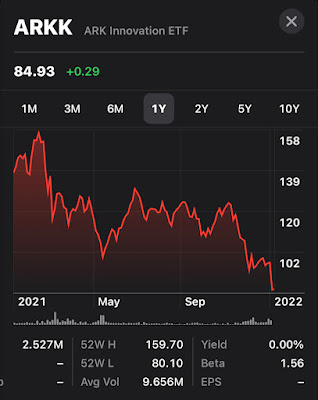
There is no doubt that Wall Street has been shedding risk like a snake molting skin. Case in point is the complete liquidation of stocks without an "E" in the P/E ratio...take a look at symbol ARKK for example, which is Cathie Wood's Ark Innovation ETF. That portfolio is composed almost exclusively of higher growth, lower (no) earnings companies. It has been dealt a severe blow in the past 6 months, and increasingly in the last month, as investors dump the speculative sector and plow right into the blue chips.

Grantham believe that this too will not matter when the reckoning comes because there will be an epic blow off taking down multiple markets simultaneously. It might be time for investors still riding high from recent valuations surges to round up some cash. Assets (things that pay YOU to own THEM) always seem to be in vogue, regardless of market conditions. But speculative "assets" without adequate reserves or more importantly paying customers might be in serious trouble. 

The big winners in history when bubbles pop are those with little to no debt, and an abundance of liquid cash. They have the ability to buy on the cheap when there is blood in the streets. Prices are high. Inflation is high. BUT high(er) paying jobs are still plentiful. If that final paradigm shifts, watch out below.


Tuesday, January 11, 2022

ARKK Barometer

 ARKK Barometer


Cathie Wood's ARK Innovation ETF (ARKK) acts as an excellent barometer for investor sentiment. Almost halved in a year, while the Dow spiked to over 35,000, ARKK visually displays the change in investor philosophy and risk appetite. 

A disciple of Arthur Laffer, Wood started her investment firm with the underlying thesis of disruptive innovation underpinning her investment goals, namely that disruptive companies create new markets and value networks. These companies hope to displace established market leaders aka entrenched monopolies.

In essence Wood is betting on a future of new technology that would improve humanity with better efficiency, because as a rule monopolies become less efficient and innovative as they mature into complete control of a market.

So why has Cathie's fund be cut in half? Rather than a collapse in the underlying technology, I believe there has been a 180 degree change in investor sentiment that believes reward (or gain) will come from "established" (read monopolies) that have existing market share, customers, and the big "E" in the P/E ratio...EARNINGS.

Mathematically, investors are betting on "business as usual" rather than innovation. Why? Because they are receiving signals that entrenchment wields the power and will be rewarded. Why? Because those are the signals being sent by Washington. How? Increased taxation. Increased regulation. Increased inflation. Increased enforcement. Decreased autonomy. Decreased workforce flexibility. Decreased worker qualifications. Those are a handful of the signals flashing. Investors have taken note.

Contrary to popular belief, Wall Street isn't dumb. Money flows where it is welcome and makes a return. Typically it chases winners. Just take a look at net new flows of money. It almost always flows into funds that have most recently performed well. And flees poorly performing funds. It seeks to survive and grow by chasing returns. The most successful funds of 2021 were the tech monopolies and natural resource monopolies. Small innovation got utterly crushed.

My final thought on this subject is that immutable laws are hard to break. They can be avoided. They can be postponed. But ultimately there is a reckoning. Although policy and regimes may put their weight behind the status quo, ie monopolies, the proverbial sidewalk flower will grow in a concrete jungle. 


Monday, January 10, 2022

Bad Omens

 Bad Omens


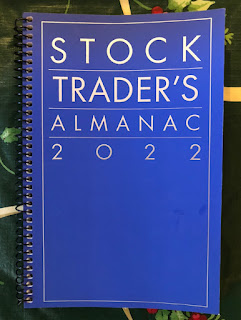
Although the old Wall Street quip is to never believe that "past results are indicative of future performance," my Stock Trader's Almanac 2022 (similar to the Farmer's Almanac, but specifically devoted to the stock market) is flashing some serious warning signs.

Consider: "Every down January on the S&P since 1950, without exception, preceded a new or extended bear market, flat market, or a 10% correction." We are definitely NOT doing well out of the gate in '22.

Also: "...the second year of new Democrat presidents have been down -2.3% on average."

Finally there are *kinda* a couple other concerns: 1) A raging Covid variant named Omicron which is sweeping across the world at hyperbolic infection rates. 2) Inflation that is almost off the charts (we have to go back to the  late 1970s/ early1980s for similar data points during the Jimmy Carter Administration.) 3) Mid-term elections which promises to be every bit as cantankerous at the last Presidential Election.

What is an investor to do? Head for the hills and bunker down? Withdraw cash from your own savings accounts in amounts less than $10K so the government doesn't put you on a suspected money lauder list? Buy more toilet paper? No I say! Rather consider the following course of action: Remain employed if possible and continue to purchase assets (things that pay you to own them) and keep physically fit.

The stock market, and the entire world for that matter, has almost universally survived and prospered on the back of growth...meaning the survival of individuals and companies via increased earnings in one form or another. A large part of this growth over the past 50 years has been due to the integrated circuit. That has spawned the technology to vastly improve the lives of billions.

The "Age of Silicon" is not over by a long-shot, as growth in medicine, manufacturing, engineering, teaching, and yes even Wall Street is underpinned by the ability to increase speed, accuracy, and quality while at the same time lowering cost and barriers to entry.

So although there are multiple bad omens on the horizon, keep faith with the prospect of a better tomorrow...whether that is next week, next month, or next year. High volatility in Covid, the markets, and even politics does not last. Hopefully all three will moderate in the coming months. Until then, as financial farmer focus on accumulating assets, increasing your cash flow, and keeping physically fit. Life is a marathon.


Friday, August 9, 2019

Compound

Compound


Usually when someone says "invest," what they really mean is "compound." It has often been quoted that Einstein remarked that the power of compounding was beyond human comprehension. That very well may be true, but seeing something visually should offer some understanding of the phenomenon.

Consider the leading image of this post; it is almost an ideal example of what is possible over a long-term (10 years) with a stock that compounded some 1070.36% (ten-bagger in Wall Street parlance) earning the holder a $107,048.51 profit from an original investment of $10,000.

What's nice about this example is that it includes the purchase date and hold date exactly, the purchase price, end price, dividends, and the average annual total return. Those factors are very telling.

Successful compounding almost always involves 3 vital factors: security selection, holding time, and either additional paid-in capital or dividends. These 3 variables, when working in concert, can produce extraordinary results as the above indicates; for every $1 invested the owner received $11.70 in return a decade later. For every $9.60 paid per share in 2009, $6.80 was returned in dividends alone!

These are the growth stars every investor and portfolio manager should constantly be on the look for while screening for stocks. How do you find them? With questions! Does the company offer consumable products that need to be continuously repurchased? Does the company pay a dividend? What rate? What is the growth rate of the dividend? How stable is the dividend? Is this company a monopoly? What's the competition like? Is their product dangerous or subject to regulation?

There's an old adage that Financial Famers like you who read this blog know well, "invest your time before your money." The fruition of these words can be found in results like the above example which can have a meaningful impact on an investor's life both now and in the future.

Thursday, May 17, 2018

The Stoic Investor

The Stoic Investor


The redwood is a very interesting tree; it is impervious to most diseases, it can withstand fires, and also has extreme drought tolerance. In many ways, the redwood tree physically demonstrates the virtues of a successful investor, the stoic investor.

I'm often asked what stocks I like or where to invest. Good questions, but they are meaningless if an investor doesn't have the stoic fortitude to actually invest like a farmer. Stoicism, an ancient Greek philosophy of enduring pain or hardship without a display of feelings or complaint, valued virtue as the highest good. The wise were considered indifferent to the vicissitudes of fortune and to pleasure and pain equally. I believe successful investing requires a great deal of stoicism, especially if one is hoping to turn a sapling of savings into a redwood fortune.

From a distance, and in a single moment in time, the redwood is seen as still and massive, but over the course of hundreds of years a multiple of growths and starts have occurred that are imperceptible in the here and now. There have been droughts. Fires. Earthquakes. Meteors. And men. But yet the redwood survives. Without a doubt stoic investing involves mental fortitude, but it also involves pruning.

You can lose the small bets in life, and many of them, but you gotta win the big ones. Winning the big bets is the manifestation of a mathematical formula dubbed the Pareto Principle. In short, amongst a handful of redwood seedlings (the recommendation is 20 seeds) perhaps only one will successfully germinate, take root, and rise to the heavens. The rest are failures. So too is the investing landscape littered with the refuse of an absurdly high mortality rate for true start-ups, and only decreasing marginally with ventures that survive the initial lean years. Even then, successful ventures are typically only sustaining ventures.

Consider for a moment that only about 4% of all stocks drive the market's return over time. That's just about the success rate for a single redwood amongst 20 seeds! Coincidence? I think not. The challenge of course is finding these redwood seedlings early and often in your investing career. Which leads me to what I believe is a great fallacy. The thought process of making no mistakes is flawed; I think of investing along the mindset of having a financial destination in mind, a means to secure it, and being able to change course, tac, as necessary.

As investors, theoretically, we should be indifferent to the underlying security, only interested in its potential Alpha...and this is why passive investing survives but by the grace of active investing. By this I mean passive investing owns too much of the forest floor and not enough of the redwoods. Case in point is Warren Buffett's Berkshire Hathaway, which has soundly beaten the S&P 500, no small feat, over the course of 50 plus years. This is due in large measure to Buffett selecting redwoods over time and sticking with them. Technological innovation, branding, and strong leadership matter; buy redwoods!


Monday, April 9, 2018

Buy and Hold On!

Buy and Hold On!


Take a moment fellow financial farmers and click on the image above and take a look at all the world crises...yet since 1970 $1 invested in a basket of global equities would have returned $59 by the end of 2017. Think about that for a moment. $59 dollars for every $1 originally invested. Remove the green line and look only at the headlines and few would believe that an investor would stand to get even his own original $1 back!

Being a student of the markets and economic history, I have yet to find a time period which wasn't described at "troubling" or "heady" or "uncertain." There has, however, been one constant: the desire for a better life. And that economic theme reigns supreme in mankind's evolution and greatly explains the rise in global stock markets over time.

Buy and hold on!

Tuesday, July 11, 2017

Money Is Made In The Holding


What a bountiful harvest we are enjoying this year fellow farmers! I wanted to take a moment away from the fields and share with you a favorite quote of mine from my favorite book on investing.

Edwin Lefevre's masterwork "Reminiscences of a Stock Operator" has stood the test of time well and tells the story of Jesse Livermore, dubbed the "Boy Plunger," who turned his smarts, energy, and grubstake into an extremely successful career on Wall Street (up until his untimely death in the coat closet of the Sherry-Netherland.)

The primary take-away is this: "Money is made in the holding." And by that Livermore explains that the largest fortunes he made in his career were the result of buying and HOLDING the position.

Do some positions flop? Yes, many. Do some seeds fail? Yes, many. But the potential for an outsized return via an exponential winner dwarfed them all. The proverbial bumper crop that keeps a harvest going for years, generations in fact. There are many ne'er-do-wells reaping the success from seed planted generations before them. And why? They have held.

This ties in well with the Invest Like A Farmer philosophy of buying monopolistic dividend paying stocks with a steadily increasing left to right chart. Day-to-day a position may lose money. Over months it may as well, but over an increasing time period the confluence of inflation, consumption, and (hopefully) brand management those holding a position can harvest a bountiful crop.

So the is my mid-summer wisdom passed along from Jesse Livermore: "Money is made in the holding."

Monday, February 27, 2017

Reagan 2.0


On the surface it might not seem likely given the significant divergence in their public personas, but Donald Trump might just be Ronald Reagan 2.0

Behind the media's candelabra, there is a distinct similarity for the love of America and laser-focus on defense, infrastructure, and big deals between Donald Trump and Ronald Reagan. Obviously both are Republicans, but both weren't scions of the GOP establishment. Rather, both Presidents started off in that other party...the Democratic one, which left them and millions of other moderate Americans behind.

If history is any indicator, Reagan 2.0 should continue to be a boon for stock market investors as the government will ramp up spending on defense and infrastructure, while reducing regulation, lowering taxes, and putting America First (read as smart trade negotiation.) On the proverbial back of the envelop is the calculation of Dow 25,000 by the end of President Trump's 1st Term; there are estimates of Dow 30,000 too, but those make some really difficult assumptions.

It is going to be nearly impossible for President Trump to accomplish everything he sets out to do in his first term. Nevertheless, if President Trump can navigate the tricky deal of providing health care coverage for millions of Americans while simultaneously lowering taxes, reducing regulation, and securing our borders he'll have succeed in the bulk of his goals. Even on the belief that he will accomplish just some of these monumental tasks, the stock market has risen some 3,000 points in the past 4 months.

Investing in America has never seemed brighter; companies are regularly beating their earnings expectations and a pipeline of new incentives are on the horizon. Corporate tax reduction coupled with the ability to repatriate trillions from overseas is likely to bolster the corporate bottom line immediately, while the effects of ongoing, material reduction in regulations will provide intrinsic value which will materialize over time.

Financial farmers are in essence buying into the American Dream at a ripe time. Further prosperity via innovation and growth in the underlying fields of business should provide a bumper crop for years to come. How do I like them apples? I love 'em!

Saturday, February 25, 2017

Monkey Business


Wall Street might just be the most vilified business, right after politics of course. Warren Buffett said as much today in his eagerly awaited annual letter to shareholders, calling members of the financial world "monkeys." Lest we forget dear readers, the 1956 Buffett Partnership Ltd. pioneered one of the highest fee structures in existence; a flat 2% for assets under management PLUS an additional 50% performance fee of any profits above a 4% return. 

Warren contributed $100 (one hundred) dollars of his own money from his savings of $174,000 in 1956 to the total partnership capital of $105,100. Over the next 14 years the Buffett Partnership did very well, but Warren Buffett did EXTREMELY well. Although it is impossible to determine exactly what his take-down was, according to multiple sources his personal profit was along the lines of $25,000,000. This grub stake would be leveraged into the on-going fusion of Berkshire Hathaway and GEICO into the modern day holding company. There was just one problem, his partners. 


May 29th, 1969...A Day That Will Live In Infamy

In 1969 the partnership was shut down, which coincidently coincided with the the consolidation and formation of the present day holding company of Berkshire Hathaway. Please note fellow financial farmers, at this critical juncture Warren advised his partners that there weren't any viable investment opportunities in the future and disbanded the partnership. His money, however, went into the holding company. This is probably one of the most important facts glossed over by the sycophant business media; Warren Buffett "advised" all of his limited partners to a magnitude almost incalculable, but I'll give you a back of the envelope number: $420 Billion in missed opportunity. It probably ranks as one of the greatest swindles of all time.

Today Warren Buffett is depicted as a grandfatherly investing sage championing index funds, although he has nearly his entire net worth in Berkshire Hathaway stock. Berkshire has the ability and desire to negotiate sweetheart deals (aka shareholder extraction) the likes of which could never be accomplished by ordinary mom and pop investors. 2008 was a seminal extraction year for Berkshire, it was able to succor dozens of deals; Goldman Sachs, General Electric, Dow Chemical, Bank of America, etc. all paid homage (on the backs of their shareholders) to secure funding from Warren.

History, in its purest form a trade blotter, reveals all; Warren Buffett changed career paths in the early 1950s from a stockbroker to partnership not to benefit clients, but rather to harness his "unique" investing ability as the son of a sitting Congressman, which coincidently paid one of the highest fees in the financial industry. At the juncture when his partnership provided an adequate stepping stone to leapfrog into total control of assets in which he could use the float from GEICO and simultaneously extract value out of those glorious old spinning mills Berkshire and Hathaway he didn't hesitate.

Without a doubt, Warren Buffett is one of the greatest investors of all time; his ruthless pursuit of profits is virtually without equal. Berkshire Hathaway has a market cap of some $420 Billion and generates billion in yearly profits. It is the the 4th largest company in the world. Buffett has extracted vast value from many, many companies via their existing infrastructure, brands, and workers; surely he is the leader of the monkey troop.

The irony in Warren's investing words and actual behavior is summed up simply by the residents of Fall River, Rhode Island and New Bedford, MA...the respective headquarters of Warren's launching pad for holding company Berkshire Hathaway...there are no bronze statues to this man, just crumbling factories and lost American jobs.

Monday, January 2, 2017

2017 Dogs of the Dow*


*Honorable Mention: Altria (MO): 3.61% Yield (But Not A Member of the 30 Stock Dow Jones Industrial Average.) "Dogs of the Dow" is an investment strategy that picks the highest yielding 10 Dow components from the previous year-end to comprise next year's investment portfolio. It is theorized that the Dogs of the Dow, via their high yields, are by definition under-valued as an asset class to their peer group and may offer superior returns over the coming year.

Friday, August 7, 2015

Earnings Beat…Stock Sell-Off


Nothing like the sound of the Fed starting up its interest rate machine to destroy the gains in the stock market…as the 2nd quarter of earnings releases are announced, and approximately 90% BEATING estimates, one would surmise that this market would have taken off. Heck, historically years ending in 5 which are the last year of a lame duck presidency are the BEST…but alas it is not to be the case.

The flu started with the infection of Google which completely destroyed earnings (hey, it's great to be a total and utter monopoly and control the fate of the internet…that pays handsomely) to the upside. After crushing earnings and spiking some $60B in market cap during a single day, Wall Street lined up like a pack of hyenas for the next killing…Apple. That didn't turn out too well; over the past 2 weeks the largest public company on Earth gave up nearly 20% of its market cap. Facebook and Twitter would save them, right? Not to be. Billions more lost the following trading days. Well surely blue chips like Disney wouldn't disappoint? Scratch that; because beating is no longer beating if the current trading cartels can justify after a call (in hindsight naturally) what was wrong in a beat. We're seeing any excuse to sell. Case in point, start-up Fitbit nearly quadrupled earnings yet is off some 25% since their announcement. Benjamin Graham said it well, "…in the short term the stock market is a voting machine." 

The list goes on and on, but the trend has taken place; biotech broke and the majority of tech got whacked too…the blue chips followed and underpinning all of this is a compete collapse in commodities.

Barron's had a great piece on commodities versus GDP growth…it wasn't pretty. If investors are to put stock in their article lower and lower commodity prices signal the end of robust growth.

In short order the most powerful (and unelected) person in the world, Fed Chair Janet Yellen will almost certainly raise the Fed funds rate.  The data and rhetoric has been too strong not to make a move now.

Recent results we've seen globally are, unfortunately, I believe, a precursor of what is going to happen over the coming months as global growth stalls, the Fed raises rates, and investors cash in significant gains accumulated since the last recession in the hopes of buying even lower. And lower. And lower still.

Probably a better idea to wait until there is not only clear inflation, but several sustained quarters of it before raising the Fed funds rate; cutting the fuel and pulling up the stick isn't a good combination.

Monday, October 14, 2013

Batten Down the Hatches!


One of my favorite Wall Street books is The Greatest Trade Ever which chronicles a group of traders who had the foresight, capital, and luck to both predict the fall of the mortgage market and trade on it. They all bet against the sustainability of the mortgage security market in one form or another (mainly through derivative contracts); they were all successful because despite the proverbial writing on the wall, no one else was betting that this could ever happen. I think we're in a similar situation right now.

As financial farmers we want to Invest Like A Farmer for some very practical reasons, a really good one is not to go broke. This is what is referred to as the risk of ruin. There is one goal that is paramount to every farmer; avoid ruin. This simple goal, frequently overlooked or ignored, bears repeating: Avoid Ruin.

Young or old, we all have different tolerances to risk. We should pay particular attention, however, to the risk of ruin. Broadly defined, the risk of ruin is the point of no return, that place or situation you've reached where your finances, and in particular, your farm is bust. You can't squeeze another nickel from the fruit stand. All your other options are seemingly impossible as well. Essentially there is no way out. Amongst the farmer's many concerns, the risk of ruin must always run paramount. Losses can be sustained, opportunities missed, leverage overdone, and a host of any other problems survived, but we want to avoid ruin at all cost.

Ruin can be devastating and possibly unrecoverable. For those who have clawed their way back from the brink it can be a valuable life lesson, but I've never heard it described in terms of nostalgic fondness. With full respect to Nietzsche, who wrote: "that what does not kill me, makes me stronger," ruin is painful, and regardless of your age or circumstances, the true financial farmer wants to avoid the risk of ruin. It is far too celebrated amongst the entrepreneurial elite who have never tasted true ruin; they had and have back-up plans and resources that are never revealed. Keep your farm well-tilled, planted, and enjoy every harvest even if it is at first meager. Your goal should be a lifetime of sustained financial farming, a lifetime.

A lifetime of farming is sustained by not being overextended even when everyone claims we (the USA) could never default. October 17th is fast approaching, but that date doesn't necessarily scare me. What I'm concerned about is the process that led up to this point, and in particular November 1st. The tax revenues are in place for continued short term operation, but beginning on the 1st we have significant outlays; I truly wonder as a country if we're ready to have a hard conversation of what we fund and what we don't. Do we pay the debt obligations, do we pay Social Security, Medicare, the military?

I maintain the prediction of a 50/50 chance of default; at this point every financial farmer should have cash on hand as well as either a fully or partially hedged portfolio in the event of October 17th passing without a deal. In the event of a deal getting passed, I suspect it would be a short term extension at best and ultimately we'd still be left with the same systemic problems in the federal budget. The "good" news, regardless of whether a deal is cut or not, I don't see any possible chance of the Federal Reserve tightening monetary policy; not at the next meeting, the one after, or even well into 2014. The economic recovery is still too nascent and obviously there are far bigger political problems that need to be solved. The two charts below help illustrate the challenge this country faces ahead; how do we bridge the spending and revenue gap while sustaining our yearly outlays?